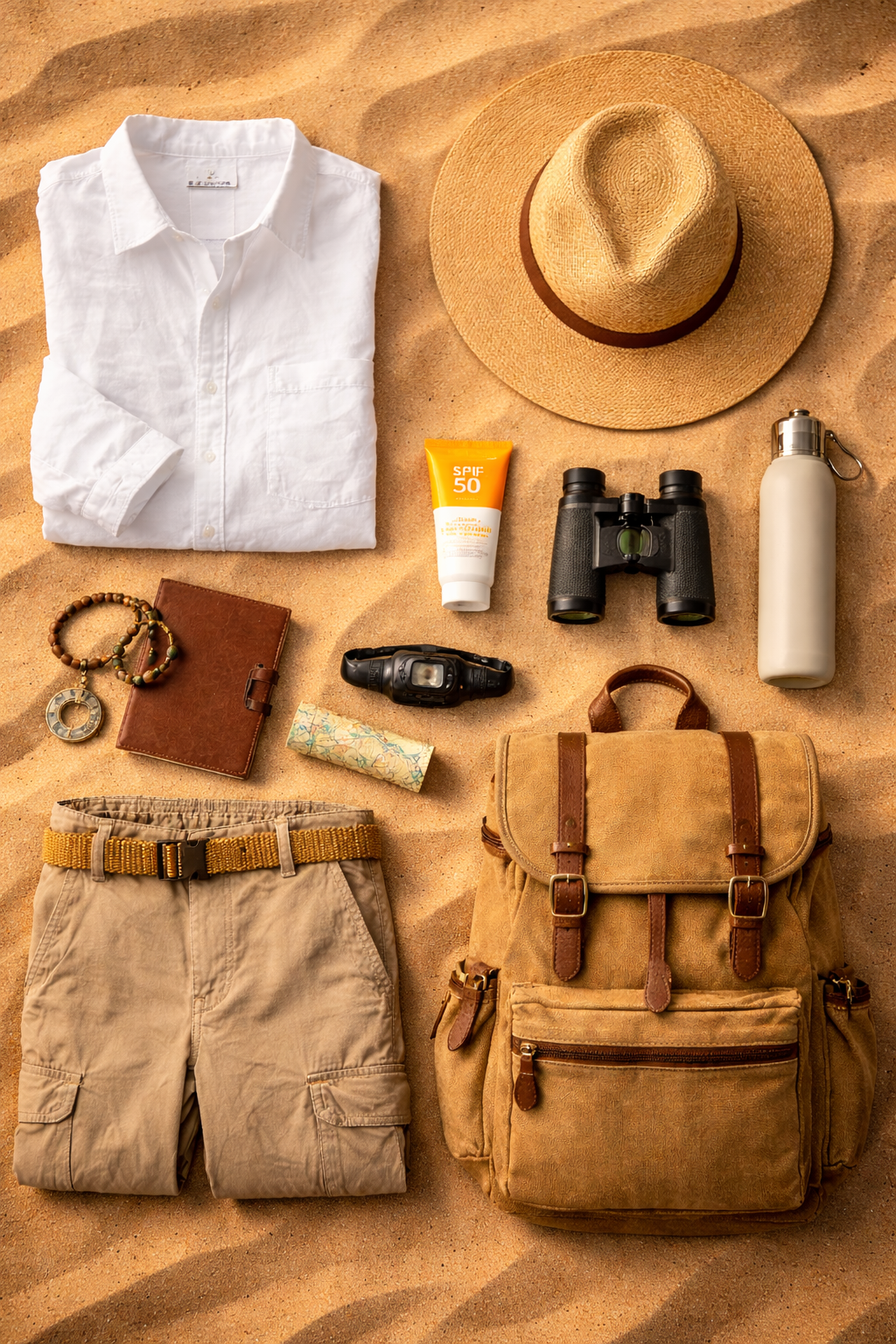
The essentials for a Morocco desert trip are: lightweight layers for temperature swings (cold nights, hot days), a wide-brim hat and SPF 50+ sunscreen, a reusable water bottle (minimum 2 litres capacity), comfortable closed-toe walking shoes, a headscarf or shawl, a headlamp for the overnight camp, and a small daypack. Cash in Moroccan Dirhams is essential — ATMs are limited south of Ouarzazate.
Packing for a Morocco desert trip is not complicated — but it requires specific thinking that differs from a beach holiday or a European city break. The Zagora and Sahara environment creates two opposing conditions simultaneously: intense daytime heat that demands lightweight, breathable clothing and serious sun protection, and cold desert nights (October through March) that require warm layers that most first-time visitors forget entirely.
This checklist is built specifically for a Zagora trip based on La Petite Kasbah — covering the camel trek, the Erg Chigaga day trip or overnight camp, the souk, and the palm grove walk. It distinguishes between what is genuinely essential, what is useful but not critical, and what you should leave at home. It also flags the most common packing mistakes made by first-time desert travellers.
|
✦ KEY TAKEAWAYS |
|
› The biggest packing mistake for Morocco desert: forgetting warm layers. Desert nights October–March drop to 5–10°C — a fleece and sleeping bag liner save the overnight camp experience. |
|
› Sun protection is not optional: SPF 50+ sunscreen, a wide-brim hat, UV sunglasses, and a lightweight long-sleeve shirt are non-negotiable for any outdoor activity. |
|
› Footwear matters: closed shoes for dune climbing — sandals fill with sand immediately. Comfortable walking shoes for the souk and palm grove. |
|
› Cash in Dirhams: souk stalls, camel trek operators and most activities are cash only. Bring more than you think you need. |
|
› One medium rucksack is better than a rolling suitcase — La Petite Kasbah's lanes and the desert terrain do not suit wheels. |
|
TABLE OF CONTENTS |
|
1. The Master Packing Checklist |
|
2. Clothing: Layering for Heat and Cold |
|
3. Sun Protection: The Desert Is Not Forgiving |
|
4. Footwear: What Works and What Doesn't |
|
5. Overnight Desert Camp: Extra Essentials |
|
6. Camera and Technology |
|
7. Health, Hygiene and First Aid |
|
8. Money, Documents and Practical Items |
|
9. What to Leave at Home |
|
10. Season-by-Season Adjustments |
1. The Master Packing Checklist
|
Item |
Why You Need It |
Season Note |
|
SPF 50+ sunscreen |
Desert UV is intense — burns happen faster than at the beach |
All seasons, every day |
|
Wide-brim sun hat |
Protects face, ears, and neck — baseball caps do not |
All seasons |
|
UV sunglasses |
Sand reflection amplifies UV exposure significantly |
All seasons |
|
Lightweight long-sleeve shirt |
UV protection + wind protection on the hammada + dust filter |
Essential summer; useful all year |
|
Breathable trousers |
Long trousers for souk (conservative dress) + sun + wind protection |
All seasons |
|
Light shorts or summer dress |
For riad, pool, and downtime — not appropriate for souk |
April–October |
|
Fleece or light jacket |
Desert nights drop sharply after sunset Oct–Mar |
October–April essential |
|
Sleeping bag liner |
For overnight camp — adds 5°C warmth to camp blankets |
October–April essential |
|
Warm base layer |
For overnight camp in winter — thermals or merino wool |
November–February |
|
Closed walking shoes |
For dune climbing and palm grove walks — sandals fill with sand |
All seasons |
|
Sandals or flip-flops |
For the riad, pool, and indoor use only |
All seasons |
|
Headtorch (red mode) |
For rooftop stargazing and overnight camp navigation |
All seasons |
|
Reusable water bottle |
1.5L minimum — refill at La Petite Kasbah filtered water |
All seasons |
|
Small rucksack (20–30L) |
Day pack for activities — rolling suitcase not practical |
All seasons |
|
Cash in Dirhams |
Souk, camel trek, activities — most are cash only |
All seasons |
|
Lip balm with SPF |
Dry desert air cracks lips within 24 hours |
All seasons |
|
Insect repellent |
Occasional mosquitoes near the seguia channels at dusk |
April–October |
|
Portable charger |
No charging at the overnight desert camp |
For overnight camp |
|
Offline maps (downloaded) |
No mobile signal at Erg Chigaga |
For Erg Chigaga trip |
2. Clothing: Layering for Heat and Cold
The Layering Principle
The Zagora climate operates on a dramatic temperature swing: the same day can reach 35°C at midday and drop to 8°C after midnight. The only rational packing strategy is layering — items that work individually and in combination for the full temperature range.
Daytime Layers (Hot)
-
Lightweight long-sleeve shirt: Counterintuitively, long sleeves are cooler than short sleeves in the desert. The fabric shades the skin while wicking sweat. Linen or technical moisture-wicking synthetics are best. Avoid dark colours in summer.
-
Breathable trousers: Lightweight cotton or linen trousers for the souk (conservative dress is respectful and expected), the Mellah walk, and Tamegroute. Also provide UV protection on the hammada drive. Convertible trousers (zip-off legs) work well.
-
Light shorts or dress: For the riad, pool, and downtime. Not appropriate for the souk, Tamegroute library, or Mellah — cover up when entering traditional spaces.
Evening and Night Layers (Cold)
-
Fleece or light down jacket: The single most commonly forgotten item. The La Petite Kasbah rooftop at midnight in November is cold. The Erg Chigaga overnight camp in October drops to 10°C by 2am. A fleece weighs 300g and transforms the experience.
-
Sleeping bag liner: Essential for the overnight camp. The camp provides blankets, but a sleeping bag liner adds 4–6°C of warmth and ensures comfort in October–March conditions.
-
Warm base layer: Merino wool or thermal underwear for anyone visiting November through February. Desert cold at 3am is not the same as European cold — it is drier and penetrates faster.
The rule: if the forecast low is below 15°C, pack a fleece and a liner. If below 10°C, add a warm base layer. The forecast low for Zagora is easy to find — check Weather Underground for the exact dates of your stay.
3. Sun Protection: The Desert Is Not Forgiving
The clear, dry Saharan air that makes the Zagora night sky exceptional also removes the atmospheric filtering that reduces UV intensity at lower latitudes. The UV index in Zagora during summer regularly reaches 10–11 (extreme). Even in October and March, UV index 7–8 (very high) is typical. Sunburn happens faster here than at any European beach.
-
Sunscreen SPF 50+: Apply 20 minutes before any outdoor activity. Reapply every 2 hours and after swimming in the riad pool. Use a genuine broad-spectrum SPF 50 — 'factor 30' is insufficient for sustained desert exposure. Bring enough from home; SPF 50 is available in Zagora but the selection is limited.
-
Wide-brim sun hat: The brim must shade the face, ears, and back of the neck. A baseball cap protects only the face and is inadequate. Packable straw or canvas wide-brim hats weigh almost nothing and are the single most effective sun protection item.
-
UV sunglasses: Category 3 or 4 UV protection. Sand reflects UV significantly — the ground contributes to UV exposure as much as the sky. Wraparound styles are more effective.
-
Long-sleeve shirt: As noted above — the fabric itself is UV protection. Choose UPF-rated fabrics if possible (most technical outdoor shirts are rated); otherwise plain linen or cotton works adequately.
-
Lip balm SPF 30+: The desert air dries lips within 24 hours of arrival. Chapped, cracked lips in a dry environment are painful and slow to heal. Apply before going outside, not just when lips are already dry.
4. Footwear: What Works and What Doesn't
Footwear is the most common packing error for first-time desert travellers. The obvious choice — sandals — is the wrong choice for almost every desert activity.
What Works
-
Closed walking shoes or light hiking shoes: For the camel trek (mounting and dismounting camels requires a stable sole), the palm grove walk (uneven earthen paths), the dune climb at Erg Chigaga (sand gets into every opening — closed shoes lose only a little), and the souk (crowded, uneven surfaces). Trail runners or light hiking shoes are ideal.
-
Sandals or flip-flops: For the riad, the pool area, and moving between rooms. Comfortable and practical indoors. Also useful in the camp tent at night.
What Doesn't Work
-
Sandals for any outdoor desert activity: Sand enters immediately and creates abrasion between the grains and the skin. After 30 minutes on the dunes in sandals, the underside of your feet will be raw. This is genuinely painful and takes days to resolve.
-
High heels or platform shoes: Irrelevant to the desert context but occasionally packed for 'evening at the riad' — the riad courtyard and rooftop are uneven stone or tile and not heel-friendly.
-
New shoes not yet broken in: The camel trek, palm grove walk, and dune climb combined add up to several kilometres of walking on irregular terrain. New shoes will blister. Bring shoes you have already worn.
5. Overnight Desert Camp: Extra Essentials
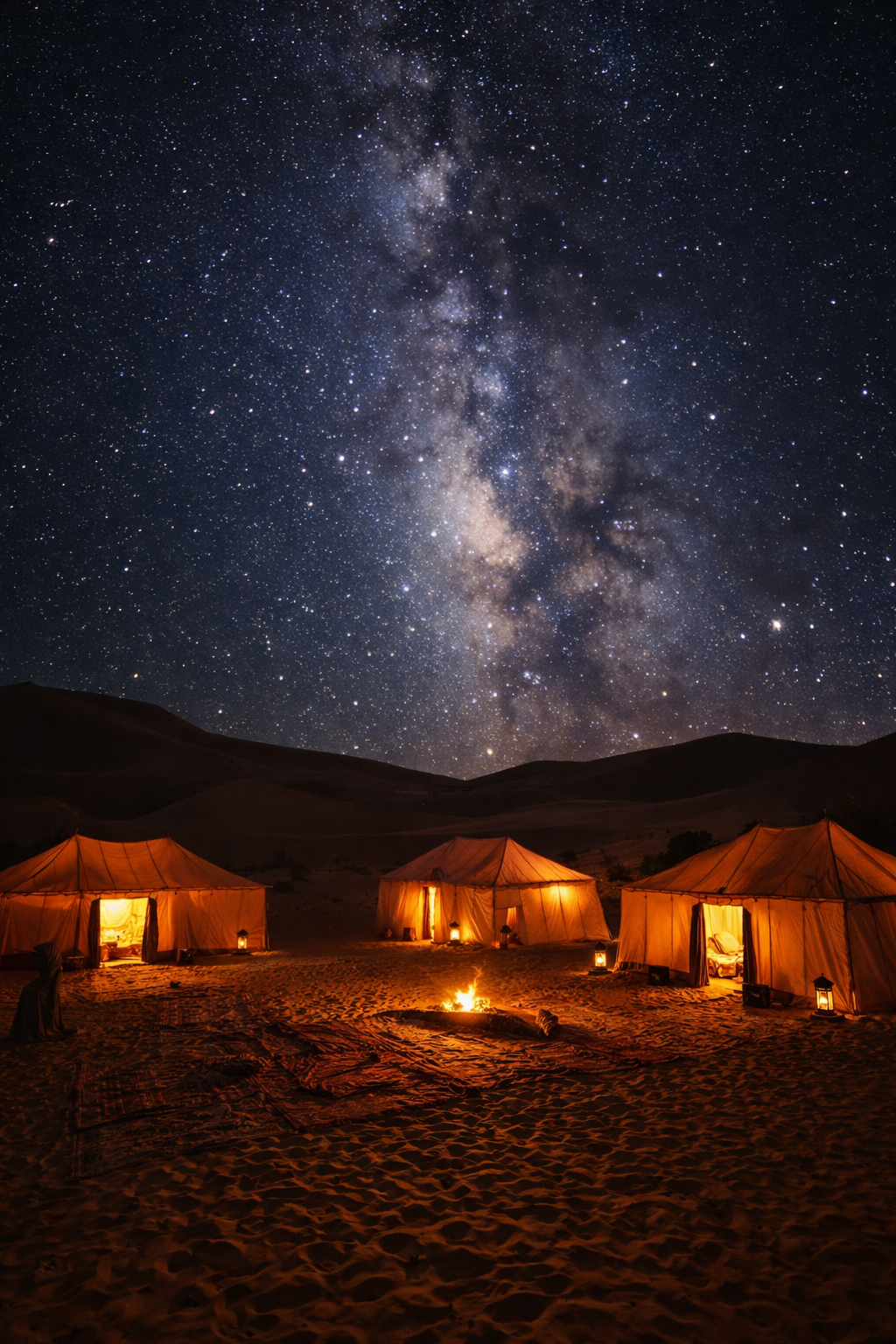
If you are doing the overnight at Erg Chigaga (arranged through La Petite Kasbah), the following items make a significant difference to the experience:
-
Headtorch with red mode: White light destroys dark adaptation for stargazing — use only red light after 9pm. Any modern headtorch has a red mode. Essential for navigating to and from the toilet facilities at camp.
-
Sleeping bag liner: Camp blankets are provided and are warm, but a liner adds insurance against cold nights in October–March. Silk liners pack to the size of a fist; fleece liners are warmer but bulkier.
-
Warm jacket and base layer: Temperatures at Erg Chigaga at 3am in November are typically 4–8°C. This is cold for anyone who has spent the previous two days in 28°C conditions.
-
Portable phone charger: There is no electricity at the overnight camp. A charged power bank means you can use your phone for the star app, photography, and the morning.
-
Earplugs: The desert at night is largely silent — but wind events across the tent fabric and occasional camel sounds can disturb light sleepers.
-
Small dry bag or ziplock bags: To protect phone, passport, and camera from fine sand. Sand enters everything at the camp level, even inside a tent.
-
Tipping cash: The guide and cook at the overnight camp expect a tip — 100–200 MAD each is appropriate. Bring small denomination notes.
6. Camera and Technology
For the Night Sky
-
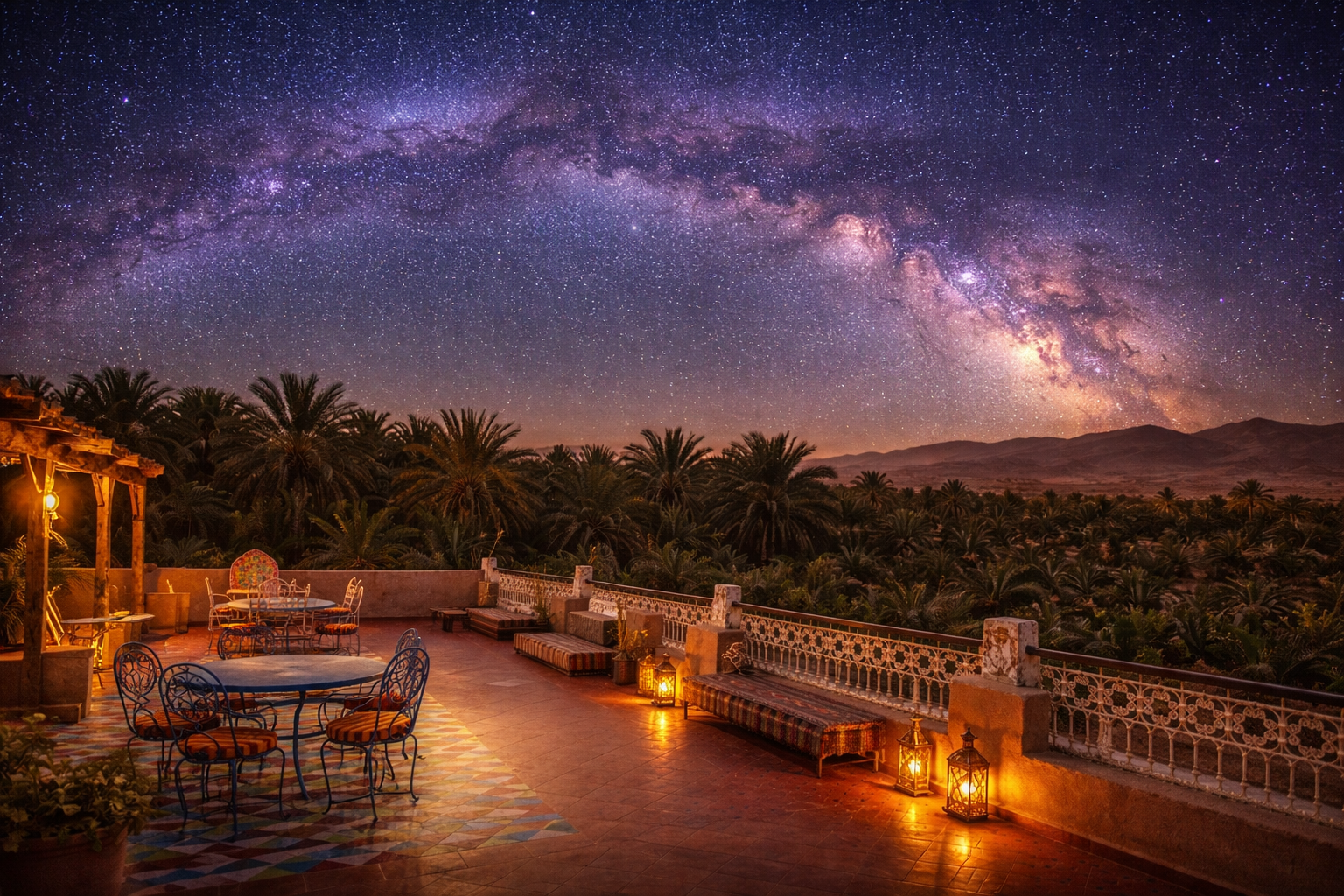
DSLR or mirrorless camera with manual settings: For Milky Way photography from the La Petite Kasbah rooftop or Erg Chigaga. Minimum f/2.8 lens, ISO 3200 capability. See the Stargazing article for full settings.
-
Tripod: Absolutely essential for night photography. A lightweight travel tripod (carbon fibre, under 1.5kg) is sufficient.
-
Extra batteries: Cold temperatures at night drain batteries faster than expected. Two fully charged batteries are the minimum for a night session.
For Day Photography
-
Wide-angle lens (14–24mm): For the Milky Way and for landscape shots across the Draa Valley. A single wide-angle covers most of the trip's photography needs.
-
Lens cloth and blower: Fine desert sand enters camera bodies and lenses. A lens cloth and a sensor blower are essential maintenance items. Keep the camera in a bag when not shooting.
-
Spare memory cards: Obvious but commonly forgotten. Bring more capacity than you think you need — the desert light generates extraordinary images.
Technology Generally
-
Download offline maps: Google Maps and Maps.me both offer offline map downloads. Download the Draa Valley region before leaving Marrakech — there is no reliable data signal along much of the N9 or at Erg Chigaga.
-
Download Stellarium offline: The stargazing app requires offline data download for full functionality. Do this in Marrakech or at the riad before heading to the desert.
-
Plug adaptor: Morocco uses type C and E plugs (same as continental Europe). UK and US visitors need an adaptor. La Petite Kasbah has adaptors available but bringing your own is more reliable.
7. Health, Hygiene and First Aid
-
Oral rehydration salts: Dehydration happens faster in dry desert air than in humid climates. ORS sachets (Dioralyte or equivalent) replace electrolytes more effectively than water alone after a hot day outdoors.
-
Antihistamine: For dust sensitivity, the occasional bee or wasp near the seguia channels, and as a general precaution.
-
Blister plasters (Compeed): The combination of closed shoes, sand infiltration, and sustained walking creates blisters for many travellers. Compeed-style hydrocolloid plasters heal blisters faster than conventional plasters.
-
Personal prescription medications: Bring more than needed — the nearest pharmacy is in Zagora town centre (15 minutes). The nearest hospital is Ouarzazate (165km). Do not rely on sourcing prescription medication locally.
-
Imodium or equivalent: Traveller's stomach is not guaranteed but not uncommon on a first Morocco visit. An antidiarrhoeal is worth having.
-
Travel insurance documents: Print or save offline. Medical evacuation from Erg Chigaga to Ouarzazate requires a vehicle; from Ouarzazate to Europe may require a helicopter. Insurance with evacuation cover is non-negotiable.
-
Hand sanitiser: For the souk (many shared surfaces) and before meals when handwashing facilities are unavailable. La Petite Kasbah has soap and water at all times.
8. Money, Documents and Practical Items
-
Moroccan Dirhams (MAD): Withdraw at Marrakech airport or city centre ATMs before departure — the selection and reliability is better than in Zagora. The Zagora ATMs work but can run out on busy market days. Bring enough for the full stay plus a 20% buffer.
-
Small denomination notes: For souk stalls (20, 50 MAD notes), tipping (50, 100 MAD notes), and camel trek payment. Large notes (200 MAD) are sometimes difficult to change at stalls.
-
Passport: Required for hotel check-in in Morocco. La Petite Kasbah will record your passport number at arrival — this is standard procedure across all Moroccan accommodation.
-
Photocopies of travel documents: Keep a photocopy of passport, travel insurance, and emergency contacts in your bag separate from the originals.
-
Headscarf or light shawl: For women visiting the Tamegroute library or the Mellah synagogue. Not required at the riad or for general Zagora travel, but respectful when entering religious and heritage sites.
9. What to Leave at Home
|
✗ LEAVE THESE AT HOME — THEY WON'T HELP IN THE DESERT |
|
✗ Rolling suitcase: the lanes of Amezrou are earthen and uneven; the desert camp has no hard ground. A 20–30L rucksack carries everything needed. |
|
✗ Expensive jewellery: fine sand gets everywhere and damages settings. Leave valuables at home or locked in the riad safe. |
|
✗ Stilettos or platform shoes: the riad, souk, and palm grove are all incompatible with heels. |
|
✗ Heavy guidebooks: download digital versions or bookmark specific pages — print guidebooks add weight for no benefit in a single-destination trip. |
|
✗ Multiple pairs of jeans: denim is heavy, slow to dry, and restrictive in heat. One pair maximum if you cannot travel without them — otherwise lightweight trousers only. |
|
✗ Full-size toiletries: 100ml bottles of everything are sufficient. Shampoo, conditioner, and soap are available at La Petite Kasbah. |
|
✗ A laptop: unless you are working remotely, a phone handles everything needed. The desert light is better experienced through eyes than screens. |
|
✗ Cotton socks for the overnight camp: cotton holds moisture and becomes cold. Wool or synthetic socks insulate when damp — bring one pair of wool socks for the overnight. |
10. Season-by-Season Adjustments
October–November (Recommended)
The ideal packing season. Daytime 24–30°C, nights 10–18°C. Light layers for the day, a fleece for the evening and rooftop. Sleeping bag liner for the camp. SPF 50 and hat mandatory. October adds the date harvest context — bring a small bag to carry dates bought at the souk.
December–February
The cold season. Add a proper warm jacket (down or insulated), thermal base layers, and wool socks. The days are clear and cool (18–22°C) — very comfortable for walking. Nights at Erg Chigaga can approach 0°C in January. A sleeping bag (not just a liner) is recommended for overnight camp. The trade-off: the best stargazing of the year.
March–April
Spring equivalent of October. Light layers for the day. A fleece for evenings. SPF 50 essential. April begins to warm — add light summer clothing for midday. The occasional spring wind (chergui) brings fine dust — a buff or lightweight scarf to cover nose and mouth is useful.
May–September
Summer. Maximum sun protection at all times. Activities strictly before 10am or after 5pm. The riad pool becomes the centrepiece of the day. Light, breathable clothing only — no fleece needed. Nights are warm and comfortable without extra layers. Erg Chigaga day trip: start at 6am to be on the dunes by 10am and back in shade by noon.
|
✔ |
The biggest mistake: forgetting warm layers — desert nights Oct–Mar drop to 5–10°C, the fleece saves the experience |
|
✔ |
Sun protection non-negotiable: SPF 50+, wide-brim hat, UV sunglasses, long-sleeve shirt — every day outdoors |
|
✔ |
Closed shoes for all outdoor desert activities — sandals fill with sand immediately and cause abrasion |
|
✔ |
Overnight camp extras: headtorch (red mode), sleeping bag liner, warm jacket, portable charger, tipping cash |
|
✔ |
One medium rucksack (20–30L) is better than a rolling suitcase for Zagora's lanes and desert terrain |
|
✔ |
Cash in Dirhams, small denominations — withdraw in Marrakech before arriving in Zagora |
|
✔ |
La Petite Kasbah provides filtered water, adaptors, and local knowledge — book at hotelzagora.com |
Frequently Asked Questions
What to pack for a Morocco desert trip?
The essentials are lightweight layers for temperature swings, a wide-brim hat, SPF 50+ sunscreen, a reusable 2-litre water bottle, comfortable closed-toe walking shoes, a headscarf or shawl, a headlamp for the overnight camp, and cash in Moroccan Dirhams. For the Erg Chigaga overnight, add a warm jacket, warm socks, and a camera with a tripod for the Milky Way.
What should I wear in the Zagora desert?
Lightweight long-sleeve shirts and long trousers are ideal — they protect from the sun, are appropriate in the souk and Mellah, and keep you comfortable across the wide temperature range. A wide-brim hat and headscarf are essential. Avoid shorts in the town and souk out of respect. At the riad pool and garden, standard swimwear is perfectly appropriate.
How many days of clothes should I pack for Morocco?
For a three-night Zagora stay, pack three lightweight shirts, two pairs of trousers, one warm layer, and enough underwear for each day. Quick-dry fabrics allow hand-washing at the riad if needed. For the overnight desert camp, the same clothes work — pack a warm jacket and socks separately in a small bag for the camp night specifically.
Is it cold in the Zagora desert at night?
Yes — significantly. Desert temperatures in Zagora drop sharply after sunset regardless of daytime heat. In October and November, nights reach 10–14°C. In December through February, temperatures regularly fall below 5°C. At the Erg Chigaga overnight camp, the temperature continues dropping through the night as the fire dies. A warm fleece or light down jacket and warm socks are non-negotiable for the overnight experience.
Do I need a visa to visit Morocco?
Citizens of the EU, UK, USA, Canada, and Australia do not need a visa for Morocco for stays up to 90 days. A valid passport is sufficient. Other nationalities should check current requirements with the Moroccan embassy before booking. Entry requirements can change — verify within three months of your planned travel date.
Can you drink tap water in Morocco?
No — tap water in Morocco including Zagora is not recommended for drinking. Use bottled water or, better, a reusable bottle filled from a filtered source. La Petite Kasbah provides filtered drinking water for guests to refill reusable bottles throughout the stay. Bring a 2-litre reusable bottle — it is the single most environmentally responsible item you can pack for a Zagora trip.
What shoes should I wear in Morocco desert?
Comfortable closed-toe walking shoes are the most practical option — suitable for the Mellah walk, souk visit, camel trek dismount, and general exploring. Sandals work at the riad pool and garden. For the Erg Chigaga overnight dune climb, trainers or light hiking boots are better than sandals. Avoid new shoes — break them in before the trip. The sand at the dunes gets into everything.
Should I bring a sleeping bag to Zagora?
Not for a standard riad stay — If you book with La Petite Kasbah they arrange all bedding. For the Erg Chigaga overnight desert camp, blankets and mattresses are provided in the Berber tent. A sleeping bag liner adds warmth on cold nights (below 5°C in winter) and is more packable than a full sleeping bag. In October and November, blankets at a well-equipped camp are usually sufficient.
How should female tourists dress in Morocco?
Female tourists in Morocco are not required to wear a hijab or cover their hair. The practical guideline is covered shoulders and knees in the souk and Mellah — lightweight trousers and a long-sleeve shirt are ideal. At the riad pool, normal swimwear is appropriate. Carry a headscarf in your bag: useful for dust on the camel trek and as a modesty layer when needed.
Can a woman wear shorts in Morocco?
At the riad, pool, and garden — yes. In Zagora's souk, Mellah, and town centre — not recommended. Shorts in the market and traditional areas draw unwanted attention, particularly for solo female travellers. Lightweight linen trousers are equally cool and eliminate this friction entirely. On the camel trek through the palm grove, long trousers also protect your legs from the saddle and vegetation.
Can a woman wear leggings in Morocco?
Yes — leggings are acceptable in most contexts in Zagora, particularly when paired with a longer top or tunic that covers the hips. At the souk and Mellah, opt for loose trousers rather than fitted leggings if you want to minimise attention. At the riad, garden, and pool, dress as you would at home. Comfort in the heat is the priority — lightweight and loose is better than tight regardless of style.
What shoes are best for Morocco travel?
Comfortable closed-toe walking shoes are the most practical option for Zagora — suitable for the souk, Mellah walk, camel trek dismount, and general exploring on uneven earthen surfaces. Sandals work at the riad pool and garden. For the Erg Chigaga dune climb, trainers or light hiking boots outperform sandals. Break in any new shoes before the trip — blisters in the desert heat are a genuine problem.
How strict is the dress code in Morocco?
Morocco has no legal dress code for tourists — there is no law requiring specific clothing. The practical expectation is cultural courtesy: covered shoulders and knees in traditional areas, souks, and religious sites. Zagora is more relaxed than Marrakech or Fès in practice. The more conservative your dress in the souk and Mellah, the less friction you will encounter — this applies equally to male and female visitors.
How to avoid pickpockets in Morocco?
Zagora has a significantly lower pickpocket rate than Marrakech or Fès. At the Wednesday and Sunday souk, keep your phone in a front pocket or zipped bag. Do not leave valuables unattended at the riad pool. Standard travel awareness — not the heightened vigilance required in Marrakech's medina — is sufficient for the entire Zagora visit.
|
Pack Light, Arrive Ready — La Petite Kasbah Does the Rest Rated 9.3/10. Filtered water, local packing advice, camel trek from the garden, overnight desert camp arranged. Every question answered at check-in. → www.hotelzagora.com ← |