
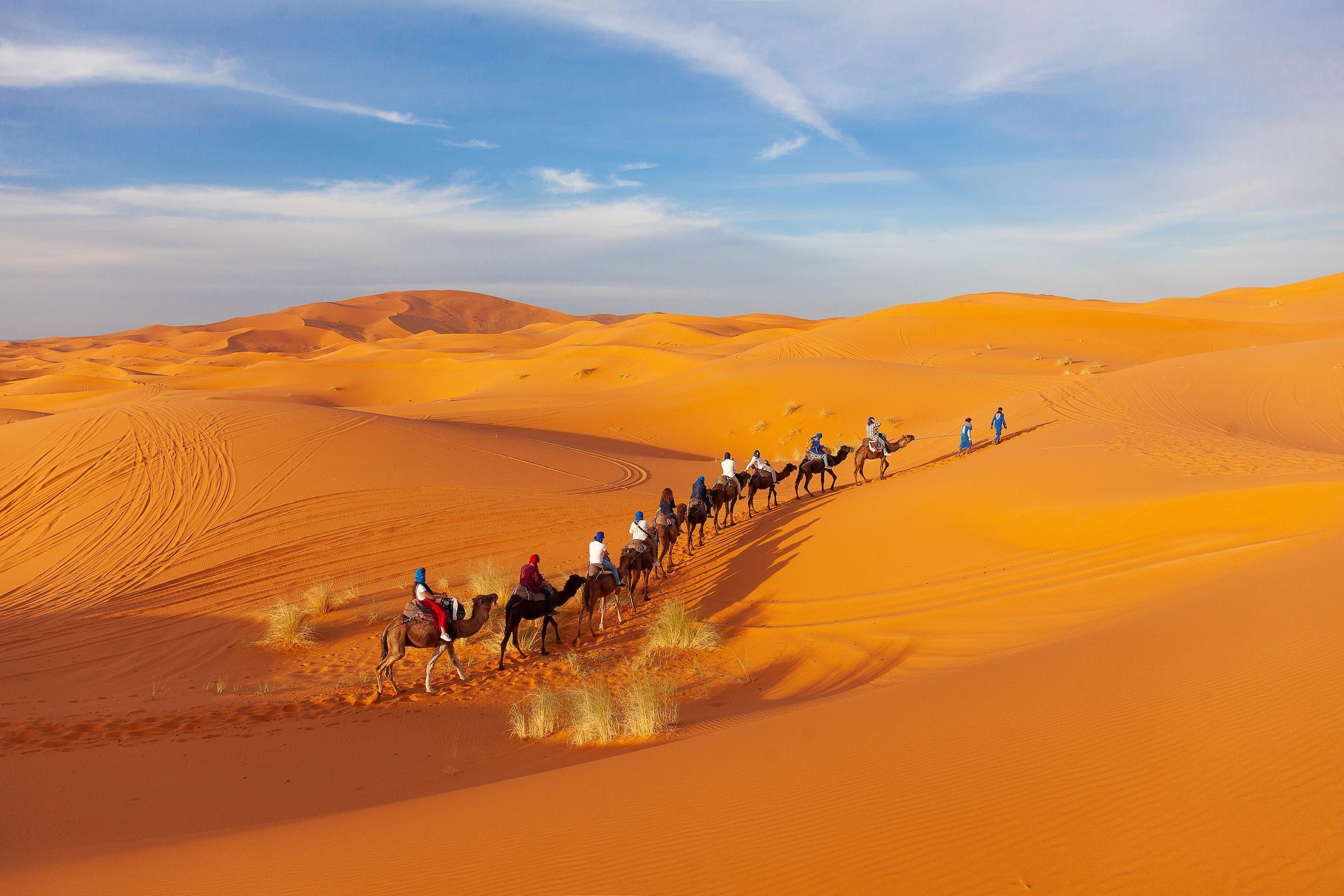
The sunset camel trek in Zagora departs from La Petite Kasbah garden at approximately 5:30pm and covers 3–5km through the Amezrou palm grove over 90 minutes. The trek is guided by a local Amezrou resident, timed deliberately for golden hour — the light on the date palms and desert horizon at that hour is the defining visual experience of any Zagora stay. Suitable for all ages and fitness levels.
A camel trek at sunset in the Zagora desert is one of those travel experiences that exceeds expectation almost universally. People describe it in their reviews not as a tourist activity but as a moment — the kind of thing they replay when someone asks what their favourite memory of Morocco was.
This guide covers everything you need to know before you go: the different trek options available from Zagora, what the experience actually feels like, how to prepare, what to expect from your camel and your guide, and — critically — why booking through La Petite Kasbah rather than a random street operator makes a significant difference to the quality of what you experience.
What to Expect on a Camel Trek in Zagora
- Departure from the riad garden (5:30pm) — the camels arrive at La Petite Kasbah at approximately 5:15pm. Mounting a camel is done from a kneeling position — the guide assists and the camel rises in two stages, back legs first. First-time riders find this disconcerting but it takes about 30 seconds and is straightforward with guidance.
- The palm grove route — the trek moves south through the Amezrou palm grove, following the seguia irrigation channels. The guide knows the grove in detail — the date varieties on specific trees, the families whose plots flank the path, the points where the oasis opens onto the pre-desert landscape. This is not a tourist route through a picturesque backdrop. It is a working agricultural landscape explained by someone who grew up inside it.
- The golden hour light — the departure time is deliberate. By 5:45pm the sun is low enough that the light on the palm fronds, the earthen walls of the Mellah, and the desert horizon beyond the oasis is the warm amber that photographers position themselves for. This light lasts approximately 45 minutes and is the reason the trek departs when it does.
- The open desert edge — the route exits the palm grove at the desert margin. The transition from oasis to pre-Saharan landscape — palm trees to open sand and rock — happens within a few hundred metres and is visually arresting. The guide stops here for photographs.
- The return (7pm) — the trek returns to La Petite Kasbah by approximately 7pm, arriving back at the garden gate as the light fades. The camels kneel to dismount. Dinner on the rooftop follows naturally.
✦ KEY TAKEAWAYS
› Camel trekking in Zagora departs directly from La Petite Kasbah through the Amezrou palm grove — no transfer required.
› The sunset camel ride (1.5–2 hours) is the most popular option and consistently described as one of the highlights of any Morocco trip.
› The correct animal is a dromedary (one hump) — Morocco has no Bactrian camels. Your guide will likely call it a 'camel' regardless.
› Book through La Petite Kasbah (hotelzagora.com) for trusted operators, fair pricing, and a trek that begins and ends at the riad.
› Full-day and overnight desert camp options are available for those wanting to extend the experience toward Erg Chigaga.
TABLE OF CONTENTS
1. Why Camel Trekking in Zagora Is Unique
2. Dromedary vs. Camel: What You're Actually Riding
3. Trek Options: From Sunset Rides to Multi-Day Expeditions
4. The Sunset Camel Ride: What to Expect Hour by Hour
5. The Route: Through the Amezrou Palm Grove
6. Practical Preparation: What to Wear and Bring
7. Photography: Getting the Best Shots
8. Families and Children: Is It Suitable?
9. Booking Through La Petite Kasbah: Why It Matters
10. What Guests Say About Camel Trekking from La Petite Kasbah
1. Why Camel Trekking in Zagora Is Unique
Most camel treks in Morocco are essentially the same experience: a short ride on a managed camel along a well-worn path, usually with several other tourist groups visible, camera-ready at all times. In the busier desert destinations, this can feel more like a theme park ride than a genuine encounter with the desert.
Zagora is different. The camel treks that depart from La Petite Kasbah pass through the Amezrou palm grove — one of the most beautiful oasis landscapes in Morocco — before entering the pre-desert scrubland and, for longer treks, the open Saharan terrain beyond. The scale of the landscape, the relative absence of other tourists, and the quality of the Berber guides who lead these treks combine to produce something genuinely memorable.
The departure point is the riad itself. There is no bus to catch, no transfer to a starting point, no assembly area with dozens of other tourists. Your camel arrives at La Petite Kasbah and you begin. This alone sets the Zagora experience apart from the more organised desert destinations.
2. Dromedary vs. Camel: What You're Actually Riding

Technically, what you ride on a camel trek in Morocco is a dromedary — a one-humped camel (Camelus dromedarius) native to North Africa and the Middle East. The two-humped Bactrian camel (Camelus bactrianus) comes from Central and East Asia and is not found in the Sahara. In practice, your guide, La Petite Kasbah, and every signpost in Zagora will simply call them 'camels', so there is no practical confusion — but the distinction is worth knowing.
Dromedaries are exceptionally well-adapted to desert life: they can go up to seven days without water, their split upper lip allows them to graze on thorny desert vegetation, and their large padded feet distribute weight across soft sand without sinking. They are also, once you get used to them, surprisingly comfortable to ride — particularly at walking pace, which is how all guest treks operate.
First-timer note: The most dramatic moment of a camel ride is standing up and sitting down. Dromedaries rise back-legs first, which gives a sharp forward pitch followed by an equally sharp backward one. Hold on, lean back, and it is over in three seconds. Once up, the walking motion is gentle and rhythmic — most guests find it very comfortable after the first few minutes.
3. Trek Options: From Sunset Rides to Multi-Day Expeditions
La Petite Kasbah offers or can arrange several different camel trekking options, depending on your time, appetite for adventure, and whether you want to sleep under the stars.

The sunset ride is the most requested option and, for most travellers, the right one. It fits naturally into the La Petite Kasbah daily rhythm — pool in the afternoon, camel trek at sunset, rooftop terrace and dinner afterwards. The golden hour light in the Zagora desert is extraordinary, and having a camel beneath you while the sky changes from gold to rose to deep blue is an experience that photographs exceptionally well and stays in the memory for years.