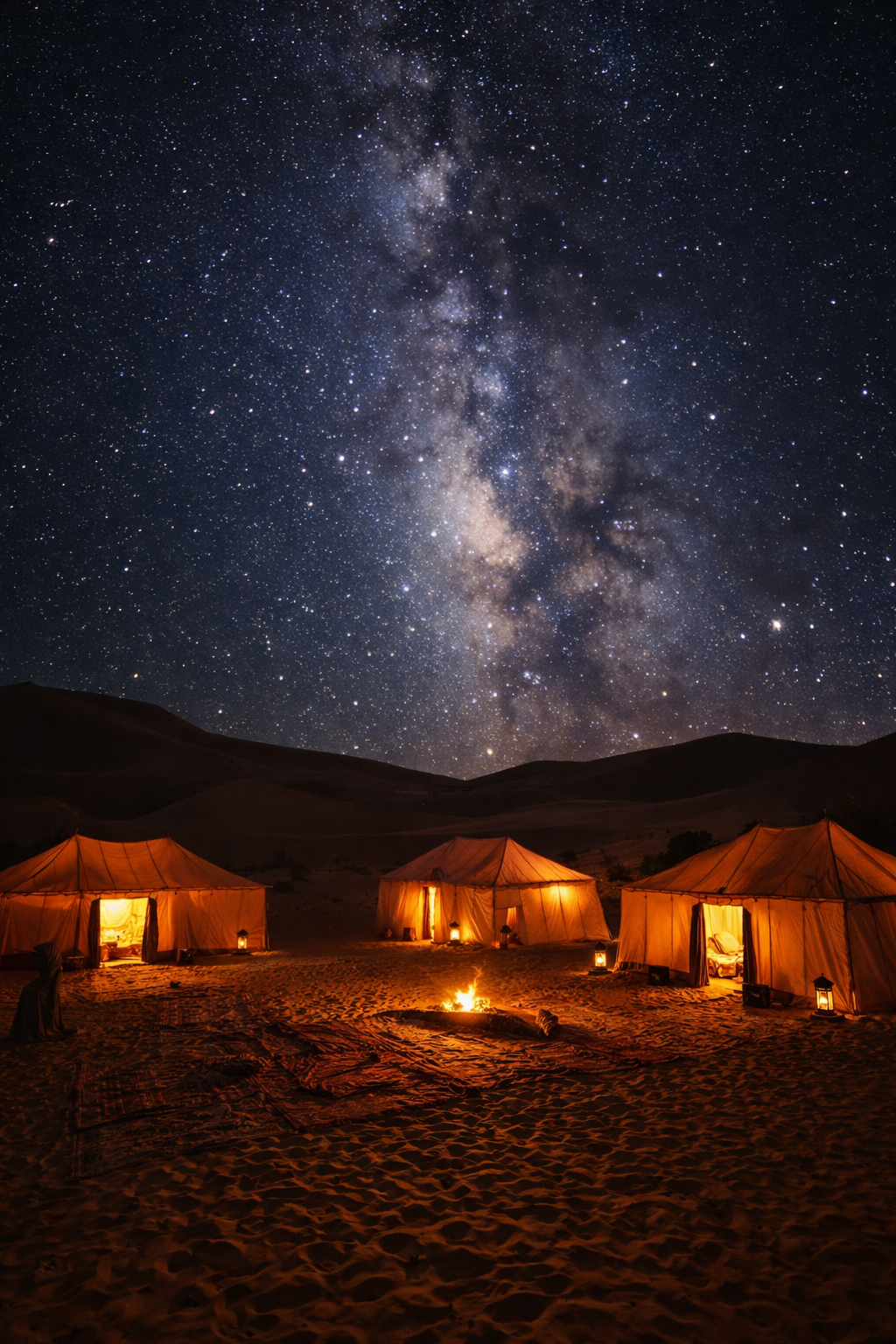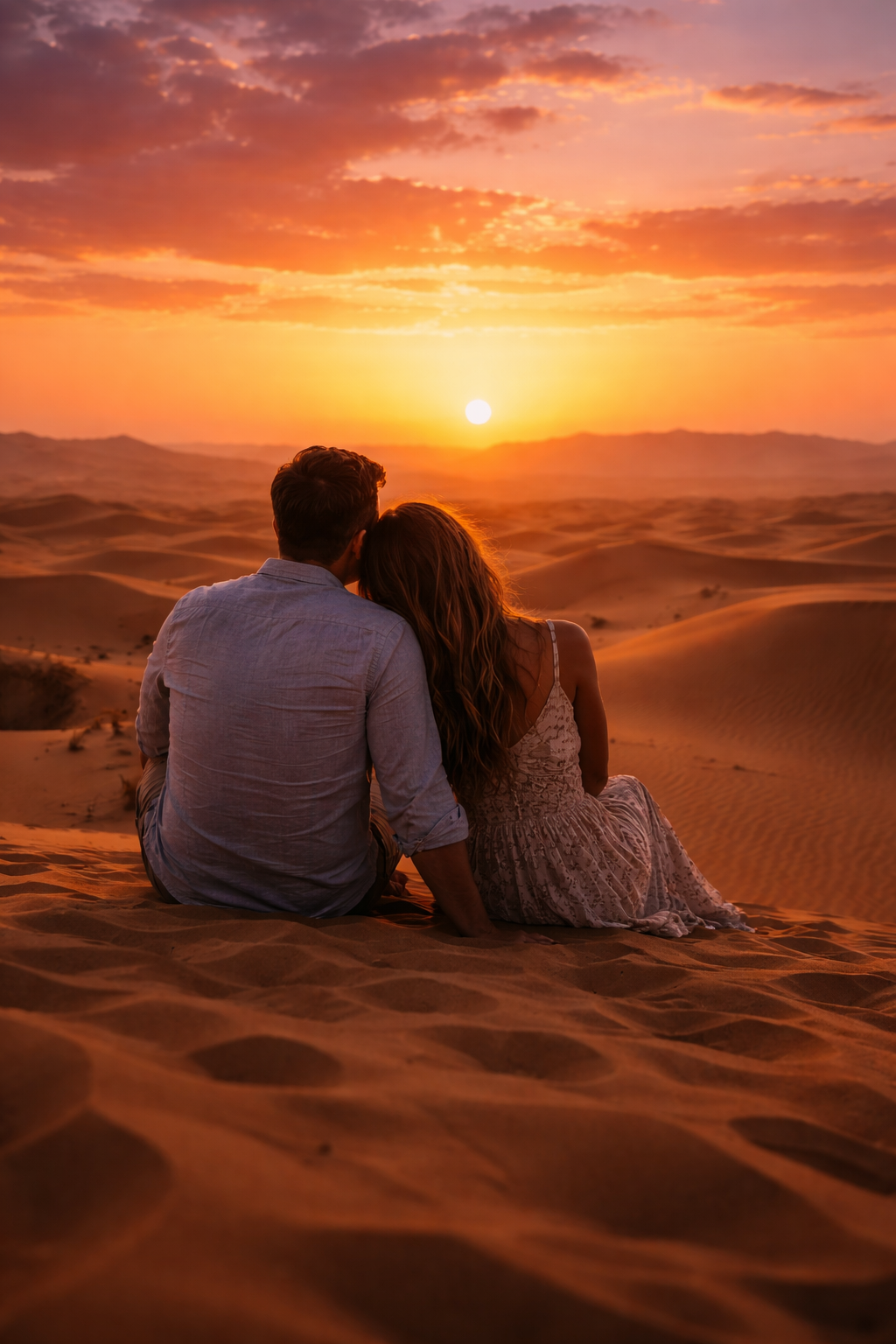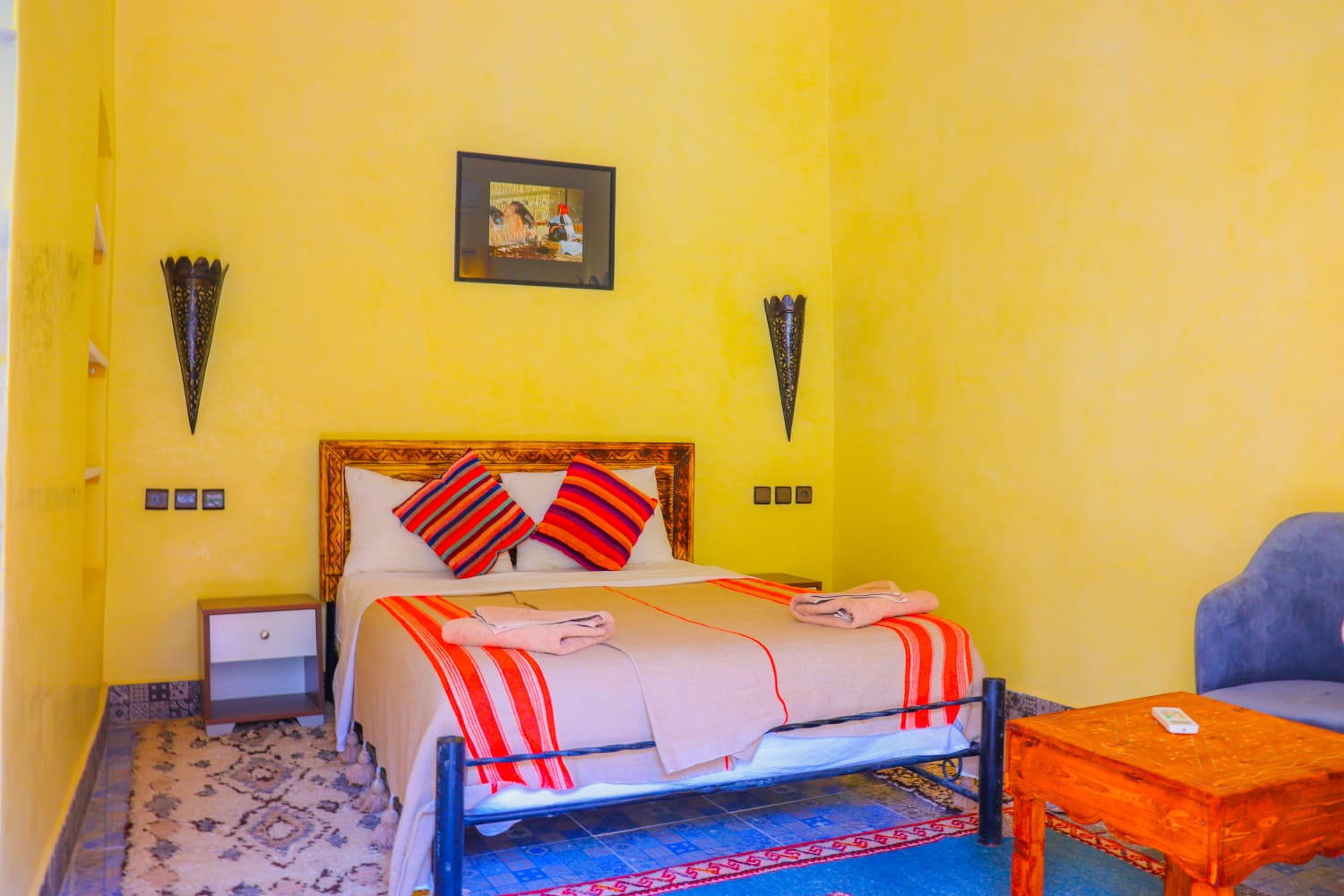
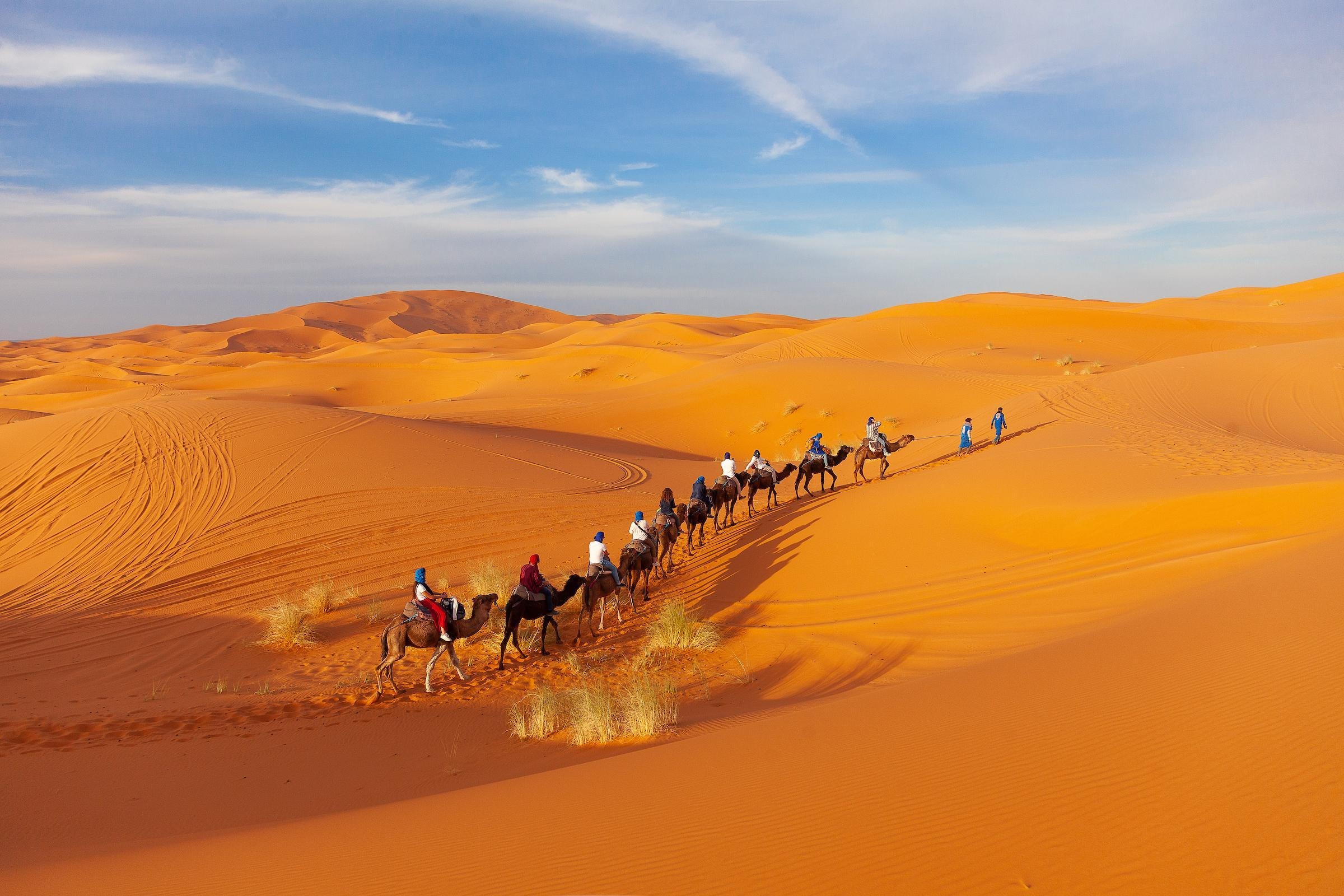
The sunset camel trek in Zagora departs from La Petite Kasbah garden at approximately 5:30pm and covers 3–5km through the Amezrou palm grove over 90 minutes. The trek is guided by a local Amezrou resident, timed deliberately for golden hour — the light on the date palms and desert horizon at that hour is the defining visual experience of any Zagora stay. Suitable for all ages and fitness levels.
A camel trek at sunset in the Zagora desert is one of those travel experiences that exceeds expectation almost universally. People describe it in their reviews not as a tourist activity but as a moment — the kind of thing they replay when someone asks what their favourite memory of Morocco was.
This guide covers everything you need to know before you go: the different trek options available from Zagora, what the experience actually feels like, how to prepare, what to expect from your camel and your guide, and — critically — why booking through La Petite Kasbah rather than a random street operator makes a significant difference to the quality of what you experience.
What to Expect on a Camel Trek in Zagora
- Departure from the riad garden (5:30pm) — the camels arrive at La Petite Kasbah at approximately 5:15pm. Mounting a camel is done from a kneeling position — the guide assists and the camel rises in two stages, back legs first. First-time riders find this disconcerting but it takes about 30 seconds and is straightforward with guidance.
- The palm grove route — the trek moves south through the Amezrou palm grove, following the seguia irrigation channels. The guide knows the grove in detail — the date varieties on specific trees, the families whose plots flank the path, the points where the oasis opens onto the pre-desert landscape. This is not a tourist route through a picturesque backdrop. It is a working agricultural landscape explained by someone who grew up inside it.
- The golden hour light — the departure time is deliberate. By 5:45pm the sun is low enough that the light on the palm fronds, the earthen walls of the Mellah, and the desert horizon beyond the oasis is the warm amber that photographers position themselves for. This light lasts approximately 45 minutes and is the reason the trek departs when it does.
- The open desert edge — the route exits the palm grove at the desert margin. The transition from oasis to pre-Saharan landscape — palm trees to open sand and rock — happens within a few hundred metres and is visually arresting. The guide stops here for photographs.
- The return (7pm) — the trek returns to La Petite Kasbah by approximately 7pm, arriving back at the garden gate as the light fades. The camels kneel to dismount. Dinner on the rooftop follows naturally.
✦ KEY TAKEAWAYS
› Camel trekking in Zagora departs directly from La Petite Kasbah through the Amezrou palm grove — no transfer required.
› The sunset camel ride (1.5–2 hours) is the most popular option and consistently described as one of the highlights of any Morocco trip.
› The correct animal is a dromedary (one hump) — Morocco has no Bactrian camels. Your guide will likely call it a 'camel' regardless.
› Book through La Petite Kasbah (hotelzagora.com) for trusted operators, fair pricing, and a trek that begins and ends at the riad.
› Full-day and overnight desert camp options are available for those wanting to extend the experience toward Erg Chigaga.
TABLE OF CONTENTS
1. Why Camel Trekking in Zagora Is Unique
2. Dromedary vs. Camel: What You're Actually Riding
3. Trek Options: From Sunset Rides to Multi-Day Expeditions
4. The Sunset Camel Ride: What to Expect Hour by Hour
5. The Route: Through the Amezrou Palm Grove
6. Practical Preparation: What to Wear and Bring
7. Photography: Getting the Best Shots
8. Families and Children: Is It Suitable?
9. Booking Through La Petite Kasbah: Why It Matters
10. What Guests Say About Camel Trekking from La Petite Kasbah
1. Why Camel Trekking in Zagora Is Unique
Most camel treks in Morocco are essentially the same experience: a short ride on a managed camel along a well-worn path, usually with several other tourist groups visible, camera-ready at all times. In the busier desert destinations, this can feel more like a theme park ride than a genuine encounter with the desert.
Zagora is different. The camel treks that depart from La Petite Kasbah pass through the Amezrou palm grove — one of the most beautiful oasis landscapes in Morocco — before entering the pre-desert scrubland and, for longer treks, the open Saharan terrain beyond. The scale of the landscape, the relative absence of other tourists, and the quality of the Berber guides who lead these treks combine to produce something genuinely memorable.
The departure point is the riad itself. There is no bus to catch, no transfer to a starting point, no assembly area with dozens of other tourists. Your camel arrives at La Petite Kasbah and you begin. This alone sets the Zagora experience apart from the more organised desert destinations.
2. Dromedary vs. Camel: What You're Actually Riding

Technically, what you ride on a camel trek in Morocco is a dromedary — a one-humped camel (Camelus dromedarius) native to North Africa and the Middle East. The two-humped Bactrian camel (Camelus bactrianus) comes from Central and East Asia and is not found in the Sahara. In practice, your guide, La Petite Kasbah, and every signpost in Zagora will simply call them 'camels', so there is no practical confusion — but the distinction is worth knowing.
Dromedaries are exceptionally well-adapted to desert life: they can go up to seven days without water, their split upper lip allows them to graze on thorny desert vegetation, and their large padded feet distribute weight across soft sand without sinking. They are also, once you get used to them, surprisingly comfortable to ride — particularly at walking pace, which is how all guest treks operate.
First-timer note: The most dramatic moment of a camel ride is standing up and sitting down. Dromedaries rise back-legs first, which gives a sharp forward pitch followed by an equally sharp backward one. Hold on, lean back, and it is over in three seconds. Once up, the walking motion is gentle and rhythmic — most guests find it very comfortable after the first few minutes.
3. Trek Options: From Sunset Rides to Multi-Day Expeditions
La Petite Kasbah offers or can arrange several different camel trekking options, depending on your time, appetite for adventure, and whether you want to sleep under the stars.

The sunset ride is the most requested option and, for most travellers, the right one. It fits naturally into the La Petite Kasbah daily rhythm — pool in the afternoon, camel trek at sunset, rooftop terrace and dinner afterwards. The golden hour light in the Zagora desert is extraordinary, and having a camel beneath you while the sky changes from gold to rose to deep blue is an experience that photographs exceptionally well and stays in the memory for years.
4. The Sunset Camel Ride: What to Expect Hour by Hour

Departure (5:00–5:15pm)
Your dromedary arrives at La Petite Kasbah saddled and decorated. Your guide — a local Berber man who knows this landscape intimately — helps you mount and makes sure you are comfortable. The group sets off through the gate of the riad's garden into the Amezrou village lanes.
Through the Palm Grove (5:15–5:45pm)
The first section passes through the Amezrou palm grove — centuries of irrigation agriculture laid out along the Draa river bed. The date palms rise on both sides. The light is extraordinary at this hour: warm, long, golden, filtering through the canopy in ways that change every minute. Birdsong. The creak of saddle leather. The soft pad of camel feet on packed earth.
Into the Pre-Desert (5:45–6:15pm)
Beyond the palm grove, the landscape opens up. The vegetation thins. The colour of the earth shifts from green and ochre to a purer, cleaner sand and stone. The Jebel Zagora is visible to the east, its flat top silhouetted against the sky. The space around you expands. This is where many guests describe feeling, for the first time, that they are genuinely in the desert.
Golden Hour (6:15–6:45pm)
The sun drops toward the horizon. The light turns amber, then deep gold, then pink. The shadows lengthen. Your guide stops the caravan at a high point with a 360-degree view of the desert landscape — this is the moment most guests photograph. The silence is remarkable. On a calm evening, you can hear nothing at all except the wind and, occasionally, the comfortable exhale of a dromedary settling its weight.
Return (6:45–7:15pm)
The return follows a different route — often passing through a different section of the palm grove, or along an elevated ridge with the lights of Zagora visible in the valley. You arrive back at La Petite Kasbah as the sky moves from deep blue to purple. Mint tea is waiting on the terrace. The stars are beginning to appear.
5. The Route: Through the Amezrou Palm Grove

The route from La Petite Kasbah is one of the most naturally beautiful camel trek routes in southern Morocco, specifically because it begins in the oasis and moves gradually into the desert. This transition — from the green density of the palm grove to the open silence of the pre-Saharan landscape — gives the experience a narrative arc that instant-access dune rides lack.
The Amezrou palm grove itself is historically significant. It was part of the Trans-Saharan trade route network for centuries — the point where caravans from Timbuktu stopped to water their animals before pushing north through the Atlas. Walking a camel through this landscape, even today, connects you to something very old. Your guide, if you ask, will tell you about it.
6. Practical Preparation: What to Wear and Bring

What NOT to Bring
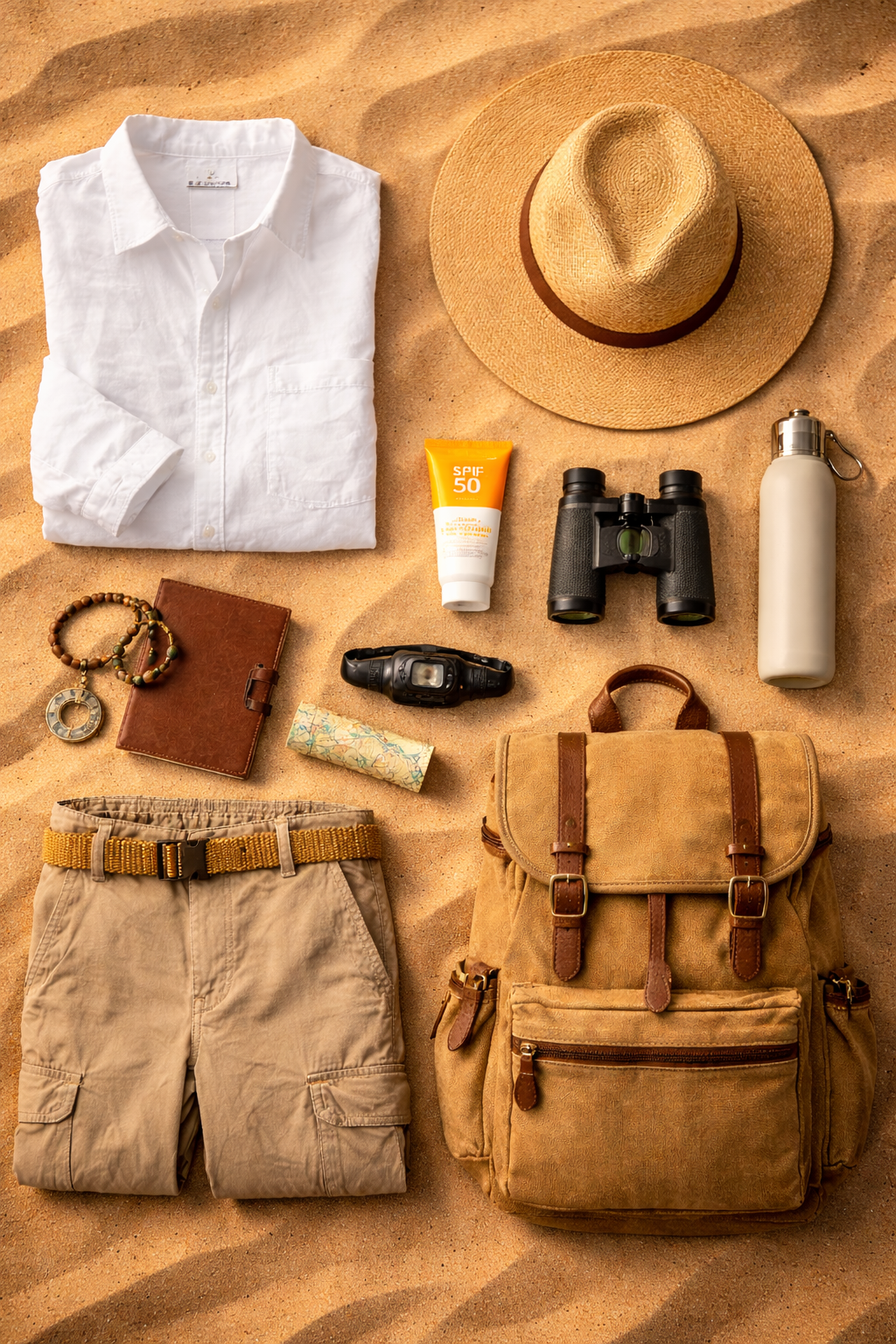
Large backpacks are awkward on camelback. Leave heavy bags at the riad. Avoid wearing valuable jewellery on desert excursions. Do not bring food that melts or spoils — dates and dry biscuits work well if you want a snack.
7. Photography: Getting the Best Shots
A camel trek at golden hour in the Zagora desert is one of the most photogenic experiences Morocco offers. A few tips from travellers who have done it:
• Shoot into the sun: The silhouette shot — camel and rider outlined against the orange sky — is the image everyone wants. Position yourself or ask your guide to help. Shoot with the sun slightly to one side of the frame for the best results.
• Use portrait mode sparingly: The wide landscape is the star, not the subject. A wide-angle shot that captures the full scale of the desert sky is more powerful than a close-up.
• Shoot during the last 20 minutes: The light changes fastest in the final 20 minutes before sunset. Put the phone away during the middle section and just experience it, then shoot intensively at the end.
• Ask your guide to stop: Guides from La Petite Kasbah are experienced with photography-focused guests. Ask them to stop at a high point — they will know exactly where.
• Vertical for Instagram, horizontal for reality: Take both. The landscape deserves the wide frame. Your Instagram deserves the portrait. You have time for both.
*You can book a professional travel photographer here.
8. Families and Children: Is It Suitable?
Camel trekking is one of the most family-friendly activities in Zagora, and La Petite Kasbah's guides are experienced with younger guests. Children from around age 5 upwards can ride independently; younger children ride seated in front of an adult. The walking pace of the trek means there is no significant physical risk, and children almost universally love the experience.
The sunset timing works well for families — it falls after the pool afternoon and before dinner, fitting naturally into the day without disrupting nap schedules or creating a late return. Multiple families at La Petite Kasbah have described the camel trek as the moment their children declared Zagora 'the best place in the world'. The guides are patient, attentive, and excellent with children.
For very young children (under 5): Consider the 30-minute introductory ride around the palm grove rather than the full sunset trek. It gives a genuine experience without the length and heat.
9. Booking Through La Petite Kasbah: Why It Matters
Camel trek operators in Zagora range from excellent to exploitative. Street operators approach tourists aggressively, sometimes offer low prices that conceal extras, use animals whose condition is questionable, and provide guides with little knowledge of the landscape or English or French language skills.
Booking through La Petite Kasbah removes all of this uncertainty. Brahim and Rhizlane work exclusively with trusted Berber guides — local men who have spent their lives in this desert and who know how to create an experience rather than just complete a route. The animals are well cared for. The pricing is transparent. There is no negotiation at the starting point, no unexpected extras, and no assembly with tour groups from other hotels.
The La Petite Kasbah advantage: your trek begins at the riad, returns to the riad, and the people who arranged it are the same people who will serve you breakfast the next morning and ask how it was. That continuity of care is the difference between a service and an experience.
10. What Guests Say About Camel Trekking from La Petite Kasbah

Frequently Asked Questions
What is the camel trek like in Zagora Morocco?
The Zagora camel trek departs from La Petite Kasbah garden at 5:30pm and covers 3–5km through the Amezrou palm grove over 90 minutes at golden hour. The guide is a local Amezrou resident who explains the palm grove's seguia irrigation system and date varieties. The trek ends at the desert edge before returning to the riad by 7pm — timed precisely for the best desert light of the day.
How long is the camel trek in Zagora?
The sunset camel trek from La Petite Kasbah lasts approximately 90 minutes — departing at 5:30pm and returning to the riad by 7pm. The route covers 3–5km through the Amezrou palm grove to the desert edge and back. Longer camel excursions to the Tinfou dunes (25km south) are available as a half-day or full-day option and can be arranged through the riad in advance.
Is camel trekking in Zagora suitable for beginners?
Yes — the trek is designed for complete beginners. The camels are calm and accustomed to first-time riders. The guide assists with mounting and dismounting and walks alongside throughout. The pace is slow and the route flat. Children from age 6, older adults, and anyone without riding experience all complete the trek comfortably. Mention any mobility concerns when booking through hotelzagora.com.
What should I wear for a camel trek in Morocco?
Long trousers — camel saddle leather chafes bare legs over 90 minutes. Closed-toe shoes rather than sandals — more stable in the stirrups and better on uneven ground at the desert edge. A headscarf or hat for sun protection — the rider is fully exposed at head height. Apply sunscreen before departure. A light jacket for the return if visiting in October through March.
How much does a camel trek cost in Zagora Morocco?
The sunset camel trek from La Petite Kasbah costs approximately 100–200 MAD per person (€9–19) — arranged directly through the riad at local rates without agency markup. Longer excursions to the Tinfou dunes or a half-day desert circuit are priced separately. Tip the camel guide directly in cash at the end of the trek — 50–100 MAD is appropriate and genuinely appreciated.
What is the best time of day for a camel trek in Zagora?
Sunset — 5:30pm departure from October through April. The golden hour light on the Amezrou palm grove at this time is the reason the trek exists at its current departure time. A morning option is available but misses the defining light quality. If you can only do one thing in Zagora, do the sunset camel trek on your first evening — it sets the tone for the entire stay.
Is the camel trek at Zagora or Merzouga better?
Different experiences. The Zagora trek moves through the Amezrou palm grove — seguia channels, date palms, Mellah architecture — before exiting at the desert edge at golden hour. The Merzouga trek runs along the Erg Chebbi dune edge for camp access. The Zagora trek is more culturally layered; the Merzouga trek is more visually dramatic for dune photography. Most travellers who do both prefer the Zagora version.
Can children do the camel trek in Zagora?
Yes — children from age 6 complete the Zagora camel trek comfortably. Younger children can ride with a parent. The pace is slow, the route flat, and the guide walks alongside throughout. An Australian family with children aged 8 and 11 completed the trek — the 8-year-old was nervous initially and described it as a trip highlight by the end.
How much should a camel ride cost in Morocco?
The sunset camel trek from La Petite Kasbah in Zagora costs approximately 100–200 MAD per person (€9–19) — arranged directly through the riad at local rates. Camel rides in Marrakech (Palmeraie area) typically cost 150–300 MAD for 30–60 minutes. Always agree the price before mounting and clarify whether the quoted price is per person or per camel. Book through your accommodation rather than from touts at the roadside.
Are there ethical camel rides in Morocco?
Yes — the markers of an ethical camel trek are: well-fed camels showing no visible distress, treks of 90 minutes to 2 hours maximum, guides who are local residents rather than commercial herd operators, and fair local pricing. The La Petite Kasbah sunset trek meets these criteria — local Amezrou guide, well-maintained camels, 90 minutes at walking pace. Avoid camel rides offered by touts at tourist sites where animal welfare standards are harder to verify.
Should you wear jeans when riding a camel?
Jeans work but are not ideal — thick inner leg seams create pressure points over 90 minutes in the saddle. Lightweight cotton or linen trousers in a looser fit are more comfortable. The key requirement is covered legs — bare skin against a camel saddle for 90 minutes causes chafing. Any long trousers are better than shorts regardless of material.
How much to tip a camel guide in Morocco?
50–100 MAD is the appropriate tip for a 90-minute camel trek guide in Zagora — given directly in cash to the guide at the end of the trek, not left at the riad front desk. The guide's wage for the trek is modest; the tip makes a meaningful difference to the income. For a longer half-day or full-day desert excursion by camel, 100–200 MAD is appropriate.
Is a camel ride in Marrakech worth it?
The Marrakech Palmeraie camel ride is a 30–60 minute tourist experience worth doing if Zagora is not on your itinerary — but a pale comparison to the La Petite Kasbah sunset trek. The Zagora version moves through a genuine working oasis at golden hour with a local guide. If visiting Zagora, skip the Marrakech camel ride — the Zagora experience is categorically different.
Do camels feel pain when ridden?
Camels are domesticated working animals bred for riding — a single adult rider causes no pain to a healthy, well-maintained camel. The welfare concern in tourist contexts is overwork, poor feeding, and inadequate rest rather than riding itself. A camel ridden for 90 minutes at walking pace by one rider is not being harmed. The ethical question is about the operator's standards, not the activity.
|
Book Your Camel Trek Through La Petite Kasbah Rated 9.3/10. Treks depart directly from the riad through the Amezrou palm grove. Sunset rides, overnight desert camps, and Erg Chigaga expeditions — all arranged for you. |