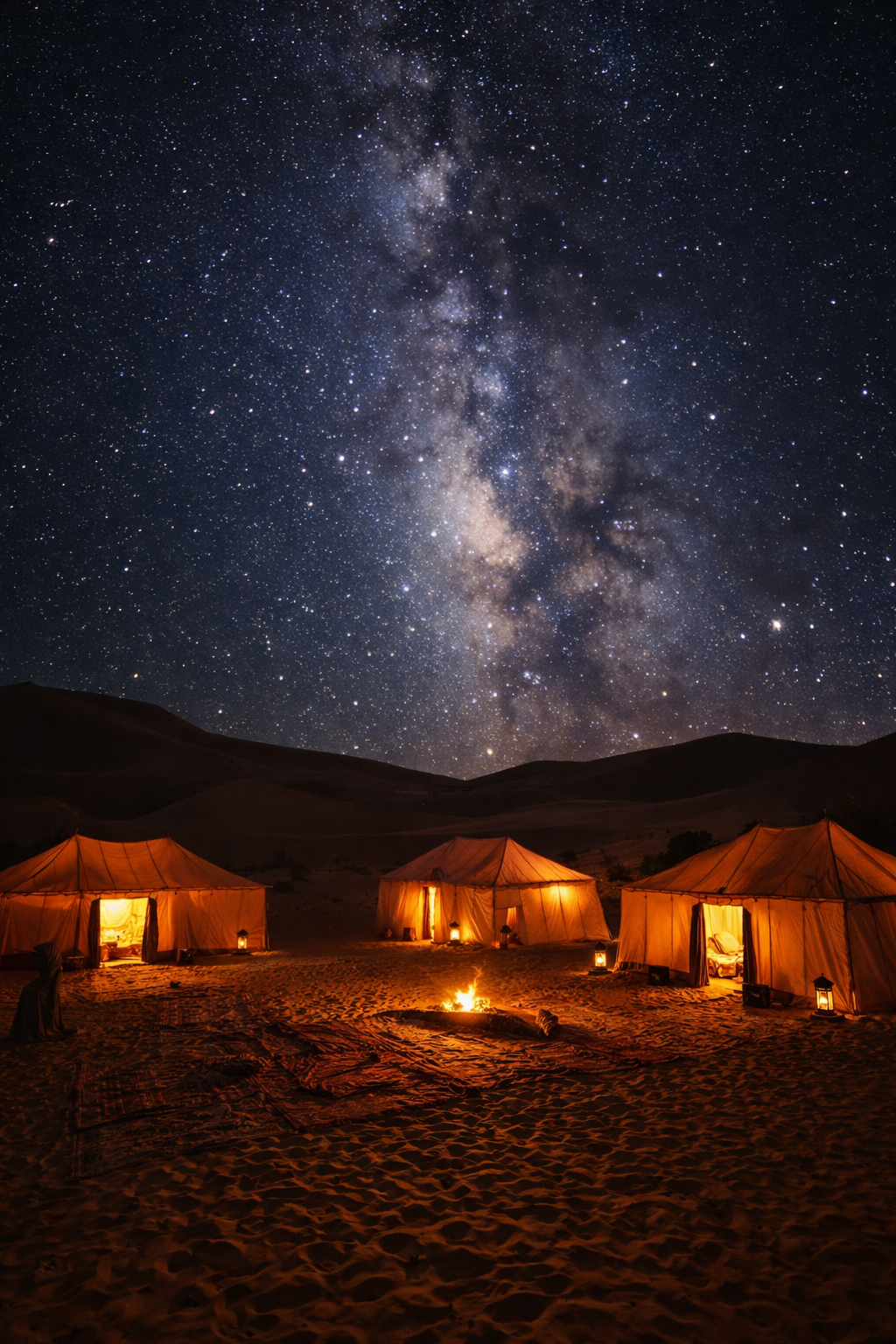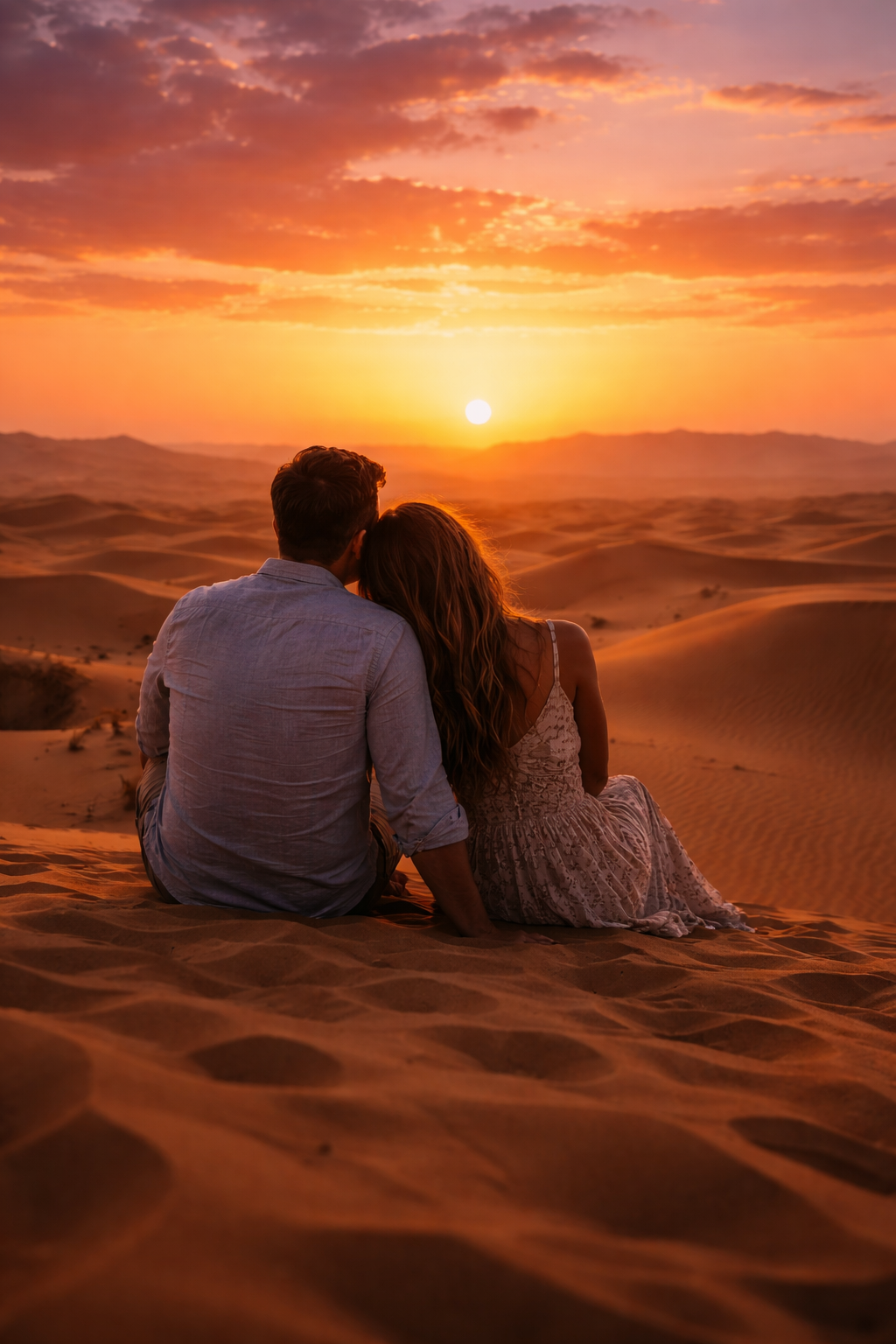
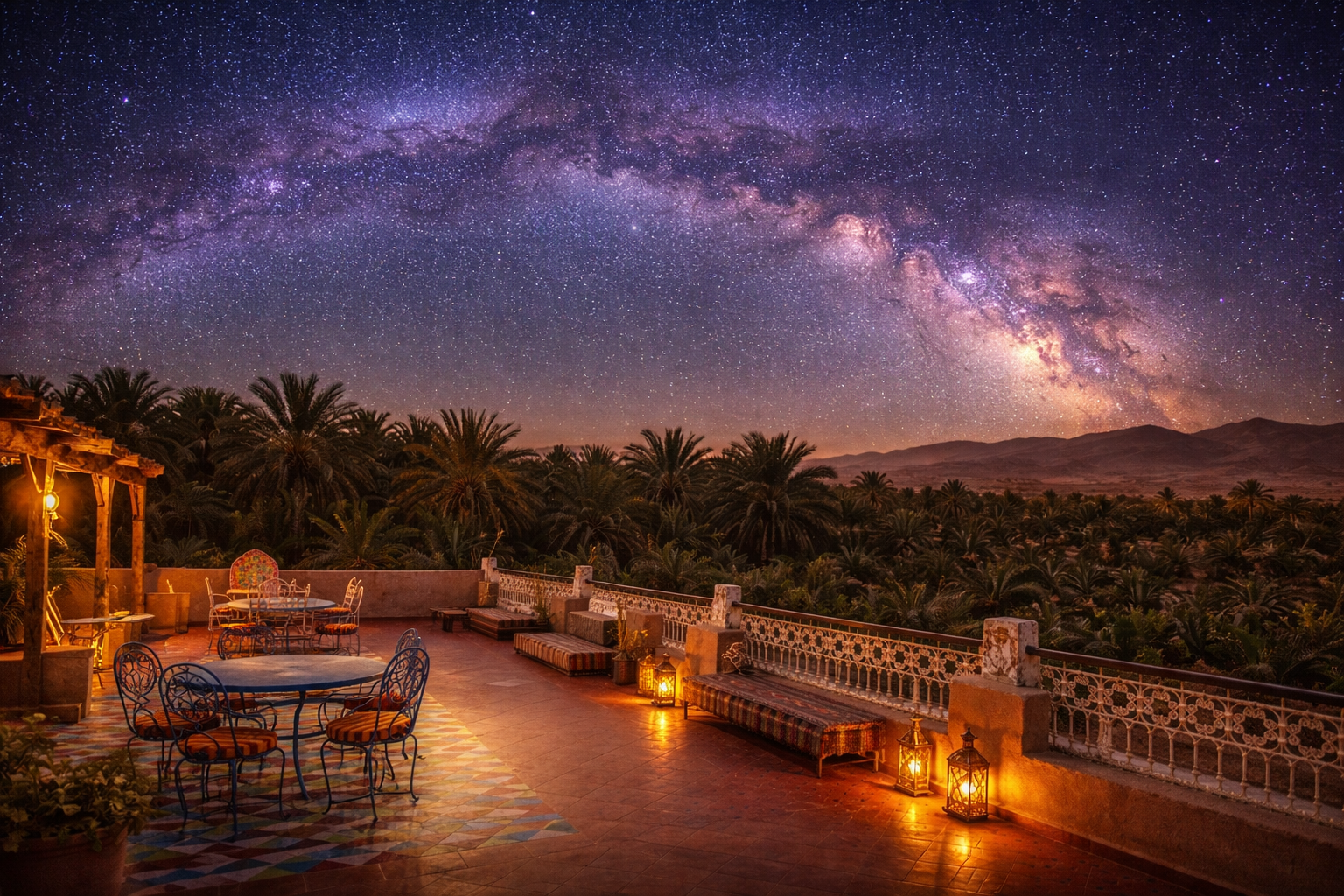
On a clear night in Zagora, the sky is not dark blue. It is white. Not the washed-out white of city light pollution, but the dense, populated white of a sky with no competing brightness — the Milky Way not as a faint smear but as a physical structure overhead, three-dimensional and close in a way that visitors from European or North American cities consistently describe as disorienting. It looks artificial. It looks wrong. It looks like something that should only be in photographs.
The Zagora region sits at the edge of the Sahara, in a section of southern Morocco with almost no permanent settlement, no industrial lighting, and clear, dry air that filters almost nothing between the stars and the observer. The nearest city of significant size — Ouarzazate — is 165km north. The nearest source of substantial light pollution — Marrakech — is 365km north. In the valley between those two points, at the oasis town of Zagora, the night sky is one of the darkest in the country.
This guide explains why Zagora's sky is exceptional, what you will actually see there, the best places to watch from, what to bring, and how to plan your visit around the night sky.
|
✦ KEY TAKEAWAYS |
|
› Zagora sits in one of Morocco's lowest light-pollution zones — the Draa Valley between Ouarzazate and M'Hamid has almost no artificial light for 200km. |
|
› The Milky Way is visible to the naked eye on any clear moonless night — no equipment required. |
|
› Two best locations: La Petite Kasbah rooftop (immediate, comfortable, any night of stay) and Erg Chigaga (completely dark, 180° horizon, requires overnight camp). |
|
› Best season for stars: October–March — longer nights, cleaner air, the galactic core visible from October. |
|
› The moon's phase matters: plan around new moon for maximum darkness. A full moon obscures faint stars but is beautiful in its own right over the desert. |
|
TABLE OF CONTENTS |
|
1. Why Zagora's Sky Is So Dark: The Science |
|
2. The Bortle Scale: Where Zagora Sits |
|
3. Two Best Locations: Rooftop vs Erg Chigaga |
|
4. What You Will See: A Season-by-Season Sky Guide |
|
5. The Milky Way at Zagora: What to Expect |
|
6. Planets, Shooting Stars, and Satellites |
|
7. Moon Phases and How They Affect Viewing |
|
8. Equipment: What to Bring (and What You Don't Need) |
|
9. Photography: Capturing the Zagora Night Sky |
|
10. Planning Your Stargazing Visit |
1. Why Zagora's Sky Is So Dark: The Science
Light pollution — the brightening of the night sky by artificial light sources — is the single greatest obstacle to astronomical observation. It operates by scattering artificial light off atmospheric particles (dust, water vapour, aerosols) back toward the ground, creating a diffuse glow that overwhelms faint celestial objects. A sky with significant light pollution appears grey-black at night rather than true dark blue-black, and the fainter stars and the Milky Way are simply erased from view.
Zagora's sky is dark for three compounding reasons:
• Absence of nearby artificial light: The Draa Valley south of Ouarzazate has no cities, no industrial installations, and very low population density. The N9 road carries traffic but no roadside lighting. The villages along the valley use low-intensity domestic lighting. There is no significant light dome above Zagora even on the horizon.
• Dry, clean air: The Saharan air mass that dominates the Zagora climate is among the driest and cleanest in the world. Low humidity means minimal water vapour scatter. Low dust (outside sandstorm events) means minimal particle scatter. The atmospheric path between the stars and your eyes is as transparent as it gets at low altitude.
• Altitude and latitude: At 700 metres above sea level and 29°N latitude, Zagora sits at the intersection of conditions that put a large portion of both hemispheres' sky overhead. The galactic core — the brightest, densest part of the Milky Way — rises to a good elevation above the southern horizon in the Zagora latitude, where it would be partially obscured by horizon haze at higher northern latitudes.
2. The Bortle Scale: Where Zagora Sits
The Bortle Dark-Sky Scale is a nine-level numeric scale measuring the darkness of the night sky at a given location. Class 1 is the darkest possible sky — found in the most remote deserts and high mountains. Class 9 is an inner-city sky where only the moon, a few planets, and the brightest stars are visible.
• Class 9 (inner city): Moon, a handful of stars visible. No Milky Way.
• Class 6–7 (suburban/rural): Most European and North American skies. Milky Way faintly visible in best conditions.
• Class 4–5 (rural dark): Good dark site. Milky Way clearly visible. Thousands of stars.
• Class 2–3 (truly dark): Remote desert or mountain. Milky Way casts a faint shadow. Airglow visible.
• Class 1 (pristine): The theoretical perfect dark sky.
Zagora: estimates place the Zagora valley at approximately Class 3 — a genuinely exceptional dark sky by any standard. The Erg Chigaga location, further from any settlement, likely reaches Class 2. Both are extraordinary by European standards, where Class 5 would be considered a good rural dark site.
3. Two Best Locations: Rooftop vs Erg Chigaga
Location 1: La Petite Kasbah Rooftop
The panoramic rooftop terrace of La Petite Kasbah is available every night of any stay — no planning required, no additional cost, no transport. From the terrace, the view extends in all directions above the palm grove canopy. The southern horizon — the direction of the most interesting sky from this latitude — is dark and unobstructed. The northern horizon carries a faint glow from Zagora town centre, but it is minimal and does not materially affect viewing.
The rooftop works best between 9pm and 1am when the sky is fully dark and before the pre-dawn twilight begins to brighten. Bring a blanket in cooler months — the rooftop has no wind protection and desert nights in October–March can drop to 10°C or below.
Verdict: the rooftop is the accessible, comfortable, every-night option. Perfect for casual stargazing, photography, and the experience of lying on your back watching the galaxy turn. Not the most remote sky but still extraordinary by European standards.
Location 2: Erg Chigaga
The Erg Chigaga overnight camp offers the darkest sky available from Zagora. The camp is 120km south of the town on the far side of the hammada plateau — a sky measurement at this location would likely reach Class 2, with virtually no artificial light in any direction to the horizon. The experience of lying on a dune at Erg Chigaga at midnight — with the Milky Way filling the entire overhead sky and the horizon dark in every direction — is by most accounts among the most impressive astronomical experiences available without a telescope.
The camp requires the 4x4 overnight expedition (arranged through La Petite Kasbah) and adds significantly to the cost of the stay. But for anyone who has a specific interest in dark skies, it is the definitive Zagora experience.
Verdict: Erg Chigaga is the serious dark-sky option. Plan around new moon if stargazing is a priority. The combination of desert silence, zero light pollution, and the full sky from horizon to horizon is incomparable.
4. What You Will See: A Season-by-Season Sky Guide
|
Object / Feature |
Best Season |
What to Expect at Zagora |
|
Milky Way (galactic core) |
The densest, most colourful part of the galaxy visible in the south — yellows, blues, dark dust lanes clearly visible to the naked eye |
|
|
Orion |
Nov–Feb |
One of the most recognisable constellations — rises in the east and dominates the winter sky. The Orion Nebula (M42) visible as a fuzzy star without binoculars |
|
Pleiades (Seven Sisters) |
Oct–Mar |
Tight cluster of blue-white stars in Taurus — at Zagora's darkness you can see 9–12 individual stars rather than the usual 6 |
|
Scorpius |
May–Sep |
The full scorpion shape including the long tail — visible from horizon to near-overhead in summer; partially obscured by the southern horizon at higher latitudes |
|
Jupiter |
Year-round |
Brightest planet visible — the four Galilean moons visible with any binoculars, even small ones |
|
Saturn |
Year-round |
The rings are visible with a small telescope or strong binoculars — one of the most reliably thrilling sights in amateur astronomy |
|
Andromeda Galaxy (M31) |
Sep–Dec |
The most distant object visible to the naked eye — a faint elongated smudge near the Andromeda constellation, 2.5 million light years away |
|
Shooting stars |
Aug (Perseids) |
The Perseid meteor shower peaks mid-August — up to 100 meteors per hour at peak; any clear night offers several per hour from random sources |
|
International Space Station |
Year-round |
Visible as a fast-moving bright star several times per week — check heavens-above.com for passes over Zagora |
|
Magellanic Clouds |
Nov–Jan |
Two satellite galaxies of the Milky Way, visible as detached patches of the galaxy low in the southern sky — only visible from latitudes south of about 45°N |
5. The Milky Way at Zagora: What to Expect
The Milky Way — the disc of our galaxy seen edge-on — is the defining feature of a dark sky site. At Zagora's darkness level, it is not a faint smear but a structure: a wide, irregular band of light crossing the entire sky, brighter and denser toward the galactic core in the southern sky, with visible dark lanes (dust clouds that block starlight behind them), colour gradients from yellow-white at the core to blue-white at the edges, and what astronomers call 'airglow' — a faint luminescence of the upper atmosphere that gives the very darkest parts of the sky a subtle green or red tint.
For visitors who have never seen the Milky Way from a genuinely dark location, the experience is often disorienting. The sky appears too bright. The sheer density of stars — not just the Milky Way but the tens of thousands of individual stars visible at this darkness level — makes the familiar patterns of the constellations harder to identify, not easier, because they are surrounded by so many additional points of light.
Practical note: allow your eyes 20–30 minutes to fully dark-adapt after leaving any lit area. The rooftop lanterns at La Petite Kasbah should be turned off or shielded during serious viewing. Never use a bright white torch — use a red-light torch, which does not destroy dark adaptation. Phone screens are the most common enemy of dark adaptation at camp and should be kept face-down.
6. Planets, Shooting Stars, and Satellites
Planets
At any given time, two or three planets are typically visible in the night sky with the naked eye. Venus (brilliant white, often near the horizon at dawn or dusk), Jupiter (the brightest point in the mid-sky), Mars (distinctly orange-red), and Saturn (yellow-white, slightly dimmer than Jupiter) are the most commonly visible. From Zagora's dark skies, Jupiter's four main moons — Io, Europa, Ganymede, and Callisto — are detectable with any standard binoculars as tiny points of light on either side of the planet. Saturn's rings are visible with a small telescope or 15× binoculars.
Meteor Showers
Shooting stars — meteors — are visible on any clear night at a rate of several per hour from random background sources. Major meteor showers produce significantly higher rates. The best showers visible from Zagora:
• Perseids (August 11–13 peak): The most reliable annual shower — 60–100 meteors per hour at peak, fast and often leaving persistent trails. The combination of warm desert nights and a reliable shower makes August a legitimate stargazing travel choice despite the heat.
• Geminids (December 13–14 peak): Often considered the best annual shower — 120+ meteors per hour at peak, slow and bright. Cold desert nights in December mean warm clothing is essential but the sky is at its most transparent.
• Leonids (November 17–18 peak): Variable shower — some years produces dramatic storms, most years 15–20 per hour. Fast, bright meteors.
• Quadrantids (January 3–4 peak): Short-duration peak (6 hours) but high rate — 120 per hour at exact peak. Worth setting an alarm if the timing coincides with your stay.
Satellites and the ISS
The International Space Station passes over Zagora several times per week, visible as a fast-moving star that crosses the sky in 4–6 minutes. It is one of the brightest objects in the night sky during a good pass. Check heavens-above.com or the NASA Spot the Station app for exact pass times during your stay — the ISS is one of the most reliably impressive things to show anyone who has not seen it before.
7. Moon Phases and How They Affect Viewing
The moon is the primary enemy of dark-sky observation. A full moon is roughly 400,000 times brighter than the full moon of a dark sky — it floods the sky with reflected light that overwhelms faint objects. Planning around the moon's phase is the single most effective way to improve your stargazing experience.
|
★ Moon Phase Guide for Zagora Stargazing |
|
★ New Moon (0% illumination): The ideal night — completely dark sky from dusk to dawn. The Milky Way visible all night. Book accommodation around new moon if stargazing is a priority. |
|
★ Waxing Crescent (1–49%): Good stargazing after moonset (typically before midnight). The crescent itself is beautiful over the desert — a thin sliver above the western horizon at dusk. |
|
★ First Quarter (50%): Moon sets around midnight — good dark-sky viewing in the early hours. Not ideal but workable. |
|
★ Waxing Gibbous (51–99%): Difficult — the moon illuminates the sky for most of the night. Faint objects like the Milky Way are washed out. |
|
★ Full Moon (100%): The bright side — the full moon over the Zagora desert is extraordinarily beautiful. The palm grove is lit, the kasbahs are visible, the desert glows. A different but valid experience. |
|
★ Waning phases: Mirror of waxing — gibbous is difficult, quarter workable (dark before moonrise), crescent excellent. |
|
★ Check the lunar calendar before booking if stargazing is a primary objective. New moon dates are listed on any basic astronomy app. |
8. Equipment: What to Bring (and What You Don't Need)
The beauty of Zagora stargazing is that it requires almost nothing. The sky does the work.
Essential
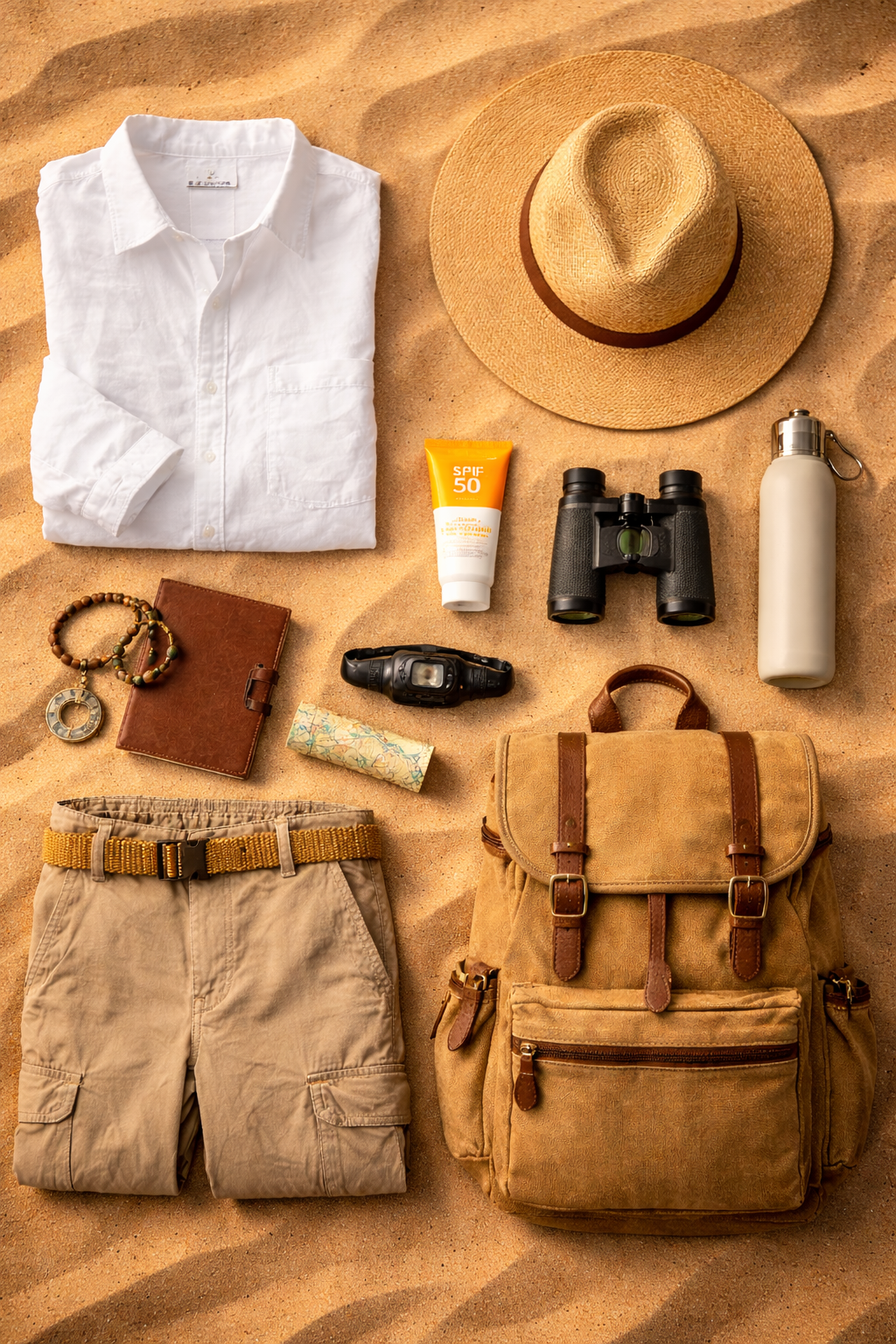
• Red-light torch: Essential for navigating the rooftop or camp without destroying dark adaptation. Standard headtorches have a red mode — use it exclusively after dark.
• Warm layers (October–March): Desert temperatures drop dramatically after sunset. The rooftop can be 12°C colder than the midday high. A sleeping bag or thick blanket for lying on the terrace is practical.
• Reclining option: A sunlounger, yoga mat, or blanket on the ground — looking straight up for extended periods with no neck support becomes painful quickly.
• Water: Desert air at night is dry. You will dehydrate while lying still watching stars. Keep water nearby.
Useful but Not Essential
• 7×50 or 10×50 binoculars: Transform the experience. The Andromeda Galaxy becomes unmistakable. Jupiter's moons are visible. Star clusters resolve into individual stars. The Milky Way reveals structure invisible to the naked eye.
• Planisphere or sky app: Stellarium (free) shows exactly what is in the sky above your location in real time. Sky Map, SkySafari, and Star Walk are all good alternatives. Download offline data before going to the desert where there is no signal.
• Star chart for Zagora (29°N): A printed star chart for latitude 29°N shows exactly which constellations are visible and at what elevation. Available free online.
Not Needed
A telescope is not necessary for an extraordinary experience at Zagora. The naked eye and binoculars deliver everything the sky has to offer for a casual visitor. A telescope adds complexity, weight, and setup time that detracts from the simplicity of the experience. If you are a serious amateur astronomer who owns one, bring it — but do not buy one for this trip.
9. Photography: Capturing the Zagora Night Sky
Night sky photography at Zagora is accessible to anyone with a camera that allows manual settings and a tripod. The fundamental technique is simple — wide aperture, high ISO, 20–30 second exposure — but the results from a Class 3 dark sky are dramatically better than anything achievable in Europe or urban North America.
• Camera settings: ISO 3200–6400, f/2.8 or wider if available, 20–25 second exposure (longer causes star trails). Start with these and adjust based on your preview.
• Lens: A wide-angle lens (14–24mm full-frame equivalent) captures the most sky. A standard 24–35mm works well. Long telephoto lenses are not useful for Milky Way photography.
• Tripod: Absolutely essential. Any vibration during a 20-second exposure ruins the image. Use the 2-second self-timer to avoid camera shake from pressing the shutter.
• Foreground: The most interesting Milky Way images have a subject in the foreground — the La Petite Kasbah rooftop with its lanterns, a camel silhouette, a dune ridge, an earthen kasbah wall. A pure sky shot with no foreground is less interesting than a composed image.
• Focus: Set focus to infinity manually. In the dark, autofocus will hunt and fail. Use the manual focus ring and check on the brightest star visible — zoom in on your LCD to verify stars are points rather than blobs.
• Post-processing: Dark sky images benefit from light noise reduction and careful shadow lifting in Lightroom or similar software. The colour of the Milky Way — the warm yellows of the galactic core against the cooler blues of the outer disc — is real and should be preserved.
10. Planning Your Stargazing Visit
• Book around new moon: Check the lunar calendar and aim for the 5 days before and after new moon for maximum darkness. The exact new moon date changes monthly.
• Best overall months: October, November, December, and March offer the best combination of long nights, transparent air, and the galactic core visible in the southern sky. January and February are also excellent but cold at camp.
• Check weather forecasts: Clear skies are not guaranteed even in the desert. The Zagora region has some cloud events in winter. Check a 5-day forecast before travelling specifically for stargazing.
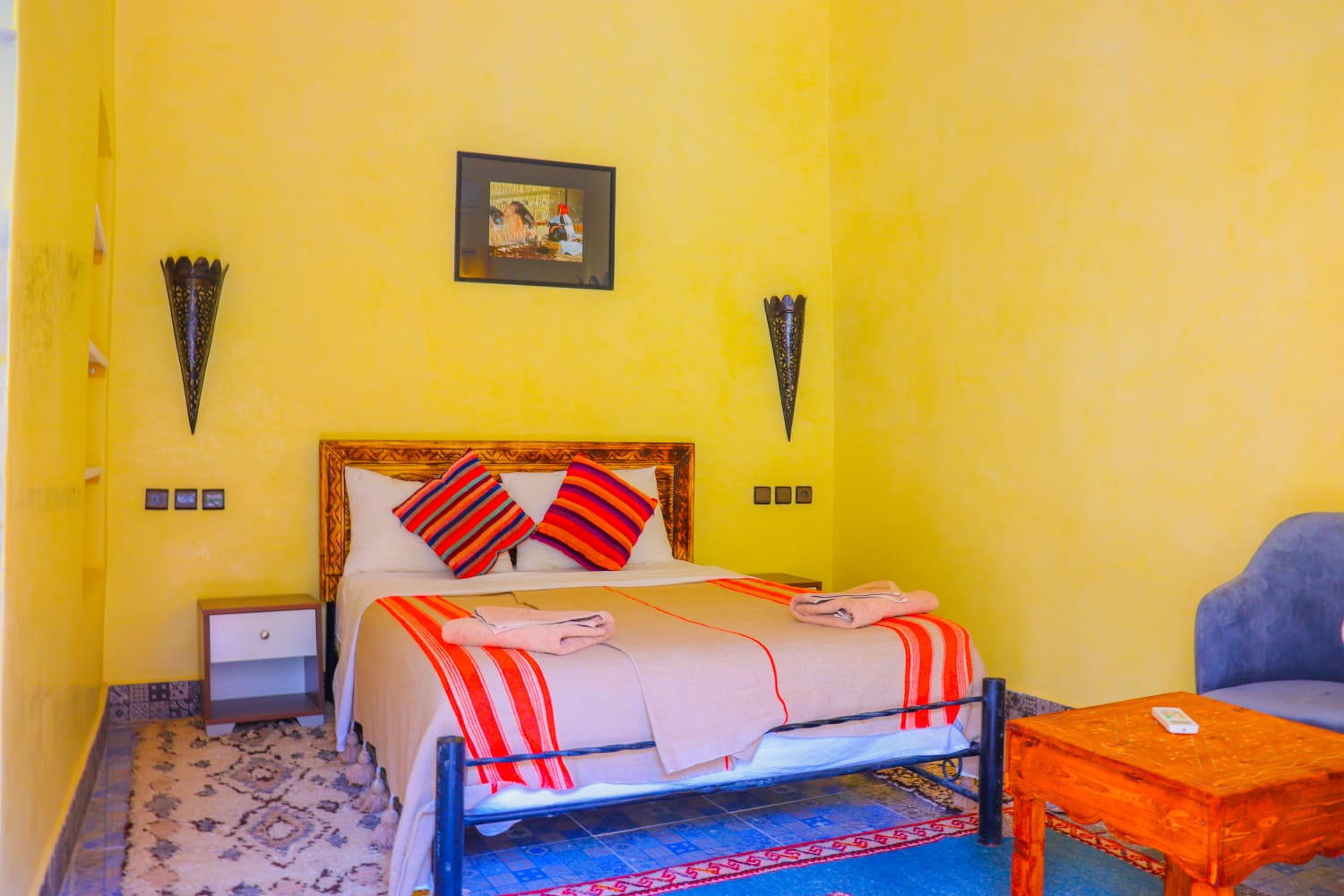
• La Petite Kasbah rooftop: Available every night — no advance planning required. Mention your interest in stargazing to Brahim and Rhizlane at check-in and they will ensure the rooftop is set up and the lanterns positioned appropriately.
• Erg Chigaga overnight: Book at least 48 hours in advance through La Petite Kasbah. Mention that stargazing is a priority so the guide positions the camp appropriately and any ambient light is managed.
• Sandstorm check: The chergui wind in summer can carry fine dust that reduces visibility significantly. Check local conditions. Light haboob events clear within hours; significant dust events can last days.
|
✔ |
Zagora sits at approximately Bortle Class 3 — one of the darkest skies accessible by paved road in Morocco |
|
✔ |
The Milky Way is visible to the naked eye on any clear moonless night — no equipment needed |
|
✔ |
Two locations: La Petite Kasbah rooftop (comfortable, every night) and Erg Chigaga (Class 2, requires overnight) |
|
✔ |
Best months: October–March for long nights and clean air; August for Perseid meteor shower |
|
✔ |
Plan around new moon for maximum darkness — the 5 days either side give the best conditions |
|
✔ |
Binoculars transform the experience — Jupiter's moons, the Andromeda Galaxy, star cluster resolution |
|
✔ |
Book through La Petite Kasbah — hotelzagora.com — and mention stargazing as a priority at check-in |
|
Experience the Zagora Night Sky from La Petite Kasbah Rated 9.3/10. Panoramic rooftop terrace with unobstructed sky views every night. Overnight Erg Chigaga desert camp also arranged — Morocco's darkest skies, no telescope required. → www.hotelzagora.com ← |