Twice a week, Zagora transforms. The Wednesday and Sunday souk draws people from across the Draa Valley — nomadic Berber families from the surrounding desert, farmers from the oasis villages, traders who follow the weekly market circuit through southern Morocco, and the occasional traveller sharp enough to time their visit right.
This is not a tourist market selling mass-produced ceramics to coach parties. The Zagora souk is a working market for a working region — the kind of place where you can stand at a spice stall and be the only non-Moroccan person in sight, where the transaction happening at the next table is a real one, and where the connection to the ancient trans-Saharan trade routes that gave this town its significance is still palpable.
This guide tells you when to go, what to look for, what to buy (and what to avoid), how to navigate the market, and how to make the most of the experience from La Petite Kasbah Zagora.
|
✦ KEY TAKEAWAYS |
|
› The Zagora souk takes place every Wednesday and Sunday — arrive before 9am for the fullest experience before the heat peaks. |
|
› The market is primarily a local Berber and Draa Valley trading event — not a tourist market, which makes it genuinely interesting. |
|
› Best buys: local dates, argan oil, desert spices, hand-woven Berber rugs, traditional silver jewellery, and tagine pottery. |
|
› La Petite Kasbah is located 2km from the souk — a short taxi or bicycle ride, or a 20-minute walk through the palm grove. |
|
› Wednesday market is typically larger and busier than Sunday; both are worth visiting if your stay overlaps with both days. |
|
TABLE OF CONTENTS |
|
1. The Zagora Souk: History and Significance |
|
2. When Is the Souk? Days, Times, and Timing Your Visit |
|
3. How to Get There from La Petite Kasbah |
|
4. The Market Layout: What's Where |
|
5. What to Buy: The Best of the Zagora Souk |
|
6. What to Avoid: Honest Advice on Tourist Traps |
|
7. Bargaining: How It Works and What's Fair |
|
8. Food and Drink at the Souk |
|
9. Photography at the Souk: Etiquette and Best Shots |
|
10. Combining the Souk with Other Zagora Experiences |
1. The Zagora Souk: History and Significance
Zagora has been a market town for centuries. Its position at the convergence of the Draa River and the pre-Saharan desert made it a natural staging point for the Trans-Saharan caravans that carried gold, salt, ivory, and enslaved people between sub-Saharan Africa and the Mediterranean world. The famous sign on the road south of Zagora — 'Timbuktu: 52 days' — marks not just a distance but a commercial connection that shaped the entire region's economy for a thousand years.
The weekly souk is the modern expression of that trading tradition. Today's goods are different — dates, spices, livestock, woven textiles, and household supplies rather than gold dust and rock salt — but the social function is the same: the souk is where the dispersed communities of the Draa Valley and surrounding desert converge, exchange, and transact. It is also where you see the region as it actually is, rather than as it presents itself to tourists.
2. When Is the Souk? Days, Times, and Timing Your Visit
The Zagora souk operates on Wednesday and Sunday. Both markets begin early — the first vendors arrive before sunrise, and the best selection and busiest atmosphere is between 7am and 10am. By midday, the heat has thinned the crowds significantly and many stalls begin packing up.
|
✦ Souk Zagora — Essential Practical Information |
|
✦ Market days: Wednesday and Sunday (weekly) |
|
✦ Best arrival time: 7:00–8:30am — market at its most vibrant and fully stocked |
|
✦ Peak activity: 8am–11am before heat disperses traders and shoppers |
|
✦ Location: Central Zagora, near the main avenue — 10-minute taxi from Amezrou |
|
✦ Wednesday market: generally larger, with more livestock, produce, and craft vendors |
|
✦ Sunday market: slightly smaller but often has more Berber textile and silver traders |
|
✦ Dress: Conservative — covered shoulders and knees is respectful and expected |
|
✦ Cash: Dirhams only — no card machines at market stalls |
|
✦ Language: Darija (Moroccan Arabic) and Tamazight Berber — some vendors speak French |
|
✦ Photography: Ask before photographing individuals — most vendors are fine with stall shots |
If your stay at La Petite Kasbah overlaps with both a Wednesday and a Sunday, visiting both is worthwhile — the vendor mix changes slightly and you will find different goods on each day. If you can only visit once, Wednesday is the larger market.
3. How to Get There from La Petite Kasbah
La Petite Kasbah is located in Amezrou, 2km south of Zagora town centre along the Route de M'Hamid. Getting to the souk from the riad takes 10–15 minutes and can be done several ways:
• Grand taxi: The easiest option — shared taxis run from Amezrou to the town centre for a few dirhams. Ask at the riad for the nearest pickup point. Return taxis are equally available.
• Bicycle: La Petite Kasbah can arrange bicycle hire. The ride from the riad to the souk follows a relatively flat route through the edge of the palm grove and takes about 15 minutes. This is the recommended option — you can stop along the way and explore the town before and after.
• Walking: A 20–25 minute walk through Amezrou village and along the main road. Very manageable in the early morning when the temperature is cool. Less advisable on the return journey if you have bought anything heavy.
• Private transfer: If you have luggage or mobility considerations, ask Brahim at La Petite Kasbah to arrange a private transfer. This is also useful for larger purchases — Berber rugs are beautiful but not easy to carry on a bicycle.
"If you are still deciding where to stay in Zagora Morocco, La Petite Kasbah's location in Amezrou makes it the closest quality riad to the souk."
4. The Market Layout: What's Where
The Zagora souk is not a single covered space but a series of adjacent outdoor market zones that expand and contract depending on the day and season. The layout is broadly consistent from week to week:
Produce and Food Section
The freshest and most active part of the market. Local farmers bring dates (Zagora is one of Morocco's most important date-producing regions), olives, olive oil, seasonal vegetables, dried legumes, and preserved lemons. This is where the best quality dates are found — look for locally grown Medjool or Boufeggous varieties rather than packaged alternatives.
Spice and Dry Goods Section
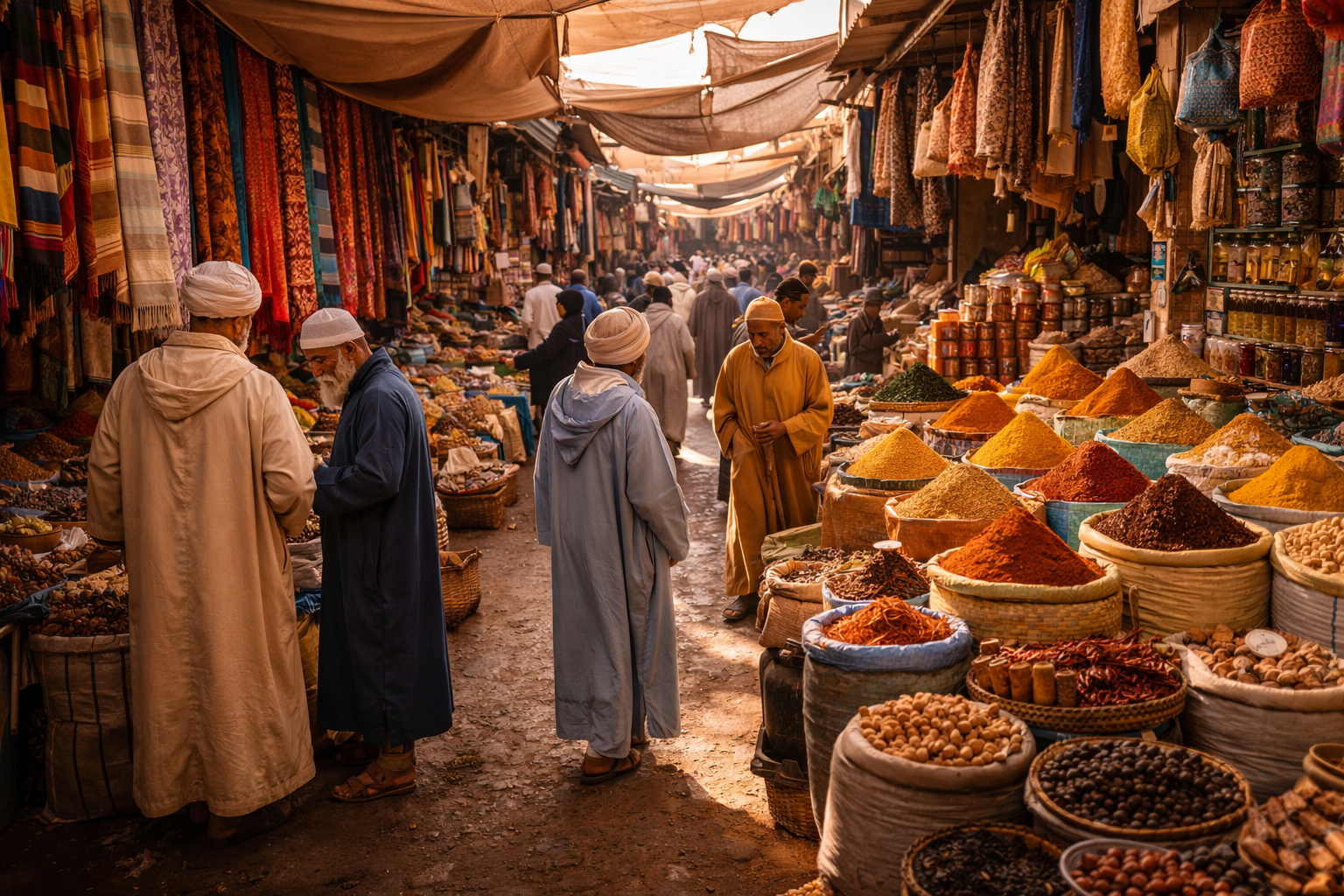
The visually spectacular part of the souk. Vendors sell ground spices in vivid pyramids — ras el hanout, cumin, turmeric, paprika, saffron threads, dried rose petals, and a dozen regional blends specific to southern Moroccan cooking. This is also where you find argan oil, honey, amlou (almond-argan paste), and kohl eye liner.
Livestock Section
A weekly livestock market operates adjacent to the main souk — goats, sheep, donkeys, and occasionally camels. This is a genuine trading environment, not a tourist display. The sounds, smells, and energy are unlike anything in the rest of the market. Worth visiting briefly even if you have no intention of purchasing.
Craft and Textile Section
Hand-woven Berber rugs and kilims, djellabas, babouche slippers, traditional silver jewellery (including Tuareg and Berber pieces), tagine pots, leather goods, and woven baskets. This section requires more time and more active engagement — the best pieces are not displayed prominently.
Household and Tools Section
The least picturesque but most authentically local section — hardware, tools, electrical goods, and plastic household items. Of limited interest to visitors but worth passing through to understand the full scope of what a working Moroccan market serves.
5. What to Buy: The Best of the Zagora Souk
|
Item |
Origin / Type |
Why It's Worth Buying |
|
Dates |
Local Draa Valley — Medjool, Boufeggous |
Among the finest in Morocco; fresher than any packaged alternative |
|
Argan Oil |
Draa Valley region pressing |
Cold-pressed local oil — better quality than supermarket versions |
|
Ras el Hanout |
Hand-blended by vendor |
Regional blend — different from Marrakech versions, worth comparing |
|
Saffron |
Sourced from Taliouine area |
Genuine Moroccan saffron — verify by colour and smell |
|
Amlou |
Local preparation of almonds + argan |
The almond-argan butter served at La Petite Kasbah breakfast |
|
Berber Silver |
Draa Valley / Tuareg tradition |
Hand-crafted; hallmarks indicate silver content; ask about provenance |
|
Kilim / Rug |
Hand-woven, Berber design |
Best value in the south — take time to examine weave quality |
|
Tagine Pot |
Local Draa Valley pottery |
Unglazed clay from this region cooks differently — functional and authentic |
|
Rose Water |
Kelaat M'Gouna, Atlas region |
Distilled from rose petals — used in Moroccan cooking and skincare |
|
Dried Rose Petals |
Atlas Mountains |
Sold by weight for cooking, tea, and decoration |
6. What to Avoid: Honest Advice on Tourist Traps
Not everything at the Zagora souk is what it appears to be. Some guidance that will save you money and disappointment:
• Mass-produced 'antiques': Ornate silver daggers, 'fossilised' amber beads, and 'ancient' coins are produced industrially and sold as antiques throughout southern Morocco. If a vendor claims something is genuinely old, treat it as modern unless you can verify otherwise.
• Synthetic argan oil: Real cold-pressed argan oil is expensive and slow to produce. If the price seems very low, it has almost certainly been diluted or substituted. Buy argan oil from vendors who press on-site or who can show you the production.
• Packaged spice 'gift sets': Pre-packaged tourist spice sets are overpriced and often contain lesser-quality spices. Buy spices loose from a vendor who will weigh them in front of you.
• Carpet pressure tactics: If a vendor insists on inviting you for tea and becomes visibly disappointed when you do not buy, that is a sales environment not a hospitality one. A genuine vendor will let you look, discuss price calmly, and accept a polite refusal without drama.
• Fossils at inflated prices: The Draa Valley has genuine fossil deposits, but the fossils sold at markets are almost universally cast replicas. If you want real fossils, visit a reputable geological shop in Erfoud or Rissani.
7. Bargaining: How It Works and What's Fair
Bargaining is expected at the Zagora souk for everything except food staples (dates, vegetables, spices sold by weight). The general principles:
• Start at 50–60% of the asking price and expect to settle somewhere between 65–75% of the first offer.
• Never make an opening offer you are not prepared to pay — once you name a price, walking away from it is awkward.
• Smile, stay relaxed, and treat the process as a conversation rather than a confrontation. Moroccan bargaining is social, not adversarial.
• If you cannot reach an agreement, walk away calmly — you will often be called back with an improved offer.
• For larger items like rugs, take time. Sit down. Ask about the weaving. Understand what you are looking at. The vendor who explains the weave and the pattern is usually the one selling the real thing.
• Fair price reference: Ask Brahim or Rhizlane at La Petite Kasbah what a reasonable price is for items you plan to buy. They know the market well and will tell you honestly — this is one of the most useful things about booking through a trusted local riad.
8. Food and Drink at the Souk
The souk is an excellent place to eat breakfast or a mid-morning snack alongside the local population. The food is cheap, fresh, and genuine:
• Harira: The Moroccan tomato-lentil-chickpea soup served hot from large pots at market food stalls. One of the great portable meals in Moroccan cuisine — filling, warm, and sold for a few dirhams a bowl.
• Msemen and meloui: Fresh flaky flatbreads cooked on griddles at market stalls. Eaten plain or with honey, argan oil, or amlou. The best version is made in front of you.
• Fresh orange juice: Pressed to order at juice stands. Morocco produces exceptional oranges and a glass of fresh-squeezed juice at a souk stand is one of the reliable pleasures of any Moroccan market visit.
• Mint tea: Available throughout the market. Accepting tea from a vendor is not an obligation to buy — it is a social ritual. Refusing is equally polite if you are not interested in the product.
• Grilled merguez: Spiced lamb sausages grilled over charcoal — a market staple that needs no further description. Follow the smell.
9. Photography at the Souk: Etiquette and Best Shots
The Zagora souk offers extraordinary photographic opportunities — colour, texture, light, and human activity at close range. Some guidance on doing it respectfully:
• Always ask before photographing people. In Arabic/Darija: 'Mumkin tsawwarni?' (May I photograph you?) — most vendors will agree once asked directly and some will appreciate the interaction.
• Do not photograph women without explicit permission. This is a strong social norm across Morocco and should be respected without exception.
• The spice section is the most photographically rewarding and the least contentious — vendors are generally happy for stall shots that showcase their goods.
• The livestock section photographs best from a distance. Moving in close with a camera in a working livestock market is intrusive and sometimes dangerous.
• Best light: 7:30–9:00am — the low angle of the morning sun creates extraordinary texture and shadow across the spice displays and fabric stalls. By 10am the light is overhead and harsh.
• Best single shot: A close-up of the spice display — pyramids of cumin, saffron, and paprika with a vendor's hands visible. Technically simple; visually very strong.
10. Combining the Souk with Other Zagora Experiences
The souk works best as part of a fuller day in Zagora rather than as a standalone visit. Some natural combinations:
• Souk + Tamegroute: Visit the souk early (7–10am), then drive 20km south to Tamegroute for the Koranic library and the famous green pottery workshop. A full and varied morning.
• Souk + Amezrou Mellah: After the souk, walk or cycle to the old Jewish quarter of Amezrou — one of the best-preserved historic Jewish districts in southern Morocco. An afternoon of contrasting cultural layers.
• Souk + Camel Trek: Morning souk, return to La Petite Kasbah for lunch and pool, sunset camel trek through the palm grove. The perfect Wednesday or Sunday structure.
• Souk + Jebel Zagora: The flat-topped mountain above the town offers panoramic views over the Draa Valley. A 45-minute hike from the town centre makes a good follow-up to a morning market.
Ask at La Petite Kasbah: Brahim knows the market days and can help you plan your days to ensure you do not miss the souk. They can also recommend specific vendors for argan oil and dates that they know personally — this is the kind of local knowledge that makes a genuine difference to a market visit.
|
✔ |
Souk days: Wednesday (larger) and Sunday — arrive before 9am for the best experience |
|
✔ |
10–15 minutes from La Petite Kasbah by bicycle, grand taxi, or on foot through the palm grove |
|
✔ |
Best buys: local dates, argan oil, loose spices, hand-woven Berber kilims, traditional silver jewellery |
|
✔ |
A genuine local trading market — not a tourist souk — with connections to the Trans-Saharan trade tradition |
|
✔ |
Bargaining expected for non-food goods; start at 50–60% of asking price |
|
✔ |
Ask at La Petite Kasbah for vendor recommendations and fair price guidance before you go |
|
✔ |
Pairs naturally with Tamegroute visit, Amezrou Mellah walk, or evening camel trek from the riad |
|
Stay at La Petite Kasbah — Two Minutes from the Palm Grove, 15 from the Souk Rated 9.3/10. The ideal base for exploring Zagora's souk, kasbahs, palm grove, and desert. Authentic Moroccan breakfast every morning. → www.hotelzagora.com ← |