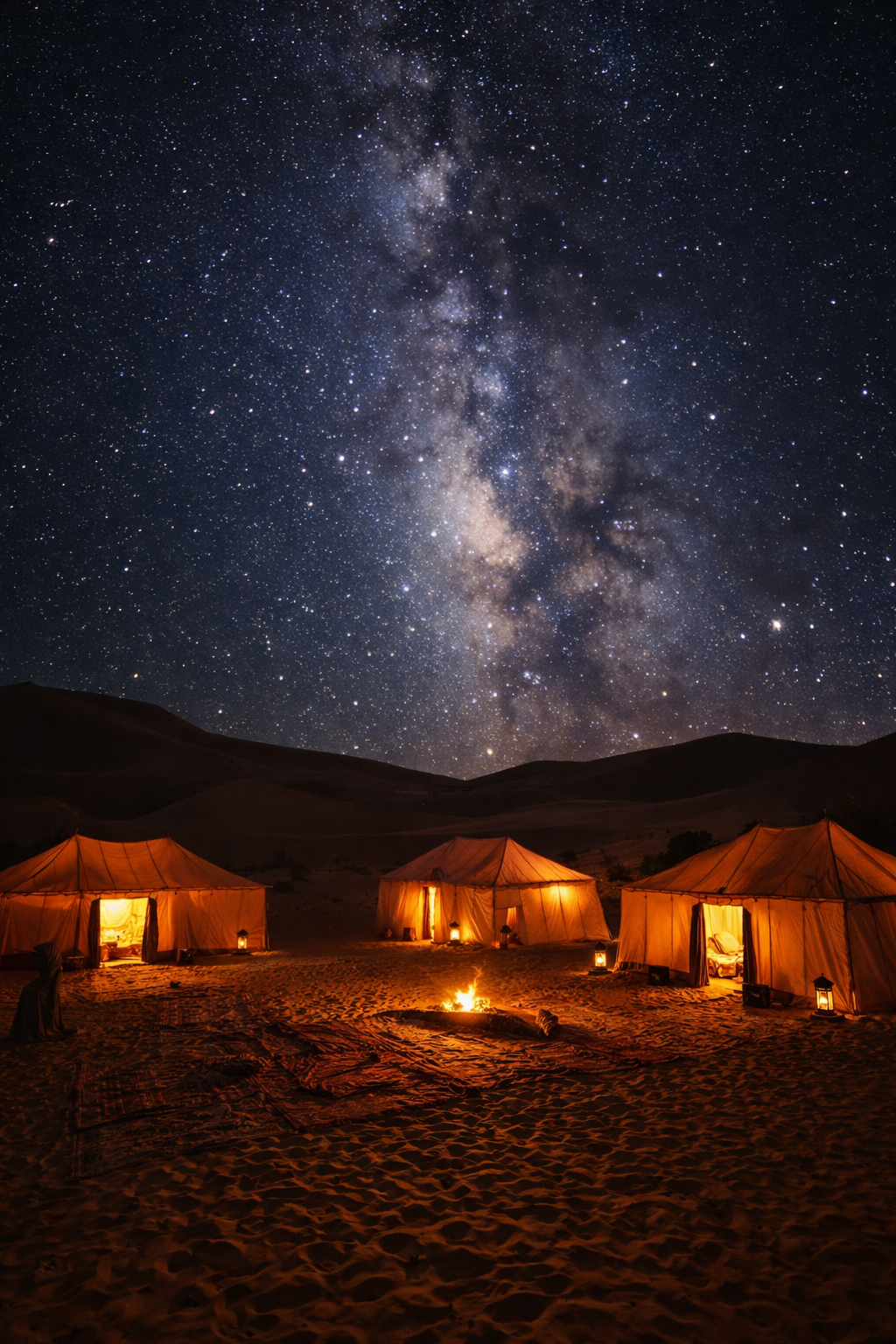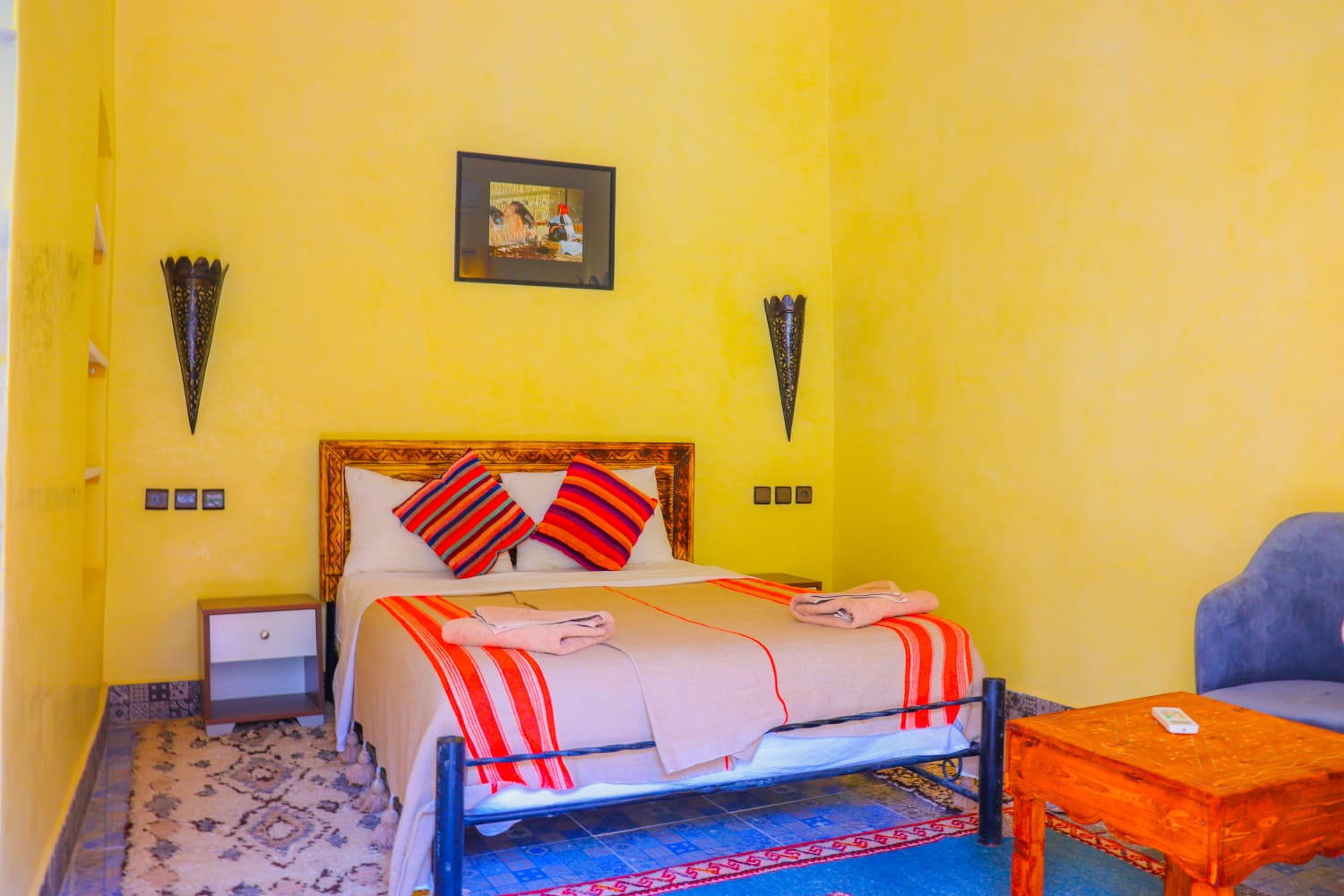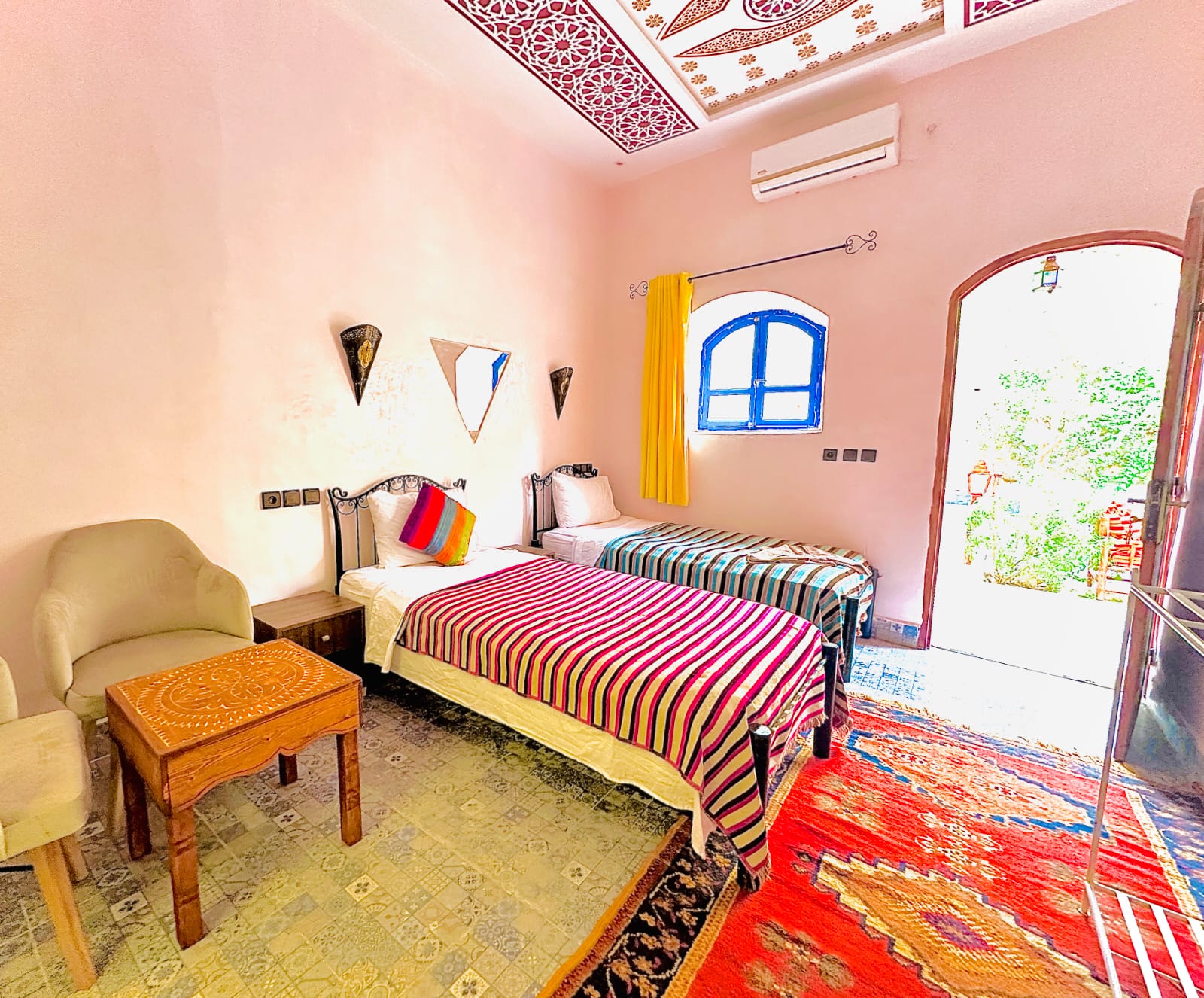
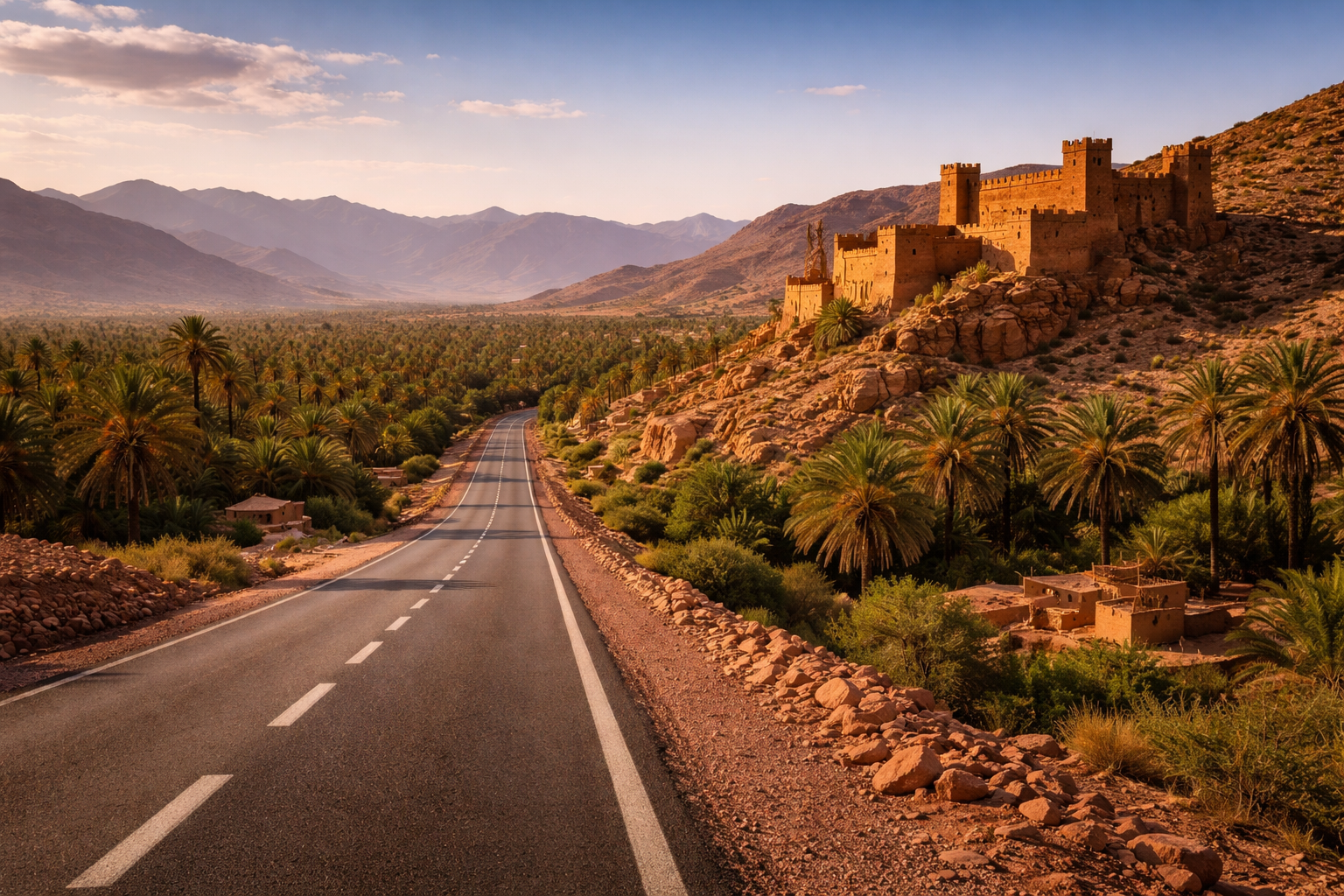
The Draa Valley road trip runs 200km south from Ouarzazate to Zagora on the N9, passing through Morocco's longest palm grove, ancient pisé kasbahs, and Berber villages along the Draa River. The drive takes 2.5–3 hours non-stop but rewards those who allow a full day — stopping at Agdz, Tamnougalt Kasbah, Timiderte, and the Tinfou dunes.
The Draa Valley road trip is one of the great drives in Morocco — and one of the least appreciated. Most travellers treat the N9 between Ouarzazate and Zagora as transit: something to get through on the way to the desert. What they miss is a 165-kilometre sequence of ancient kasbahs, oasis villages, date palm groves, and pre-Saharan landscapes that constitutes one of the richest historical corridors in North Africa.
This guide is for drivers who want to do it properly: to stop where stopping matters, to understand what they are looking at when they see a kasbah on a hill, and to arrive in Zagora having experienced the valley rather than simply passed through it. La Petite Kasbah in Zagora's Amezrou palm grove is the natural overnight base — from which the full southern extension of the valley toward Tamegroute and M'Hamid can be explored the following day.
|
✦ KEY TAKEAWAYS |
|
› The Draa Valley runs approximately 200km from Agdz to M'Hamid — the full road trip from Ouarzazate is 230km one way. |
|
› The valley contains one of the highest concentrations of ancient kasbahs in Morocco — most date to the 16th–19th centuries. |
|
› The best driving is between Agdz and Zagora — allow 3–4 hours for this 100km stretch if you stop at the key points. |
|
› La Petite Kasbah Zagora (hotelzagora.com) is the ideal overnight stop — pool, rooftop, authentic dinner, and desert excursions arranged. |
|
› Combine with the Marrakech–Zagora 2-day itinerary or extend to a 3-day circuit including Tamegroute and M'Hamid. |
|
TABLE OF CONTENTS |
|
1. The Draa Valley: History and Geography |
|
2. Practical Route Information |
|
3. Best Stops on the Draa Valley Road Trip |
|
4. Ouarzazate: The Gateway to the South |
|
5. The Road South: Ouarzazate to Agdz |
|
6. Agdz: The First Draa Valley Town |
|
7. Agdz to Zagora: The Best 100km in Morocco |
|
8. The Kasbahs of the Draa Valley |
|
9. Zagora: Overnight Stop and Desert Base |
|
10. South of Zagora: Tamegroute and M'Hamid |
|
11. Photography and Timing on the Draa Valley Route |
1. The Draa Valley: History and Geography
The Draa is Morocco's longest river — stretching nearly 1,200 kilometres from its source in the High Atlas to where it disappears into the Sahara sands near the Algerian border. For most of that length it is dry, but the middle section — the 200km between Agdz and M'Hamid — runs above ground, fed by snowmelt from the Atlas Mountains, and has created one of the most fertile oasis corridors in North Africa.
For a thousand years, this corridor was the northern terminus of the Trans-Saharan trade routes. Caravans carrying gold, salt, slaves, ivory, and spices from sub-Saharan Africa would travel north through the desert, reach M'Hamid, then follow the Draa river north toward Ouarzazate and the Atlas passes beyond. The kasbahs that line the valley today were built by the wealthy merchant families and local rulers who controlled and taxed this trade — which is why they are so numerous and so architecturally ambitious for what is now a relatively quiet rural region.
Why it matters now: driving the Draa Valley today is driving through a thousand years of commercial history written in earth and stone. The kasbahs are not ruins — many are still inhabited. The palm groves are still productive. The weekly markets still draw communities from across the valley. This is not a heritage theme park; it is a living landscape.
2. Practical Route Information
• Total distance (Ouarzazate → M'Hamid): 230km one way on paved road
• Minimum driving time (non-stop): 3 hours
• Recommended driving time (with stops): 6–8 hours for the full route
• Road condition: Excellent paved road throughout — standard car sufficient
• Petrol: Fill up in Ouarzazate. Next reliable petrol in Agdz (80km). Then Zagora (100km further). No petrol south of Zagora until M'Hamid.
• Best direction: Ouarzazate → M'Hamid (north to south) gives you the afternoon light on the kasbahs
• Best season: October–April for comfortable temperatures; summer possible but midday heat is intense
• Overnight: La Petite Kasbah in Zagora — 2km from the N9 in the Amezrou palm grove
3. Best Stops on the Draa Valley Road Trip
- Agdz — the official entry point to the Draa Valley, 75km south of Ouarzazate. Old kasbah, local souk, and the first date palms of the valley appear here.
- Tamnougalt Kasbah — one of the finest medieval kasbahs in the Draa Valley, 10km south of Agdz. Partially inhabited, exceptional tower decoration.
- Timiderte — a cluster of kasbahs on the east bank of the Draa, best photographed from the N9 in late afternoon raking light.
- Draa palm grove — the 100km corridor between Agdz and Zagora is Morocco's longest palm grove. The road runs alongside the Draa River through an almost unbroken canopy of date palms.
- Tinfou Dunes — small Saharan dune field 25km south of Zagora. Worth a late afternoon stop for the dune light before arriving at your accommodation.
- Zagora — the end point and desert gateway, base for Erg Chigaga excursions, camel trekking, and overnight desert camps.
4. Ouarzazate: The Gateway to the South
Ouarzazate sits at the crossroads of southern Morocco — at the junction of the road south into the Draa Valley, the road east toward the Dades Gorges and Merzouga, and the road north back over the Tichka Pass toward Marrakech. It is a proper town (population approximately 60,000) with a range of restaurants, petrol stations, and the last reliable ATM before Zagora.
The Taourirt Kasbah at the east end of Ouarzazate is worth a brief visit — a UNESCO-listed complex that gives a concentrated preview of what you will see spread across 165km of Draa Valley. If you are driving from Marrakech, you will pass through Ouarzazate mid-morning. Fill the tank, have lunch if needed, and then join the N9 heading south.
Film note: Ouarzazate is known as the 'Hollywood of Africa' — Lawrence of Arabia, Gladiator, Game of Thrones, and dozens of other productions have filmed here. The Atlas Studios are the largest film studios in Africa. If this interests your group, a 45-minute studio tour is worth the stop — but keep it brief to preserve time for the valley itself.
5. The Road South: Ouarzazate to Agdz
The 80km between Ouarzazate and Agdz are the most sparsely populated section of the road trip. The landscape is predominantly rocky plateau — the Jbel Sarhro range visible to the east, the first hints of the Draa Valley beginning to appear as the road descends. This stretch is worth doing at a reasonable pace: the scenery is dramatic but there are fewer stops than the sections that follow.
Approximately 40km south of Ouarzazate, the road crosses the Draa River for the first time — a moment that signals the valley is beginning. The river may be a trickle or completely dry depending on the season and recent Atlas rainfall. Either way, the vegetation along the riverbank changes: more green, more palm, the first date groves visible. The palm grove builds gradually over the next 40km until it reaches full density around Agdz.
6. Agdz: The First Draa Valley Town
Agdz (pronounced 'Agdez') is a small market town sitting at a bend in the Draa River where the valley opens up and the palm grove reaches its first significant width. It is the first proper stop on the road trip and worth 30–45 minutes of your time.
• The kasbah: The Tamnougalt Kasbah, 6km south of Agdz centre, is one of the most impressive in the valley — a medieval fortified village still partially inhabited. Turn off the N9 onto the track east of the road and follow it to the entrance.
• The souk: Agdz has a Thursday market (smaller than Zagora's Wednesday/Sunday souk but with good local produce).
• Tea stop: The handful of cafés on the main street overlooking the valley are a good place to sit with a mint tea and watch the palm grove below.
• Fossil and carpet shops: Agdz has several roadside shops selling fossils and woven goods from the region. Prices are better here than at tourist shops in Ouarzazate — but apply the same bargaining principles.
Time allocation: 30–45 minutes in Agdz if you visit Tamnougalt Kasbah; 15 minutes if you just stop for tea and a stretch. Do not spend more than an hour here — the best sections of the drive are still ahead.
7. Agdz to Zagora: The Best 100km in Morocco
The 100km between Agdz and Zagora is the heart of the road trip. The valley narrows and widens in sequence, each bend revealing a new arrangement of kasbahs, palm groves, and riverbed. There are no major towns on this stretch — just a series of oasis villages, ancient ksour (fortified settlements), and date palm estates that line both sides of the road continuously for the full distance.
The key is to slow down. The N9 is a good road and it is easy to cover this section at 90km/h in under 70 minutes. That would be a mistake. Drive at 60km/h. Stop when you see a kasbah that catches your eye. Pull over at any point where the palm grove opens toward the river and the light is good. There is no single unmissable stop on this stretch because the entire stretch is the stop.
|
🚗 AGDZ TO ZAGORA — KEY STOPS ON THE N9 |
|
Km 0 Agdz — Tea stop, Tamnougalt Kasbah 6km south (worth the detour) |
|
Km 20 Timiderte — Small ksar visible from road — classic Draa Valley architecture, good photo stop |
|
Km 35 Tinzouline — Large oasis village, date groves at maximum density, river sometimes visible |
|
Km 55 Ait Arbi — Another well-preserved ksar on the hillside — stop if the light is right |
|
Km 75 Tansikht — Viewpoint over the valley — the road rises briefly here giving a panoramic view |
|
Km 100 Amezrou / Zagora — The palm grove of Amezrou appears — La Petite Kasbah is 2km off the N9 |
Tip: the drive from Agdz to Zagora is best done in the late afternoon when the sun is low and the kasbah walls are lit in gold and amber. If driving from Marrakech in a day, time your Agdz departure for around 3pm to hit this section at 4–6pm.
The kasbahs of the Draa Valley are the defining visual feature of the road trip — and understanding what you are looking at significantly deepens the experience. A kasbah (from the Arabic qasba) in this context refers to a fortified residential complex: a family compound built in pisé (rammed earth) with defensive towers at the corners and a single heavily reinforced gate. They were built to protect families, grain stores, and valuables from rival clans, Saharan raiders, and the occasional armed conflict over water and caravan access.
|
🏰 Key Kasbahs of the Draa Valley |
|
Taourirt (Ouarzazate) (0km) — UNESCO-listed — the most restored and visited; good introduction before the drive south |
|
Tamnougalt (6km south of Agdz) — Medieval ksar, still inhabited in parts — one of the finest in the valley |
|
Timiderte (20km south of Agdz) — Visible from the N9 — classic towers, minimal tourism, photogenic setting |
|
Ait Hammou (45km south of Agdz) — Less visited, partially ruined — raw and atmospheric in late afternoon light |
|
Amezrou / Zagora (100km south of Agdz) — The historic kasbah village surrounding La Petite Kasbah — walk its lanes |
|
Tamegroute (145km south of Agdz) — Home to the 13th-century manuscript library — see Article 16 |
The pisé construction technique used in all Draa Valley kasbahs has been practiced essentially unchanged for centuries: earth mixed with straw and water, packed into wooden moulds, dried in the sun, then stacked. The walls are typically 40–60cm thick. They are extraordinarily effective at maintaining interior temperature — cool in summer, warm in winter. The decorative geometric patterns around windows and doorways are pressed into the wet earth before it dries, each family or village having its own distinctive pattern.
The kasbahs are at their most photogenic in late afternoon when the low sun angle creates strong shadows across the geometric surface decorations. Midday light is flat and uninteresting for photography of earthen architecture.
9. Zagora: Overnight Stop and Desert Base
Zagora is the natural overnight stop for the Draa Valley road trip — the largest town on the route after Ouarzazate and the last urban settlement before the desert. It sits at the point where the valley begins its transition from fertile oasis to pre-Saharan landscape, which makes it both a cultural and a physical threshold.
La Petite Kasbah in Amezrou — 2km south of Zagora town centre on the Route de M'Hamid — is the ideal base. The riad sits within the historic palm grove, within walking distance of the old Jewish quarter (Mellah) of Amezrou, and arranges camel treks directly from its garden. The Wednesday and Sunday souk in Zagora town is 15 minutes away by bicycle or taxi.
What Zagora adds to the road trip: staying overnight in Zagora rather than driving through transforms the road trip into a complete cultural experience. The sunset camel trek through the palm grove, the dinner at the riad, the stars over the desert, and the morning souk are things you cannot experience from a moving car. Allow at least one night — two if your schedule permits.
10. South of Zagora: Tamegroute and M'Hamid
Tamegroute (45km south of Zagora)
The first stop south of Zagora — home to the 13th-century Koranic manuscript library of the Zawiya Naciria and the famous green pottery workshop. An essential cultural stop that adds historical depth to the road trip. Allow 2–3 hours if combining library and pottery. See our dedicated Tamegroute guide for full details.
Tagounite (80km south of Zagora)
A small administrative town with the last petrol station before M'Hamid. Worth a brief stop to refuel and look at the landscape — by this point the palm grove has thinned significantly and the pre-desert character is dominant. The road between Tagounite and M'Hamid is the most austere stretch of the route.
M'Hamid El Ghizlane (120km south of Zagora)
The last town before the open Sahara — the ancient terminus of the Trans-Saharan caravan routes from Timbuktu. The old ksar at M'Hamid retains a compelling atmosphere of frontier remoteness. Beyond M'Hamid, the tarmac ends and the desert piste begins — leading eventually to Erg Chigaga. Most road trippers turn around here unless they have arranged the 4x4 Erg Chigaga expedition in advance through La Petite Kasbah.
11. Photography and Timing on the Draa Valley Route
The Draa Valley road trip is one of the most photogenic drives in Morocco. A few timing and technique notes:
• Morning light (7–10am): Best for the northern section (Ouarzazate–Agdz) — the light comes from the east and catches the kasbah towers on the hillsides to the right of the road heading south.
• Afternoon light (3–6pm): Best for the Agdz–Zagora section — the low western sun illuminates the western-facing kasbah walls and turns the palm groves golden. This is when the road is at its most spectacular.
• Golden hour from the road: The N9 runs roughly north–south, which means the best views of golden hour lit kasbahs are when stopping and looking east or west across the valley, not from a moving car.
• Elevated viewpoints: The road rises briefly at several points between Agdz and Zagora — these elevated sections offer the best valley-wide landscape shots. The Tansikht viewpoint (approximately km 75 south of Agdz) is particularly good.
• Kasbahs at dusk: If you arrive in Zagora in the late afternoon, drive back 15–20km north on the N9 after dropping your bags — the kasbahs between Zagora and Tansikht are extraordinary in the final 30 minutes of light.
|
✔ |
The Draa Valley N9 road trip covers 230km of historical landscape from Ouarzazate to M'Hamid |
|
✔ |
The best 100km is between Agdz and Zagora — drive slowly, stop often, prioritise late afternoon light |
|
✔ |
The kasbahs are the defining feature — earthen fortresses built by Trans-Saharan merchant families |
|
✔ |
Zagora is the essential overnight stop — La Petite Kasbah rated 9.3/10 in the Amezrou palm grove |
|
✔ |
South of Zagora: Tamegroute (manuscripts + pottery) and M'Hamid (Sahara gateway) add 2–3 hours |
|
✔ |
Best photography: afternoon light on kasbahs between Agdz and Zagora, elevated valley viewpoints |
|
✔ |
Book La Petite Kasbah directly at hotelzagora.com for the full desert base experience |
FAQ
How long is the Draa Valley road trip?
The core Draa Valley road trip runs approximately 200km from Ouarzazate to Zagora on the N9 — 2.5 to 3 hours of driving without stops. With stops at Agdz, Tamnougalt Kasbah, and the Tinfou dunes, allow a full day. Many travellers extend the trip to 2 days to experience the valley at a slower pace.
What is the best time to do the Draa Valley road trip?
October to November is the best season — warm days, golden light, and the date harvest in full swing in the palm groves. March and April offer spring clarity and fewer tourists. Avoid July and August midday driving as temperatures regularly exceed 40°C. The late afternoon light between Agdz and Zagora is extraordinary in any season.
Do I need a 4x4 for the Draa Valley road trip?
No. The N9 between Ouarzazate and Zagora is a fully paved, well-maintained road throughout. A standard 2WD rental car is sufficient for the entire Draa Valley road trip. A 4x4 is only required if you plan to leave the N9 for off-road desert tracks or the Erg Chigaga excursion south of M'Hamid.
What is the Draa Valley famous for?
The Draa Valley is famous for Morocco's longest palm grove — over 200km of date palms stretching from Agdz to Zagora along the Draa River. It is also known for its ancient pisé kasbahs, pre-Saharan desert landscapes, and its role as the main caravan route between sub-Saharan Africa and Marrakech for over a thousand years.
Where does the Draa Valley road trip start and end?
The Draa Valley road trip typically starts in Ouarzazate, where the N9 heads south over the Tizi n'Tinififte pass into the valley. It ends in Zagora, 200km south — the last major town before the Sahara. Many travellers begin the full journey in Marrakech, adding the High Atlas and Aït Ben Haddou to the northern section.
Is the Draa Valley road trip suitable for a day trip from Marrakech?
Not comfortably. Marrakech to Zagora is 350km — 6–7 hours one way — making a true Draa Valley road trip a minimum 2-day journey. A practical alternative is a day trip from Ouarzazate to Agdz and back, covering the northern section of the valley in 3–4 hours. Staying overnight in Zagora is strongly recommended to experience the valley properly.
Is the Draa Valley worth visiting?
Yes. The Draa Valley is one of the most visually dramatic landscapes in Morocco — 200km of date palm groves, ancient earthen kasbahs, and the Draa River winding toward the Sahara. It is significantly less visited than Marrakech or Fès, which means the experience is more authentic and less pressured. Allow at least one full day; two is better.
What to see in the Draa Valley?
The essential sights are Agdz and its old kasbah, Tamnougalt — one of the finest medieval kasbahs in the region — the 100km palm grove corridor between Agdz and Zagora, the kasbahs at Timiderte visible from the N9, Zagora town and the Amezrou palm grove, Tamegroute's ancient library and pottery workshops, and the Tinfou dunes south of Zagora.
Which is better — Agafay, Zagora, or Merzouga?
They offer different experiences. Agafay is a rocky desert plateau 40km from Marrakech — convenient but not the Sahara. Zagora is a genuine desert gateway town with a palm grove oasis, ancient kasbahs, and the Draa Valley — better for cultural depth and authentic desert. Merzouga has Morocco's most famous dunes but is more commercialised. Zagora suits travellers who want the Sahara without the crowds.
Can you do a day trip to the Draa Valley from Marrakech?
Not comfortably. Marrakech to Zagora is 350km — 6–7 hours one way. A true Draa Valley experience requires at least one overnight stay. A practical day trip alternative is driving as far as Agdz from Ouarzazate, covering the northern valley in 3–4 hours and returning the same day. Staying overnight in Zagora is strongly recommended.
What is the most beautiful valley in Morocco?
The Draa Valley is widely considered Morocco's most scenic — 200km of date palms along the Draa River, framed by desert mountains and punctuated by ancient pisé kasbahs. The Dades Valley to the north offers dramatic gorge scenery. The Draa Valley is the better choice for travellers combining landscape with cultural heritage and desert access.
|
Stay at La Petite Kasbah — The Draa Valley Road Trip's Perfect Base Rated 9.3/10. In the Amezrou palm grove, 2km off the N9. Pool, rooftop, camel treks, souk access, and 4x4 Erg Chigaga expeditions arranged from your doorstep. |