Tamegroute is one of the most historically significant and least visited places in Morocco. Forty-five kilometres south of Zagora along the N9, it sits at the edge of the open desert — a small oasis town that contains, almost entirely without fanfare, one of the finest Islamic manuscript collections in the world.
The Zawiya Naciria library holds manuscripts dating to the 13th century: theological texts, mathematical treatises, astronomical records, musical notation, and Koranic commentaries written on parchment and gazelle skin in inks made from local minerals. They have survived wars, floods, and eight centuries of desert dust. Most of them have never been digitised. Many are still in daily use by the scholars of the attached religious school.
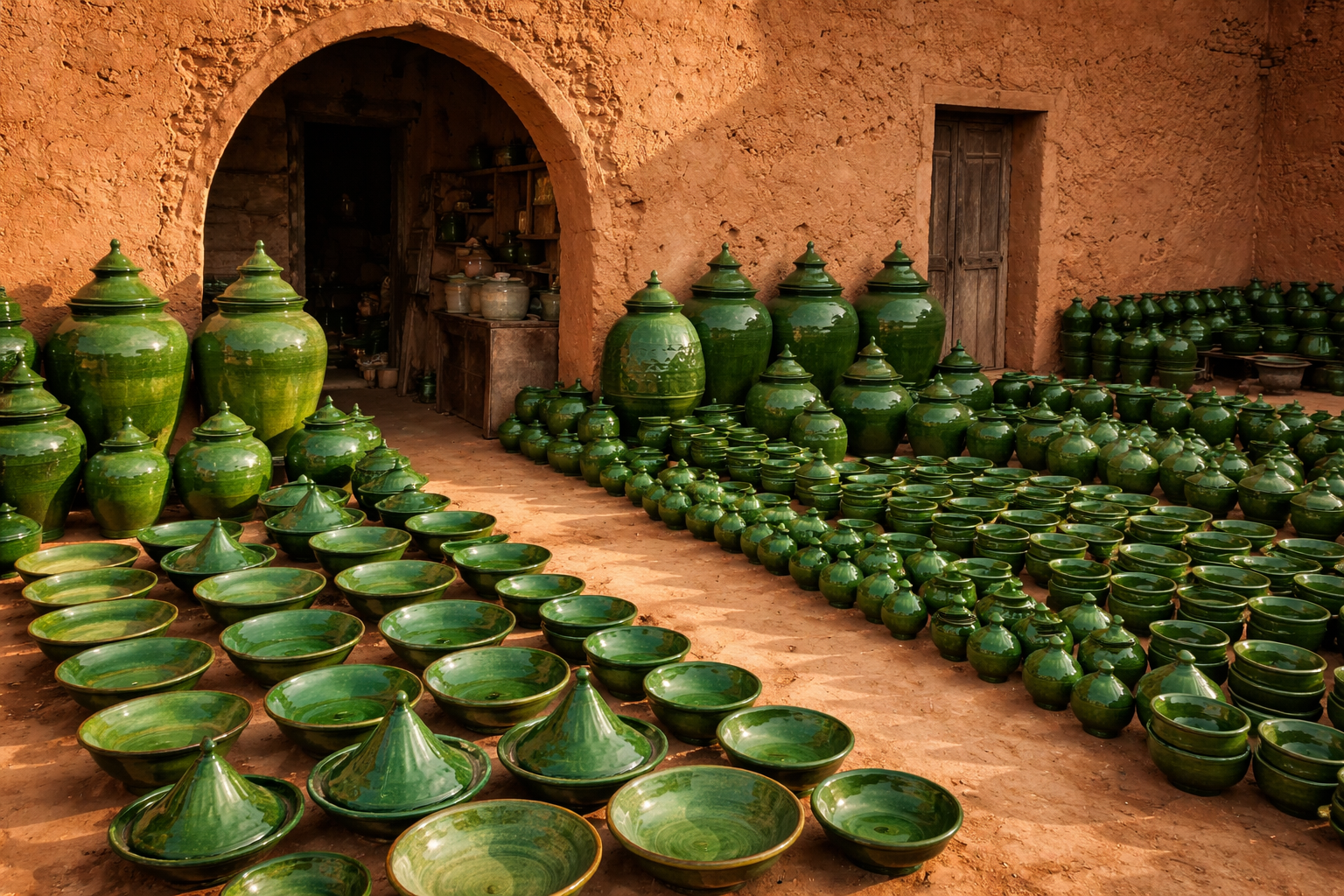
Adjacent to the library is Tamegroute's second remarkable institution: the green pottery workshop. The distinctive emerald glaze is unique to this region — produced using a manganese-rich local clay and a technique passed down within a small number of families for generations. You will have seen Tamegroute pottery in restaurants across Morocco without knowing its name. Seeing it made is something else entirely.
|
✦ KEY TAKEAWAYS |
|
› Tamegroute is 45km south of Zagora — a 40-minute drive along the N9, easily done as a morning day trip. |
|
› The Zawiya Naciria library holds 13th-century manuscripts — one of the most important Islamic collections in Africa. |
|
› The green pottery workshop is unique to Tamegroute — the emerald glaze technique is specific to this village. |
|
› Best visited in the morning (8–11am) when the library is open and the potters are working. |
|
› Combine with the M'Hamid road continuation for a full Draa Valley south day. |
|
› La Petite Kasbah can arrange transport and a guide — book at hotelzagora.com. |
|
TABLE OF CONTENTS |
|
1. Why Tamegroute Is Worth the 45-Minute Drive |
|
2. Getting There from Zagora |
|
3. The Zawiya Naciria: Library of Manuscripts |
|
4. What the Manuscripts Actually Are |
|
5. The Green Pottery Workshop |
|
6. The Village and Surroundings |
|
7. Continuing South: The M'Hamid Road |
|
8. Practical Information: Opening Hours, Entry, Etiquette |
|
9. Combining Tamegroute with Other Zagora Activities |
|
10. Photography at Tamegroute |
1. Why Tamegroute Is Worth the 45-Minute Drive
Tamegroute receives a fraction of the visitors of Marrakech's medina, Fès's tanneries, or the dunes of Erg Chebbi. There are no tour buses in its lanes. The library has no gift shop. The potters do not stop working when visitors arrive. This is not a heritage site that has been prepared for tourism — it is a living institution that happens to allow visitors, and that distinction makes it one of the most genuinely interesting places in southern Morocco.
For guests staying at La Petite Kasbah, a morning at Tamegroute gives the Zagora visit a depth of historical context that the desert experiences alone cannot provide. The manuscripts in the library and the pottery in the workshop both connect directly to the Trans-Saharan trade that made this valley significant for a thousand years. You do not need to be an academic to feel that weight.
2. Getting There from Zagora
The drive from La Petite Kasbah to Tamegroute follows the N9 south for 45km — the same road that continues toward M'Hamid and, eventually, the open Sahara. The journey takes approximately 40 minutes by car or 50 minutes by shared grand taxi. The road is paved and in good condition. The drive itself is worth the journey: the Draa Valley narrows south of Zagora, the kasbahs become more frequent, and the palm grove thickens before eventually giving way to the pre-desert landscape around Tamegroute.
• By private car or rental: 40 minutes from Zagora, 35 minutes from La Petite Kasbah. Park in the small square near the pottery workshop entrance.
• By grand taxi from Zagora: Shared taxis leave from the Zagora taxi stand toward M'Hamid and stop at Tamegroute on request. Allow 50–60 minutes each way. Negotiate return pickup or catch a passing taxi.
• Arranged through La Petite Kasbah: The riad can arrange a private driver for the morning — the most comfortable option, allowing you to stop along the Draa Valley road without a fixed schedule.
• By bicycle (experienced cyclists only): 45km each way — possible but demanding in summer heat. Best in October–March for early morning departure.
3. The Zawiya Naciria: Library of Manuscripts
The Zawiya Naciria is a religious institution — a zawiya, meaning a Sufi lodge — that has been continuously active since the 17th century, though the manuscript collection predates the current building by several centuries. The founding scholarly family, the Naciri, established one of the most important Islamic schools in the Maghreb here, and manuscripts flowed in from across the Islamic world as donations, purchases, and scholarly gifts.
Today the library holds approximately 4,000 manuscripts, of which several hundred are accessible for guided viewing. The displayed items are typically rotated — you will not see the same selection twice. What you will see includes Koranic commentaries with marginal annotations in multiple hands, medical texts with anatomical diagrams, astronomical tables, and occasionally manuscripts written on materials other than paper: parchment, gazelle skin, and in one remarkable case, a text written on what appears to be a large dried leaf.
On visiting: a local guide — either from the zawiya itself or arranged through La Petite Kasbah — is essential. The manuscripts are not labelled in English or French, the room is not well lit for independent viewing, and the guide's commentary transforms what would otherwise be a puzzling display of aged paper into something extraordinary. The guided visit takes 30–45 minutes.
4. What the Manuscripts Actually Are
|
📜 What You May See in the Zawiya Naciria Library |
|
📜 Koranic manuscripts — hand-copied Qurans with illuminated chapter headings, some dating to the 13th–14th centuries |
|
📜 Fiqh (Islamic jurisprudence) — legal texts governing trade, marriage, and property, written for the Trans-Saharan merchant community |
|
📜 Astronomical tables — star charts and calculations used for determining prayer times and navigation across the desert |
|
📜 Mathematical treatises — including texts showing early algebra and calculation techniques |
|
📜 Medical texts — herbalism, anatomy diagrams, and pharmacological notes referencing local desert plants |
|
📜 Sufi poetry and devotional texts — manuscripts from the Naciri scholarly tradition specific to this zawiya |
|
📜 Historical chronicles — accounts of the Trans-Saharan caravans, Draa Valley rulers, and inter-regional trade |
|
📜 Musical notation — rare manuscripts showing traditional Gnawa and Sufi chant notation systems |
The significance of the collection is not only in its age but in its specificity to this place. These manuscripts were written for, and used by, the traders, scholars, and travellers of the Trans-Saharan route — the people for whom Zagora was not a holiday destination but a critical commercial and spiritual waypoint on a journey of thousands of kilometres. Reading the manuscripts (if you can read 13th-century Arabic calligraphy) is reading the world as it was understood from this exact spot.
5. The Green Pottery Workshop
The pottery workshop adjacent to the zawiya is the most visual and immediately accessible part of the Tamegroute visit. The green glaze — an unmistakable emerald colour produced by mixing manganese from local deposits into the clay slip — is completely unique to this village. The pottery produced here is sold across Morocco and appears in restaurants and riads from Marrakech to Essaouira, but the technique itself has never been successfully replicated outside Tamegroute.
Visiting the workshop gives you a view of the entire process: clay preparation, wheel throwing (done by foot-powered kick wheels), drying, application of the green slip, and firing in the wood-fuelled kilns at the back of the complex. The potters work continuously and welcome observers, though the work requires concentration and noise or interruption is discouraged.
|
🏺 What to Know About Buying Tamegroute Pottery |
|
🏺 Prices at the source are significantly lower than in Marrakech medina or tourist shops — buy here if you want pieces |
|
🏺 Small items (bowls, cups, spice dishes) are easy to carry; larger tajine bases are fragile and need careful packing |
|
🏺 The green glaze is lead-free in pieces made for food use — confirm this with the vendor if buying serving pieces |
|
🏺 All pieces are hand-made — slight variations in colour and shape are not defects but marks of authenticity |
|
🏺 A set of six small espresso cups is one of the most popular and practical purchases — compact, distinctive, useful |
|
🏺 The pottery cooperative sells at fixed prices — no bargaining, which makes the transaction unusually straightforward |
|
🏺 Ask to see the kiln if you arrive in the morning — firing often happens before noon and the view is remarkable |
6. The Village and Surroundings
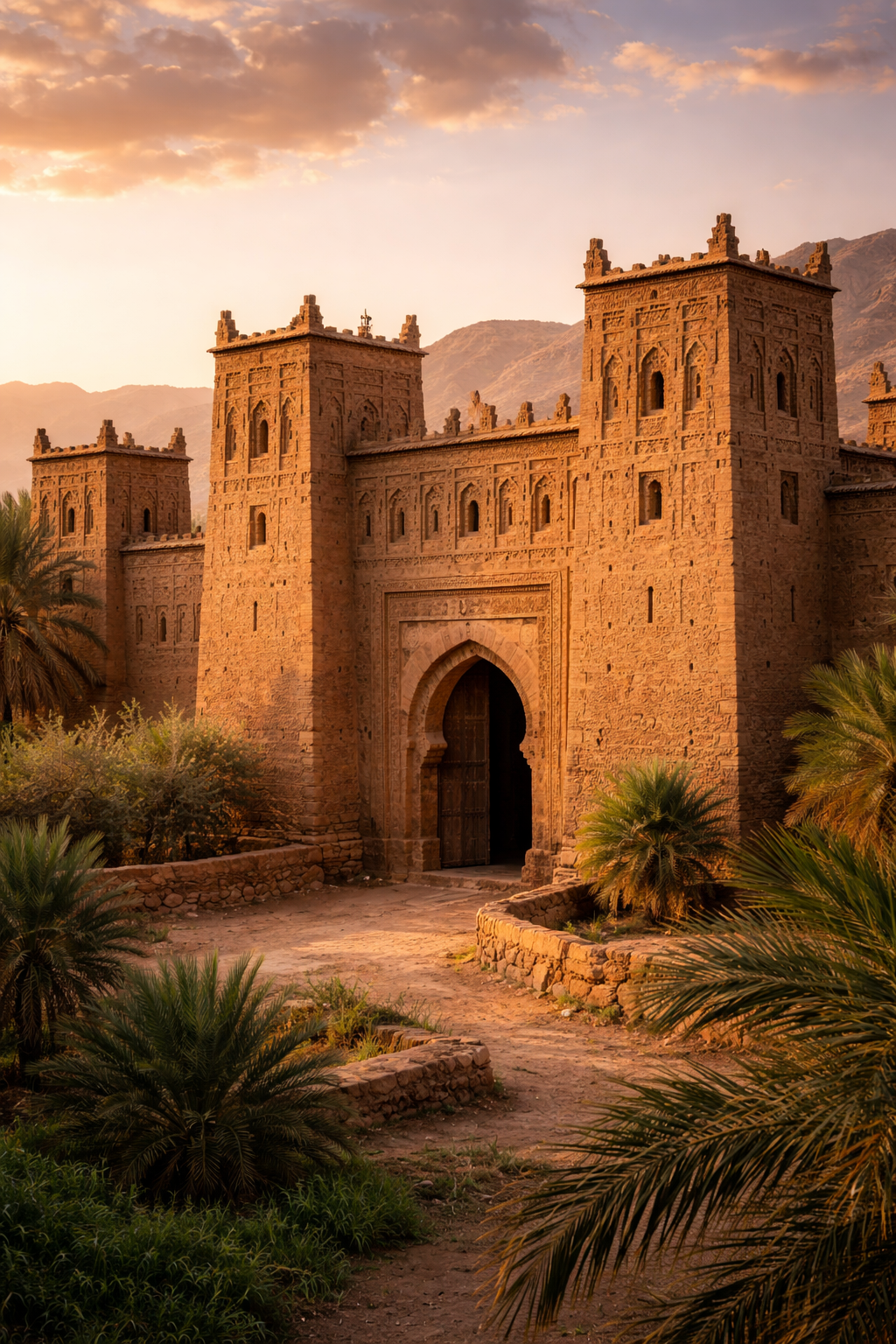
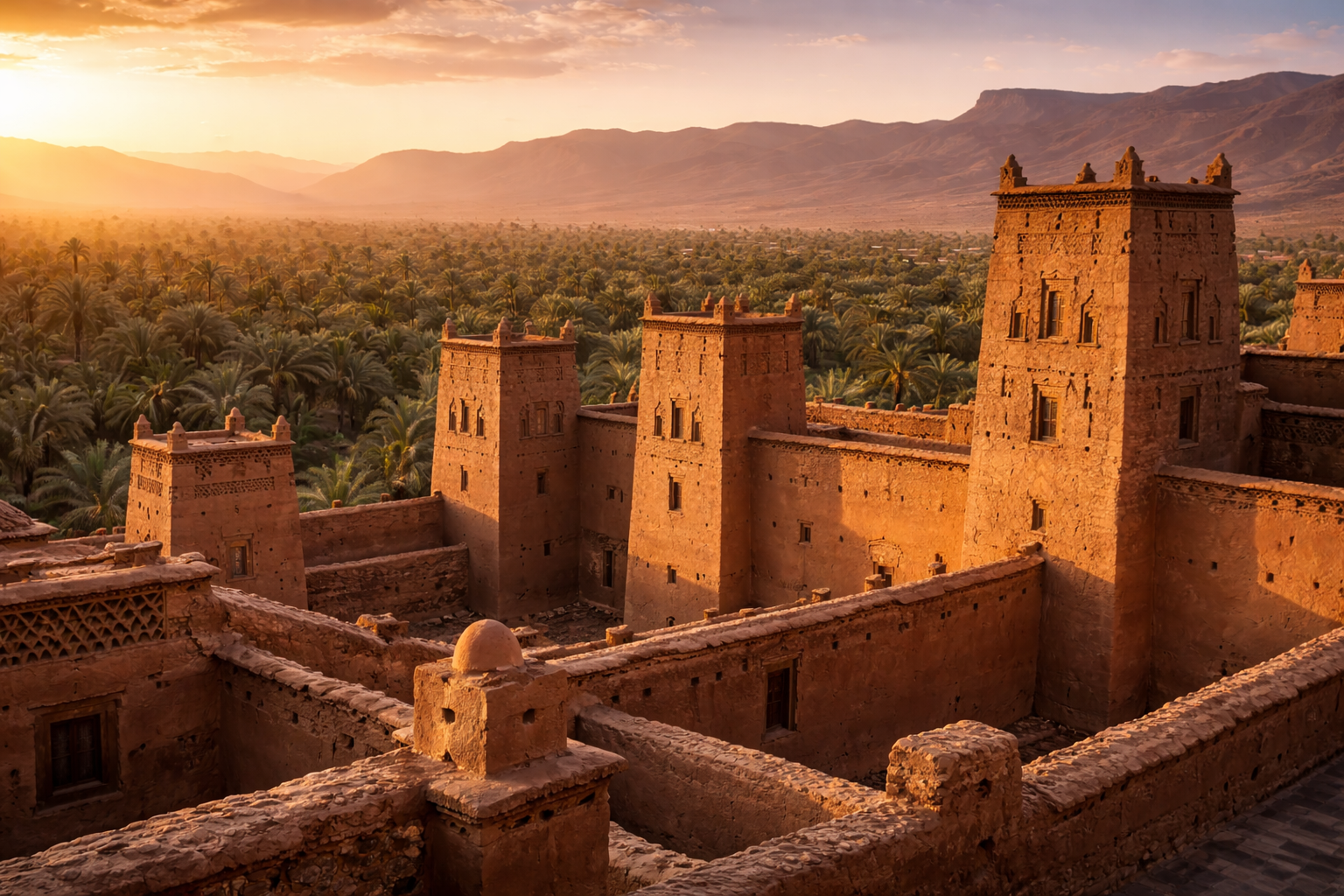
Tamegroute itself is a small oasis settlement — a ksar (fortified village) at its core, surrounded by date palm gardens and a tight network of earthen lanes. It is worth taking 20–30 minutes after the library and pottery visit to walk the village itself. The narrow streets between the earthen walls create a particular quality of shade and silence. In the morning cool, before the heat builds, it is an extraordinarily peaceful walk.
The village has a small weekly souk that operates on different days to Zagora's Wednesday and Sunday market — ask at La Petite Kasbah for the current schedule. The Tamegroute market is smaller and more local than Zagora's but has good dates and local honey from the palm grove farms.
The Draa River runs near the village — usually dry at this point, but the oued (riverbed) is edged with vegetation that creates a different landscape from the open desert. Walking the riverbed path for 15 minutes in either direction gives good views back toward the village and the palm grove.
7. Continuing South: The M'Hamid Road
Tamegroute sits at a natural transition point — south of the village, the palm grove thins and the landscape begins its final conversion to open desert. The N9 continues for another 60km to M'Hamid El Ghizlane, the last town before the Sahara, and travellers with time and transport often extend the day trip to include this further stretch.
The 30km between Tamegroute and M'Hamid contains some of the most dramatic Draa Valley scenery: isolated kasbahs on bare rock outcroppings, the river valley narrowing to a thread, fossilised dune fields visible on both sides of the road, and an increasing sense of remoteness that the Zagora–Tamegroute section does not quite match. If you have a full day and a car, continuing to M'Hamid adds approximately 90 minutes of driving and a significantly deeper desert experience.
Important: M'Hamid is the departure point for the 4x4 Erg Chigaga expedition. If you plan to do that separately, the Tamegroute day trip and the Erg Chigaga trip can be combined into a single full-day itinerary without backtracking — drive south from Zagora, stop at Tamegroute, continue to M'Hamid, then onto the desert piste. This is the most efficient way to do both if time is limited.
8. Practical Information: Opening Hours, Entry, Etiquette
• Library opening hours: Generally 8am–12pm and 3pm–6pm, Saturday to Thursday. Closed Friday and during prayer times. Hours can vary — verify with your guide or La Petite Kasbah before departure.
• Entry fee: A small donation is expected for the library — typically 10–20 MAD per person. The pottery workshop is free to visit; purchases are optional.
• Dress: Conservative dress is expected at the zawiya — covered shoulders and knees for all visitors. Women may be asked to cover their hair inside the library; a scarf is useful to carry.
• Photography in the library: Ask before photographing manuscripts. Some are too fragile to be photographed with flash; others are restricted. The exterior and courtyard are generally photographable freely.
• Language: The library guide typically speaks Arabic and some French. Guides arranged through La Petite Kasbah speak French and/or English. A bilingual guide makes a significant difference.
• Best time of day: 8:30–11am — the library is open, the potters are working at full pace, the light is excellent, and the heat is manageable. Avoid arriving after noon when the library may be closed for midday prayer.
• Duration: Allow 2–3 hours for the complete Tamegroute visit: 45 minutes for the library, 30 minutes for the pottery workshop, 20–30 minutes for the village walk.
9. Combining Tamegroute with Other Zagora Activities
Tamegroute works best as a morning activity, leaving the afternoon free for pool, rest, and the evening camel trek from La Petite Kasbah. Several natural combinations:
• Tamegroute + Souk (Wednesday or Sunday): Visit the souk in Zagora from 7–9am, then drive south to Tamegroute for 9:30–12pm. Return to La Petite Kasbah for lunch. Afternoon pool and sunset camel trek. One of the best possible full days in the Zagora region.
• Tamegroute + M'Hamid: Drive the full road south in a single morning — Tamegroute at 9am, continue to M'Hamid at 11am, lunch in M'Hamid, return to Zagora by mid-afternoon. Gives you the full lower Draa Valley in a single excursion.
• Tamegroute + Erg Chigaga (multi-day): If doing a full 4x4 Erg Chigaga expedition, stop at Tamegroute on the way south. Adds 1 hour to the journey but gives the trip a cultural layer that pure desert travel lacks.
• Tamegroute on Day 3 of the 3-day itinerary: If your Zagora visit follows the 3-day itinerary, Tamegroute on the final morning (before departure) works particularly well — the drive out of the valley on the N9 north passes through the same Draa Valley landscape you have been exploring, giving the trip a satisfying geographic arc.
10. Photography at Tamegroute
Tamegroute offers some of the finest photography opportunities in southern Morocco, precisely because it is not prepared for tourism. The earthen architecture, the library courtyard, the pottery workshop, and the village lanes are all genuinely picturesque without being staged.
• Best light: 7:30–10am — the low morning sun creates long shadows across the earthen walls and pottery workshop exteriors. The village lanes are dark and cool, lit by shafts of morning light between buildings.
• The pottery close-up: The green glazed pieces against an ochre wall is one of the most satisfying colour contrasts in Moroccan photography. Shoot in the workshop courtyard where the pieces are displayed before loading.
• The library exterior: The carved archway of the zawiya entrance in morning light is architecturally striking. Include a figure for scale if possible.
• The road south: The view back north toward Zagora from the road south of Tamegroute — with the palm grove visible and the Atlas mountains in the far distance — is an excellent landscape composition.
• Ask permission: As with all photography in Moroccan religious or artisan settings, ask before photographing people. Most potters and library staff are accommodating when asked respectfully.
* You can hire a local professional travel photography here.
|
✔ |
45km south of Zagora — 40-minute drive on the N9, easily done as a morning trip |
|
✔ |
Zawiya Naciria library — 13th-century manuscripts, one of the finest Islamic collections in Africa |
|
✔ |
Green pottery workshop — unique emerald glaze technique, prices significantly lower than in city shops |
|
✔ |
Best visited 8:30–11am when both library and potters are active |
|
✔ |
Conservative dress required at the zawiya — covered shoulders, knees, and possibly hair |
|
✔ |
Can be combined with the souk, M'Hamid road, or 4x4 Erg Chigaga trip in a single day |
|
✔ |
La Petite Kasbah arranges transport and bilingual guides — ask at check-in |
|
Arrange Your Tamegroute Day Trip Through La Petite Kasbah Rated 9.3/10. Private driver, bilingual guide, and combined Tamegroute–souk itineraries arranged directly from the riad. No planning required on your part. |