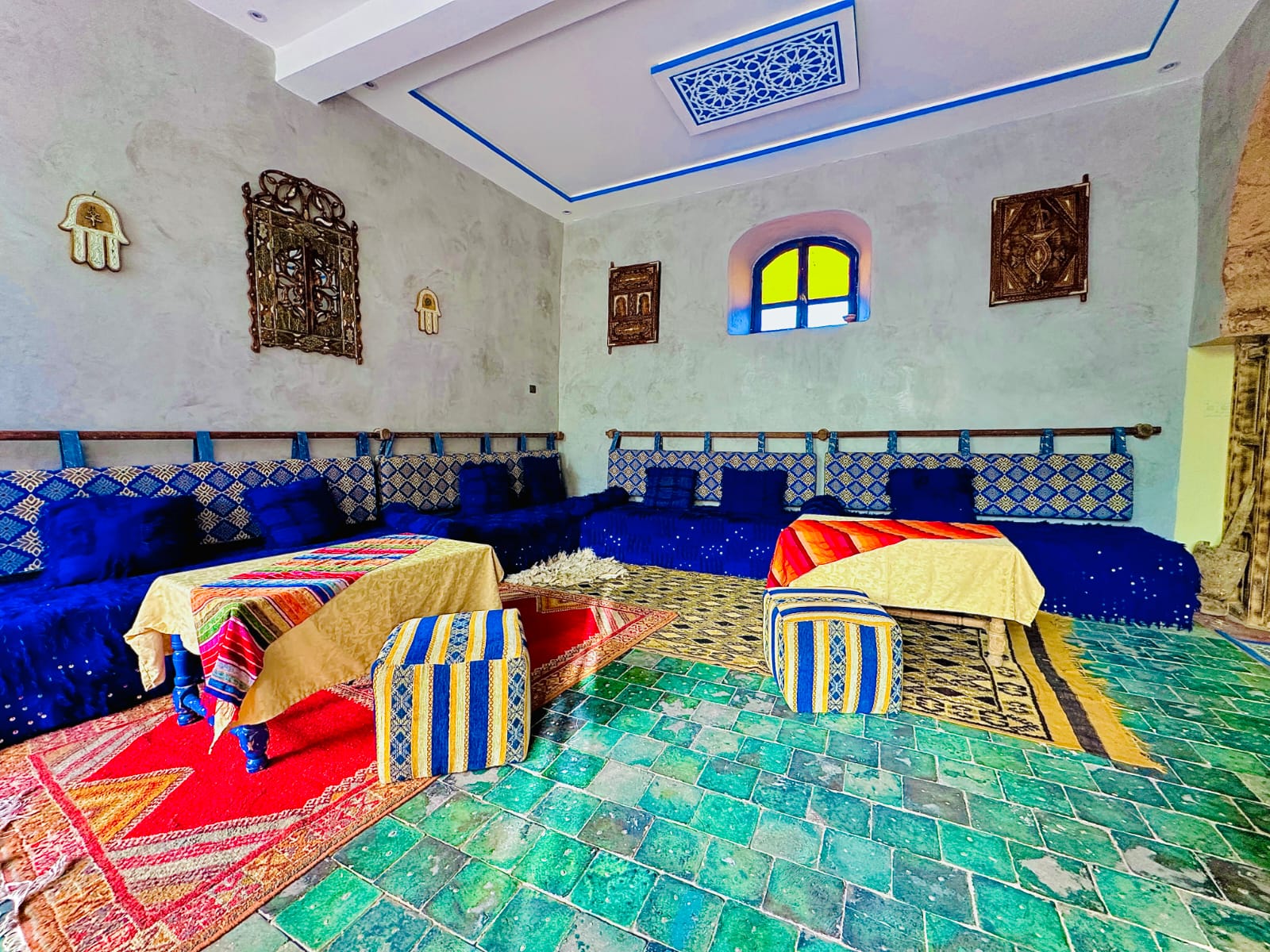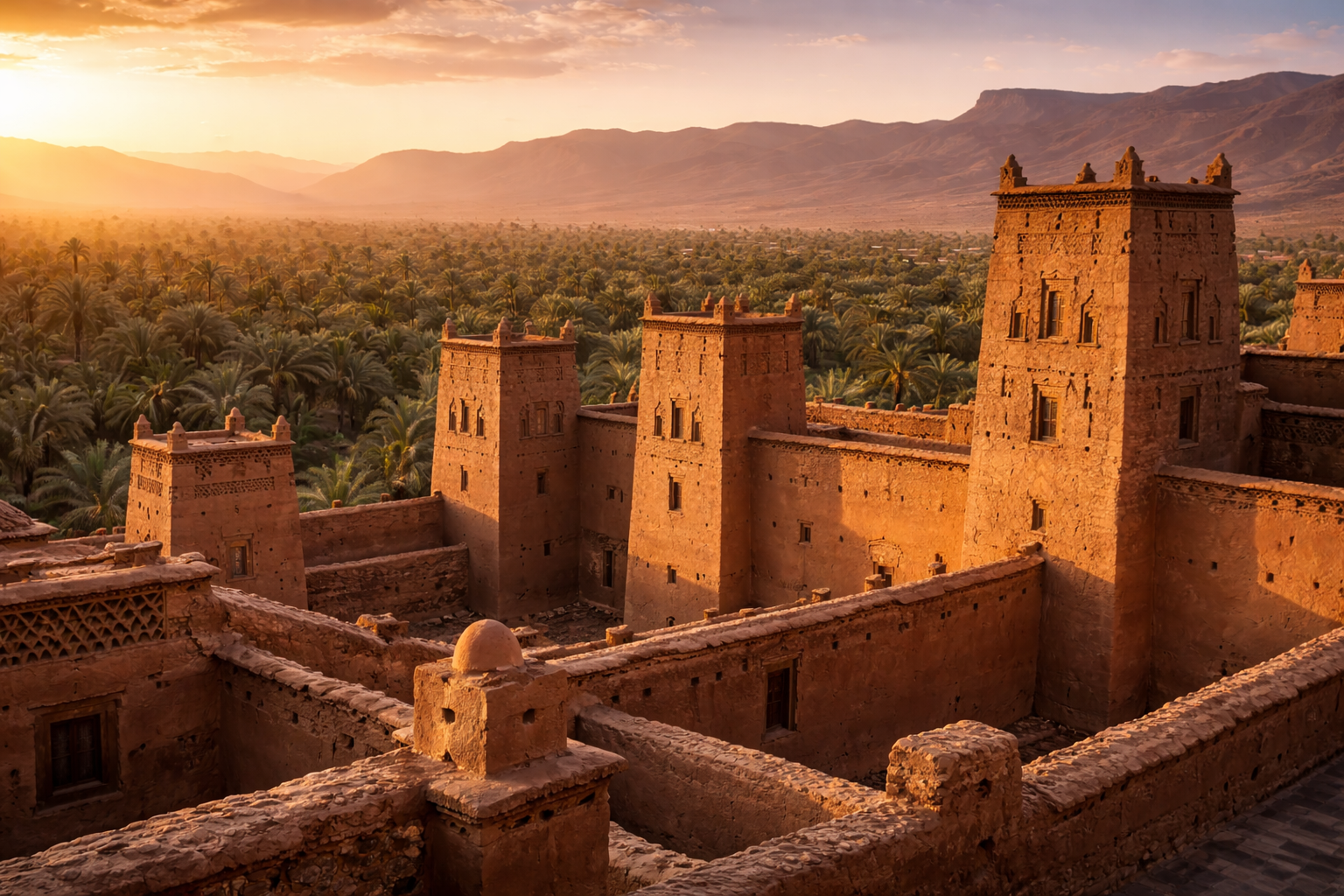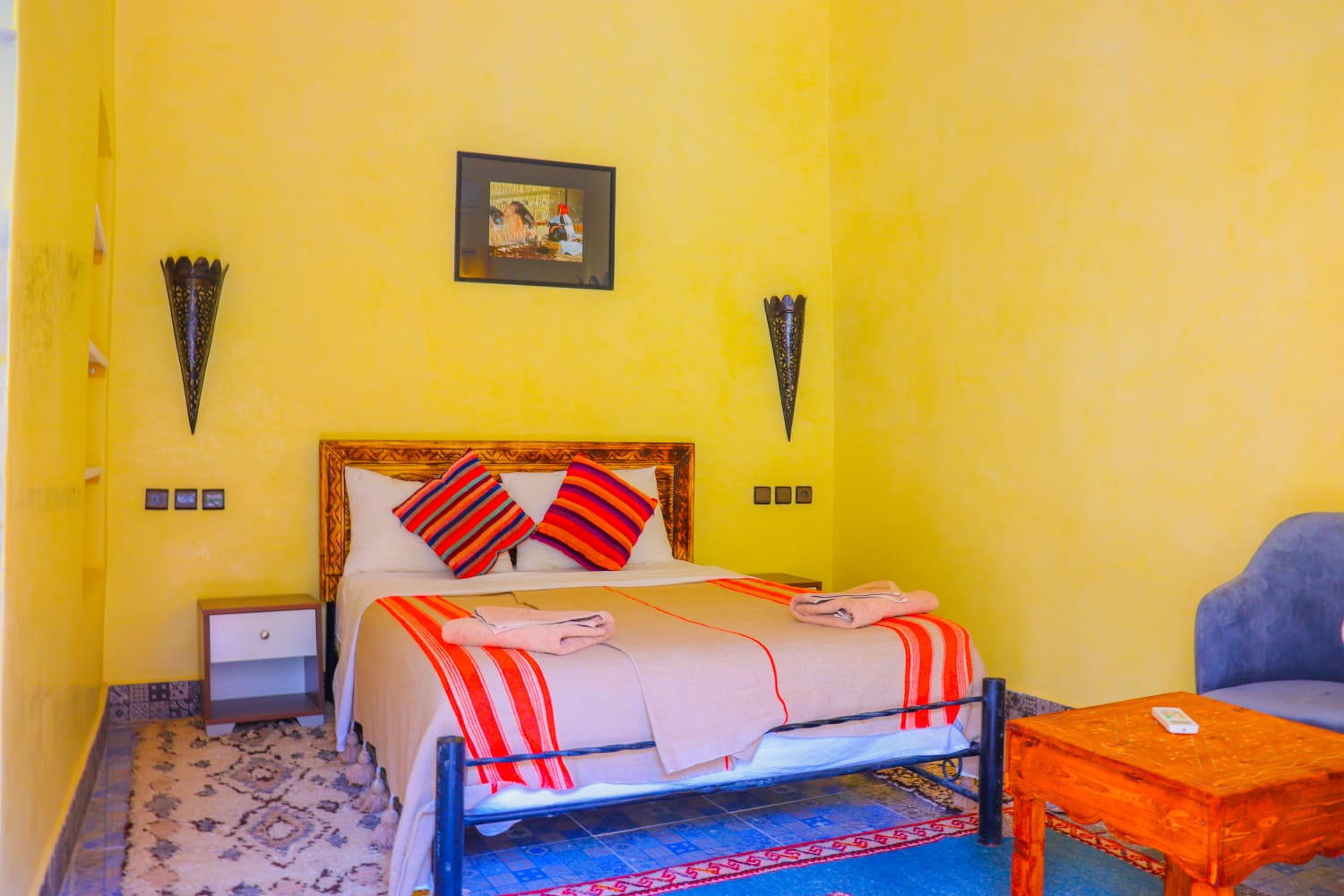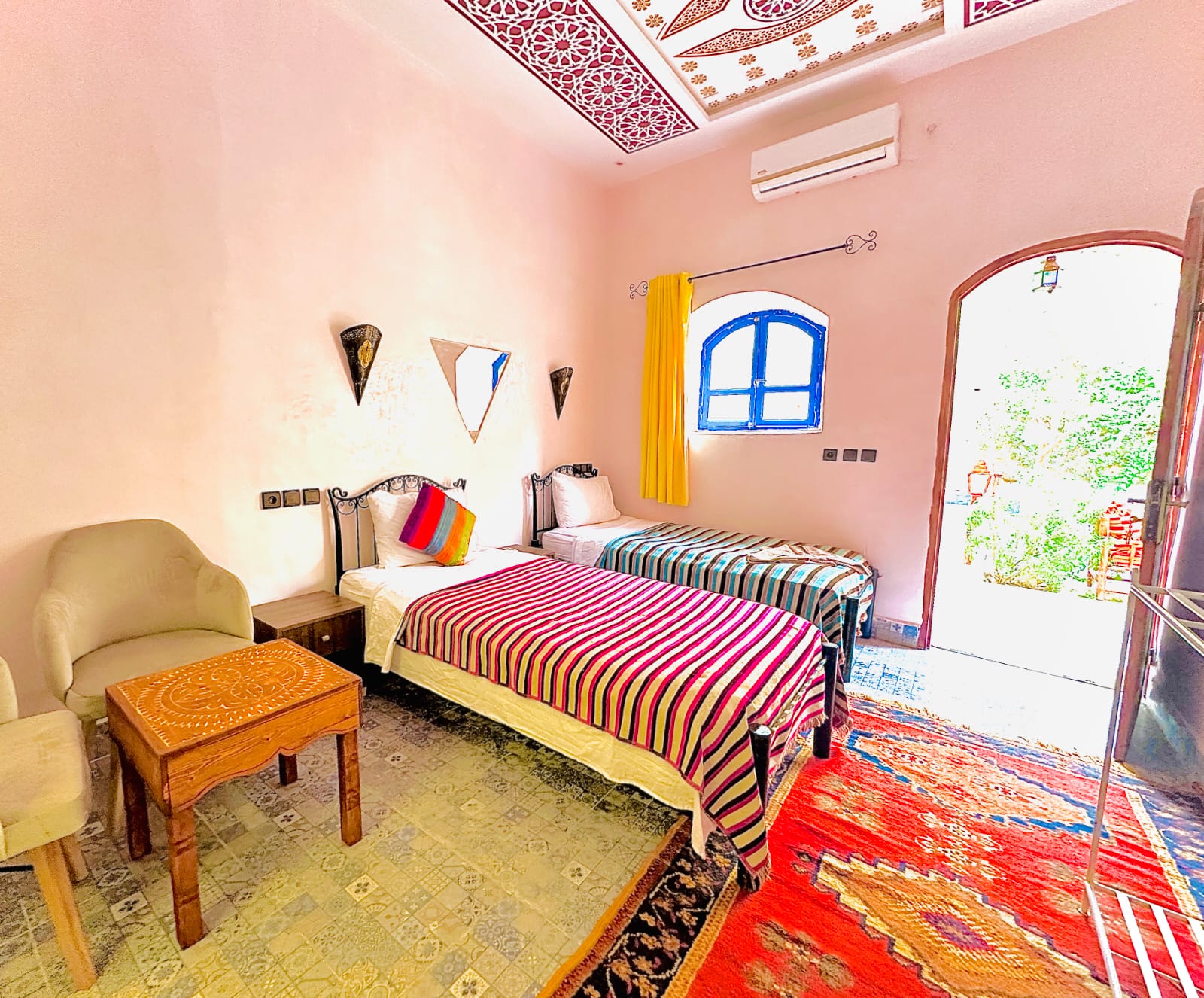
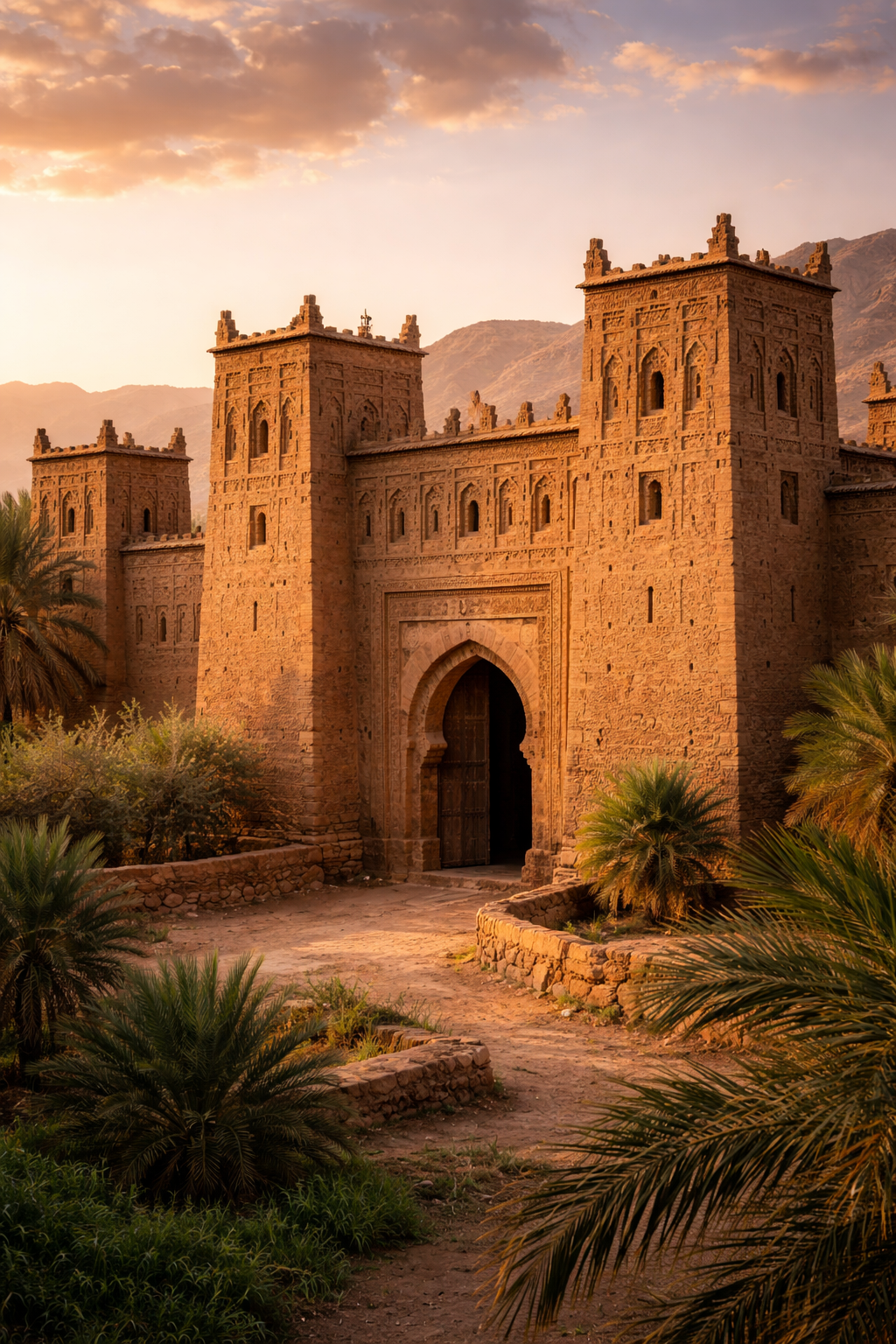
A Moroccan kasbah is not a ruin. The kasbahs you see along the Draa Valley between Agdz and Zagora are not the remnants of something that is over — they are buildings in the same material tradition as the houses being built in the villages around them today. The construction technique, the material, the tools, and the social organisation of the building process are continuous with a tradition that is over a thousand years old. In the most actively maintained kasbahs, the walls are not medieval — they are five years old, rebuilt in the same way, from the same earth, using the same technique.
This article explains how kasbahs are actually built: the material science of pisé (rammed earth), the step-by-step construction process, the architectural logic of each element, the meaning of the geometric decoration, and the difference between the kasbah, ksar, and riad. It also explains where to see the finest surviving examples from La Petite Kasbah in Zagora.
|
✦ KEY TAKEAWAYS |
|
› Kasbahs are built from pisé — rammed earth mixed with straw, gypsum and water. The same technique has been used continuously in southern Morocco for over 1,000 years. |
|
› The walls are not decorative: 40–80 cm thick pisé walls create a thermal mass that keeps interiors 8–12°C cooler than outdoor temperatures at peak heat. |
|
› The geometric patterns pressed into the wet earth before drying are clan identifiers — no two kasbahs have identical decoration. |
|
› The towers are status symbols as much as defensive structures — height and elaborateness of the corner towers signals the family's wealth and lineage. |
|
› Annual maintenance is a communal activity that has sustained these buildings for centuries. Without it, a kasbah returns to earth within decades. |
|
TABLE OF CONTENTS |
|
1. What Is a Kasbah? Definitions and Distinctions |
|
2. The Material: Earth, Straw, and Water |
|
3. How Pisé Construction Works: Step by Step |
|
4. The Architecture: Reading the Elements |
|
5. The Geometric Decoration: Language in Earth |
|
6. The Towers: Height, Status, and Observation |
|
7. Thermal Logic: Why the Walls Are So Thick |
|
8. The Difference Between Kasbah, Ksar, and Riad |
|
9. How Kasbahs Are Maintained: The Annual Repair |
|
10. Where to See the Finest Kasbahs from Zagora |
1. What Is a Kasbah? Definitions and Distinctions
The word kasbah (from the Arabic qasba, meaning citadel or fortress) is used inconsistently in tourist materials — often applied to any old Moroccan building with thick walls. In architectural and historical usage, it has a specific meaning: a fortified residential compound built for a single family or clan, constructed in pisé (rammed earth), with defensive towers at the corners and a single controlled entrance gate.
The key distinction from a Western European castle or fortress is function. A European castle was built primarily for military purposes. A Draa Valley kasbah was built primarily for residential and commercial purposes — to house a merchant family, store wealth and trade goods, and demonstrate status. The defensive elements (the towers, the thick walls, the single gate) were secondary to the residential elements.
The communities that built them: the kasbahs of the Draa Valley were built by the Amazigh clan confederacies — primarily the Ait Atta — who dominated the valley from the medieval period through the 19th century. The building of a kasbah was a clan-scale undertaking: the earth was quarried collectively, the walls were built communally, and the finished building housed the extended family of the clan's leading lineage.
2. The Material: Earth, Straw, and Water
The primary building material of the Draa Valley kasbah is the earth beneath it. Pisé construction — from the French pisé de terre — uses the local subsoil directly as the building material, processed minimally and returned to near its original state. The ideal pisé earth is iron-rich clay — the characteristic red-ochre colour of the Draa Valley kasbahs comes from the high iron oxide content of the local soil.
-
Earth composition: approximately 70% subsoil clay, 20% coarser sand for aggregate, 10% dried plant material for tensile reinforcement — proportions vary by locality based on the specific mineral composition of the local earth
-
Straw function: the dried plant fibres act as internal reinforcement — they do not add compressive strength but prevent crack propagation and give the dried pisé tensile resistance
-
Water: added in minimal quantities — just enough to allow compaction without creating a slurry. Too much water is the primary cause of structural failure in pisé
-
Gypsum and lime: some builders add small quantities of gypsum (jess in Darija) to the mix or apply it as a surface stabiliser — particularly for lower courses most exposed to ground moisture
3. How Pisé Construction Works: Step by Step
The pisé construction process requires no specialised equipment — only formwork (temporary wooden shuttering), a rammer, and the material itself. This is precisely what allowed kasbahs to be built anywhere in the valley where earth was available, without dependence on imported materials or specialist tools.
|
Stage |
Process |
Detail |
|
1 |
Site preparation |
Footprint cleared and levelled. Foundation trenches dug 60–80 cm deep. Stone rubble used for lowest foundation courses to protect earth walls from ground moisture. |
|
2 |
Stone base course |
First 40–60 cm built in dry-stone masonry — local fieldstone without mortar. Protects pisé above from rain splash and capillary moisture. |
|
3 |
Formwork assembly |
Wooden shuttering panels (60 cm high, 2–3 m long) erected on both sides of wall, held at the desired wall width (40–80 cm) by spacer rods. |
|
4 |
Earth mixing |
Pisé mix — earth, straw, water — prepared in batches beside the wall. Should hold its shape when compressed in the hand but not ooze water. |
|
5 |
Ramming |
Mix poured into formwork in 10–15 cm layers. Each layer compacted with a long-handled rammer lifted and dropped repeatedly across the full surface. |
|
6 |
Lift completion |
When formwork is full, shuttering is struck and raised to next position. Completed lift allowed 1–2 days to begin drying before next lift placed on top. |
|
7 |
Decoration pressing |
While surface is still damp (within 24–48 hours of ramming), geometric patterns pressed using carved wooden stamps. Only window for surface decoration. |
|
8 |
Drying |
Complete wall drying takes 2–6 weeks depending on thickness and season. Building must be protected from rain throughout. |
|
9 |
Surface finishing |
Dried walls sometimes treated with lime or gypsum plaster on interior surfaces. Exterior left as raw pisé — natural ochre earth, maintained by annual repair. |
Time scale: a complete kasbah of medium size (6–8 rooms, four corner towers) could be built in a single dry season by a community of 20–30 workers. The communal nature of kasbah construction was not merely practical — it was socially constitutive. The act of building together reinforced the clan bonds that the finished building was designed to house.
4. The Architecture: Reading the Elements
|
🏰 READING A MOROCCAN KASBAH: WHAT EACH ELEMENT MEANS |
|
🏰 Corner towers: Height and elaborateness signal the family's standing. Richest families built towers of 15–20 m. Also provide cross-ventilation and 360° landscape observation. |
|
🏰 The single gate: One heavily reinforced wooden door in a recessed arch. All access controlled here — trade transacted, hospitality dispensed, strangers assessed. |
|
🏰 The courtyard: Interior wost ed-dar: social centre — family life, the well, cooking fire. Proportions and paving quality indicate wealth. |
|
🏰 Interior niches: Decorative recessed taqas: practical (storage, lamps) and aesthetic. Carved plasterwork in niches is the most refined interior decoration. |
|
🏰 Women's quarters: Traditional layout separates public (male) and private (female) spaces. Women's quarters on upper floors with rooftop terrace access. |
|
🏰 The granary: Dedicated grain storage on ground floor where temperatures are most stable. Managing food reserves was as critical as managing trade goods. |
5. The Geometric Decoration: Language in Earth
The geometric patterns pressed into the pisé surface of a Draa Valley kasbah are not random ornament. They are a visual language — a system of symbols that communicate clan identity, status, cosmological belief, and craft lineage to anyone who can read them. The patterns are applied using carved wooden stamps or by hand modelling, pressed into the damp surface of a newly completed wall lift within 24–48 hours of ramming, the only window before the surface hardens.
-
Triangles and zigzag patterns: the most common motif across the Draa Valley — representing water, fertility, and the serpentine form associated with earth spirits in Amazigh cosmology
-
Diamond (lozenge) patterns: associated with female fertility and protection — found most frequently on walls facing the main entrance, where protective symbolism was most needed
-
Star polygons: geometric star forms (typically 6- or 8-pointed) appear on tower surfaces — associated with celestial protection and borrowed from Islamic geometric tradition
-
Blind arches: rows of pressed arched forms along wall surfaces — a purely decorative motif that references the structural arches of sophisticated stone architecture
-
Clan-specific combinations: the particular combination of motifs used by a family is specific to that lineage — like a coat of arms, it identifies the building's owners to anyone familiar with the local pattern vocabulary
6. The Towers: Height, Status, and Observation
The corner towers of a Draa Valley kasbah serve three distinct functions, none of which is purely military. Understanding all three is essential to understanding why kasbahs look the way they do.
-
Status display: the most important function. Tower height was the primary measure of a family's standing — the tallest towers in a village belonged to the most powerful clan
-
Observation and communication: the tower rooftop provided a 360-degree view of the surrounding landscape — useful for observing approaching caravans, monitoring irrigation water levels, and communicating with neighbouring kasbahs by signal
-
Thermal and ventilation: the towers act as thermal chimneys. Hot air rises through the tower shaft, creating a convection current that draws cooler air from the ground-floor rooms below — a passive ventilation system that significantly reduces interior temperatures in summer
The battlements: the crenellated tops of kasbah towers have a largely decorative function in most cases — the openings are too small and the wall walks too narrow for effective defensive use. They are an architectural reference to military architecture that communicates power without the towers actually being fighting platforms.
7. Thermal Logic: Why the Walls Are So Thick
The most immediately practical feature of pisé construction is its thermal performance. A 60 cm pisé wall has a thermal time lag of approximately 8–10 hours: the heat wave that penetrates the outer surface at midday does not reach the interior surface until midnight, when the outdoor temperature has already begun to drop.
The result is a building that is dramatically cooler than the ambient temperature during the day. In a climate where summer midday temperatures reach 38–42°C, a correctly proportioned pisé building maintains interior temperatures of 26–30°C without any mechanical cooling. This is not an accident — it is the primary reason the material was developed and the reason it persists.
The wall thickness logic: the thicker the wall, the longer the thermal time lag and the more effective the insulation. The 40–80 cm wall thickness of Draa Valley kasbahs is calibrated thermal engineering. The builders who refined this technique over centuries were solving an engineering problem with a precision that modern building science has only recently fully understood.
8. The Difference Between Kasbah, Ksar, and Riad
-
Kasbah: a single-family or clan fortified residential compound. Built for one dominant lineage. Characterised by corner towers, single gate, and internal courtyard.
-
Ksar (plural: ksour): a fortified communal village — a cluster of multiple family units within a single defensive perimeter wall. Where a kasbah is a family home, a ksar is a neighbourhood. The Amezrou village surrounding La Petite Kasbah is a ksar — multiple earthen compounds sharing walls within a single enclosed space.
-
Riad: an urban courtyard house found in the medinas of northern Moroccan cities. Characterised by an interior garden courtyard. Not fortified. La Petite Kasbah uses the term in its contemporary sense, though architecturally it is closer to a kasbah within a ksar.
Why this matters for visitors: when you walk through the Amezrou village surrounding La Petite Kasbah, you are walking through a ksar — a fortified communal settlement built by multiple clans. The kasbah-style buildings within it were the compounds of the wealthiest families. The streets between them are the shared public space of the ksar.
9. How Kasbahs Are Maintained: The Annual Repair
Pisé construction has one significant vulnerability: water. Rain erodes the top surfaces of walls, dissolves the corners of towers, and undercuts the base of walls at ground level. Without active maintenance, a pisé building returns to earth in 20–50 years. With maintenance, it can stand for centuries.
The traditional maintenance regime is an annual repair cycle timed to the end of the rainy season (typically March–April in the Draa Valley). Families and communities inspect their walls for erosion damage, mix fresh pisé using the same proportions as the original construction, pack the repair material into eroded sections, and re-press any decoration that has lost definition. The annual repair is not just building maintenance — it is a social ritual that involves the whole community.
Conservation note: the greatest threat to the historic kasbahs of the Draa Valley is not weather but economic change. As young people leave villages for cities, the community labour that sustained the annual repair cycle becomes unavailable. Without it, the buildings erode progressively. Several organisations are working to document traditional pisé maintenance practices before the knowledge is lost.
10. Where to See the Finest Kasbahs from Zagora
La Petite Kasbah in the Amezrou palm grove is ideally positioned for exploring the Draa Valley's kasbah heritage. The following sites are all accessible on a day out from the riad:
-
Amezrou (walking distance): the ksar surrounding La Petite Kasbah is itself a historic earthen settlement — the Mellah, the kasbah compounds of the leading families, and the watch towers at the village perimeter
-
Tamnougalt Kasbah (90 min north, N9): one of the finest surviving medieval kasbahs in the Draa Valley, near Agdz. Partially inhabited, partially accessible. The tower decoration is exceptional — some of the finest pressed geometric work surviving in the region
-
Timiderte (45 min north): a cluster of kasbahs on the east bank of the Draa between Zagora and Agdz — visible from the N9, best photographed in late afternoon light when the towers are fully illuminated
-
Tamegroute (45 min south): the earthen architecture includes the zawiya complex — a different kasbah typology (religious rather than residential). Half-day from La Petite Kasbah
-
The N9 between Agdz and Zagora: driving north from Zagora at late afternoon, every kasbah visible from the road is a complete lesson in the tradition — the way the towers catch the light, the variation in decoration between families
|
✔ |
Kasbahs built from pisé — local iron-rich clay, straw and water, rammed into formwork in 10–15 cm layers |
|
✔ |
40–80 cm walls create 8–10 hour thermal time lag — interiors 8–12°C cooler than outside at peak heat |
|
✔ |
Geometric decoration pressed into wet pisé within 48 hours of ramming — each pattern combination is clan-specific |
|
✔ |
Towers signal status as much as defence — height and elaborateness indicate the family's wealth and lineage |
|
✔ |
Annual repair is essential: without it, pisé returns to earth in 20–50 years. With it, kasbahs last centuries |
|
✔ |
Finest examples from La Petite Kasbah: Amezrou ksar (walking), Tamnougalt (90 min), Timiderte (45 min) |
|
✔ |
La Petite Kasbah sits within the historic Amezrou ksar — book at hotelzagora.com |
|
Experience Kasbah Architecture from the Inside — La Petite Kasbah Rated 9.3/10. Situated within the historic Amezrou ksar. Tamnougalt, Timiderte, and Tamegroute all within day-visit reach. Architecture that is still alive. → www.hotelzagora.com ← |