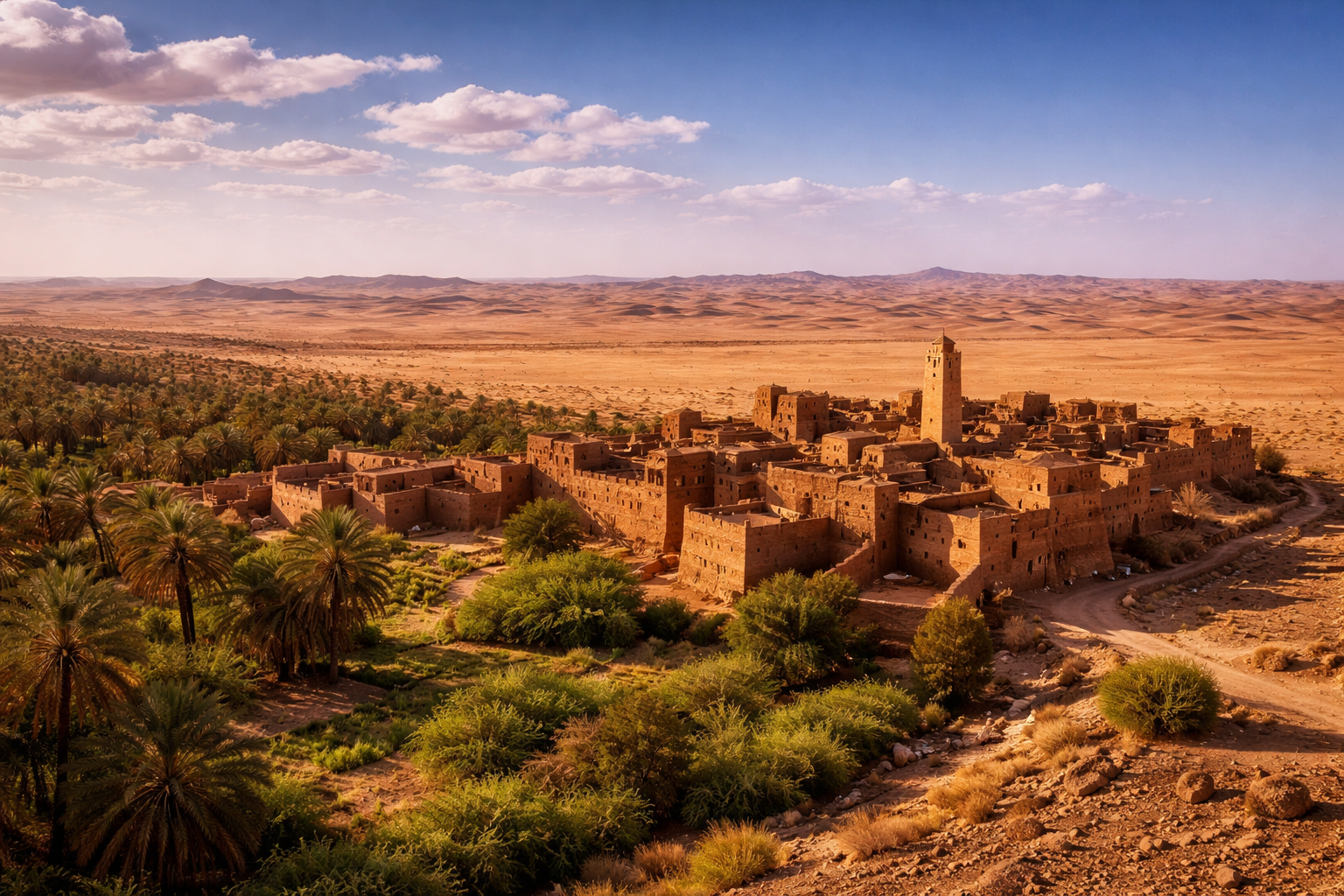
M'Hamid El Ghizlane sits at the end of the road. 120 kilometres south of Zagora, it is the last permanent settlement before the open Sahara — the point where the Draa River disappears underground for the final time, the tarmac gives way to desert piste, and the landscape makes its final transition from oasis to pure sand and stone.
For a thousand years, M'Hamid was not an ending but a beginning. It was the northern terminus of the Trans-Saharan caravan routes from Timbuktu — the point where the great caravans arrived after months of travel across the open desert, carrying gold, salt, ivory, and enslaved people northward to the markets of the Maghreb and Mediterranean. The town's Arabic name, M'Hamid El Ghizlane ('the plain of the gazelles'), speaks to a time when the desert around it was less absolute than it is today.
This article is for travellers based at La Petite Kasbah in Zagora who want to understand M'Hamid as a destination: what is there to see and do, how long it takes from Zagora, and why it is the essential southern extension of the Draa Valley road trip.
|
✦ KEY TAKEAWAYS |
|
› M'Hamid El Ghizlane is 120km south of Zagora — approximately 90 minutes' drive on the paved N9. |
|
› It is the historical terminus of the Trans-Saharan caravan routes from Timbuktu — one of the most significant commercial crossroads in African history. |
|
› The old ksar (fortified village) of M'Hamid retains an extraordinary frontier atmosphere — largely unvisited by tourists. |
|
› M'Hamid is the departure point for the 4x4 Erg Chigaga desert expedition — 60km of desert piste beyond the town. |
|
› La Petite Kasbah in Zagora (hotelzagora.com) arranges guided M'Hamid day trips and full Erg Chigaga expeditions. |
|
TABLE OF CONTENTS |
|
1. M'Hamid in History: The Caravan Terminal |
|
2. Getting There from Zagora |
|
3. The Old Ksar of M'Hamid |
|
4. The Timbuktu Sign and What It Means |
|
5. The Gnawa Music Tradition |
|
6. What to Do in M'Hamid: A Practical Guide |
|
7. Beyond M'Hamid: The Road to Erg Chigaga |
|
8. The M'Hamid Dunes: A Closer Desert Option |
|
9. Where to Eat and Stay in M'Hamid |
|
10. Combining M'Hamid with Other Zagora Activities |
1. M'Hamid in History: The Caravan Terminal
M'Hamid's significance in African history is out of all proportion to its current size. From roughly the 10th to the 17th centuries, the Trans-Saharan trade was one of the most economically important networks in the world — connecting the gold and salt mines of sub-Saharan Africa to the markets of North Africa, the Middle East, and southern Europe. Timbuktu, on the Niger River in present-day Mali, was the great southern metropolis of this network. M'Hamid was its northern gateway into Morocco.
The caravans that arrived at M'Hamid after the crossing of the open desert were enormous by pre-modern standards — sometimes thousands of camels, with goods, slaves, and guards. They would rest at M'Hamid, water their animals at the Draa River, trade with local merchants, pay taxes to the local sultan, and then continue north along the river toward Zagora, Ouarzazate, and the Atlas passes. At their peak, these caravans moved more gold than the entire European mining industry of the time.
The collapse of the Trans-Saharan trade in the 16th–17th centuries — caused partly by the Portuguese opening of Atlantic sea routes and partly by internal West African political disruption — left M'Hamid as a frontier settlement of diminishing strategic importance. What remains today is a town shaped by that former significance: the ksar, the religious buildings, the palm groves, and a community that still practices traditions — particularly the Gnawa music — that arrived with the sub-Saharan caravans centuries ago.
2. Getting There from Zagora
The drive from La Petite Kasbah to M'Hamid follows the N9 south for 120km — a journey of approximately 90 minutes on excellent paved road. The route passes through Tamegroute (at 45km — worth a stop for the manuscript library and pottery) and Tagounite (at 80km — last petrol before M'Hamid).
• By private car or rental: 90 minutes from La Petite Kasbah. Paved N9 throughout. Standard car sufficient. Park in the main square near the ksar entrance.
• By shared grand taxi from Zagora: Taxis run daily from Zagora toward M'Hamid. Journey approximately 2 hours. Taxis wait for return passengers in M'Hamid.
• Arranged through La Petite Kasbah: Private driver with guide — the most comfortable and informative option. Allows stops at Tamegroute en route and flexibility on return timing.
• As part of 4x4 Erg Chigaga expedition: M'Hamid is the fuel and preparation stop for the full desert expedition. If doing Erg Chigaga, you pass through M'Hamid regardless.
Best timing: depart Zagora by 8:30am, stop at Tamegroute for 9:30–11am, arrive M'Hamid by noon. This allows a full afternoon in and around M'Hamid before a 4pm departure and return to Zagora by dusk. If continuing to Erg Chigaga, depart M'Hamid no later than 10am.
3. The Old Ksar of M'Hamid
The old ksar of M'Hamid is one of the most atmospheric earthen settlements in Morocco — and one of the least visited. Unlike the partially restored kasbahs of the Draa Valley to the north, the M'Hamid ksar has been left largely as time has treated it: eroded by wind, repaired minimally by the families still inhabiting sections of it, and carrying the accumulated weight of centuries without the intervention of heritage tourism infrastructure.
Walking the lanes of the old ksar takes 30–45 minutes. The buildings are pisé earthen construction — the same rammed-earth technique used throughout the Draa Valley — but the desert exposure here has given the surfaces a scoured, windblown quality distinct from the more sheltered kasbahs to the north. Some sections are ruined; others are still inhabited. The relationship between the living and the fallen is immediately visible.
The ksar's mosque and the adjacent religious school (madrasa) date to the period of M'Hamid's commercial peak. The mosque is closed to non-Muslim visitors, but the exterior — with its simple earthen minaret and the sound of Koranic recitation drifting from the school — is sufficiently evocative.
Entry: there is no formal entry system or fee for the ksar. Visitors walk freely, though a local guide significantly enriches the experience. La Petite Kasbah can arrange a bilingual M'Hamid guide who was born in the ksar and whose family history is inseparable from the town's.
4. The Timbuktu Sign and What It Means
On the road south of M'Hamid, before the tarmac ends, there is a sign: 'Tombouctou — 52 jours' (Timbuktu — 52 days). It is a simple painted board on a wooden post. In the context of the open desert stretching to the horizon behind it, it is one of the most affecting objects in Morocco.
Fifty-two days by camel. Approximately 1,500 kilometres of desert, with no roads, no reliable water sources, and no shelter. The caravans that made this crossing regularly — for centuries — carried civilisations on their backs. The gold that funded the great mosques and libraries of Morocco arrived via this route. The manuscripts now housed in the Tamegroute library were paid for by the wealth generated by this trade.
Standing at the sign and looking south, the desert appears simple: flat, stony, empty. What the sign makes visible is the invisible layer of human effort and consequence that this landscape has contained. It is worth stopping here for ten minutes and simply considering what the distance meant.
5. The Gnawa Music Tradition
M'Hamid is one of the most important centres of Gnawa music in Morocco — a musical and spiritual tradition that arrived with the sub-Saharan African slaves brought north along the Trans-Saharan routes and ultimately became one of the most distinctive elements of Moroccan cultural life.
Gnawa music is ceremonial in origin — used in healing rituals called lila that invoke spirits through sustained rhythmic music, chanting, and incense. The instruments are distinctive: the guembri (a three-stringed bass lute with a camel-skin resonator), the qraqab (large iron castanets), and the tbel (drums). The music is hypnotic, physically demanding, and played at an intensity that builds over hours.
M'Hamid's Gnawa musicians are among the most authentic in Morocco — not because they perform for tourists (though some do, occasionally) but because the tradition here has maintained its ceremonial function. If you arrive in M'Hamid during a lila ceremony, you may be invited to observe. This is an extraordinary privilege; treat it as such — no photography, quiet presence, and respectful attention.
For travellers: La Petite Kasbah can sometimes arrange an informal Gnawa music session in M'Hamid — a demonstration rather than a ceremony, but performed by genuine practitioners. Ask when booking if this is something your group would value.
6. What to Do in M'Hamid: A Practical Guide
|
Activity |
Time needed |
Details |
|
Old Ksar walk |
45–60 min |
Self-guided through the ancient earthen village — guide recommended |
|
Timbuktu sign |
10–15 min |
5km south of town on the desert road — essential stop |
|
Palm grove walk |
30–45 min |
The date palm oasis at the edge of M'Hamid is beautiful at dawn or dusk |
|
Gnawa music |
60–90 min |
Arrange through La Petite Kasbah — occasional informal sessions |
|
Local market |
30 min |
Small weekly souk — check day with La Petite Kasbah before arrival |
|
Camel ride — M'Hamid |
1–2 hrs |
Short local rides in the dunes immediately south of town |
|
Lunch in M'Hamid |
60–90 min |
Several basic but genuine Moroccan restaurants in the village |
|
Erg Chigaga departure |
All day+ |
4x4 piste south — arrange through La Petite Kasbah in advance |
7. Beyond M'Hamid: The Road to Erg Chigaga
Beyond M'Hamid, the N9 ends and Morocco's most remote erg begins. The 60km of desert piste between M'Hamid and Erg Chigaga crosses the open hammada — flat stone desert with occasional dry river crossings, fossilised dune fields, and the growing silence of a landscape that has seen very few human beings in its long history.
This is not a drive you make in a normal car. The piste requires a maintained 4x4 vehicle, an experienced desert guide who knows the navigation, adequate water, and the satellite phone that La Petite Kasbah's operators carry as standard. The crossing takes 2–3 hours each way, which means a day trip from Zagora including M'Hamid and Erg Chigaga requires a very early start. The overnight option — camping at Erg Chigaga and returning the following morning — is strongly recommended.
Important: never attempt the Erg Chigaga piste without a guide and a 4x4 vehicle arranged through La Petite Kasbah or another trusted Zagora operator. The hammada is genuinely featureless in places and navigation errors can be serious. This is a wilderness, not a managed tourist route.
8. The M'Hamid Dunes: A Closer Desert Option
For travellers who want a taste of genuine desert sand without the full Erg Chigaga expedition, M'Hamid has its own smaller dune fields — the Erg El Yahudi — immediately south and west of the town. These are significantly smaller than Erg Chigaga (rising only 15–20 metres rather than 300 metres) but offer several genuine advantages:
• Accessible without a 4x4 — the nearest sections are reachable on foot or by camel from the town centre.
• Excellent for sunset and sunrise — the smaller dunes catch the low light beautifully and the relative lack of visitors means undisturbed sand surfaces in the morning.
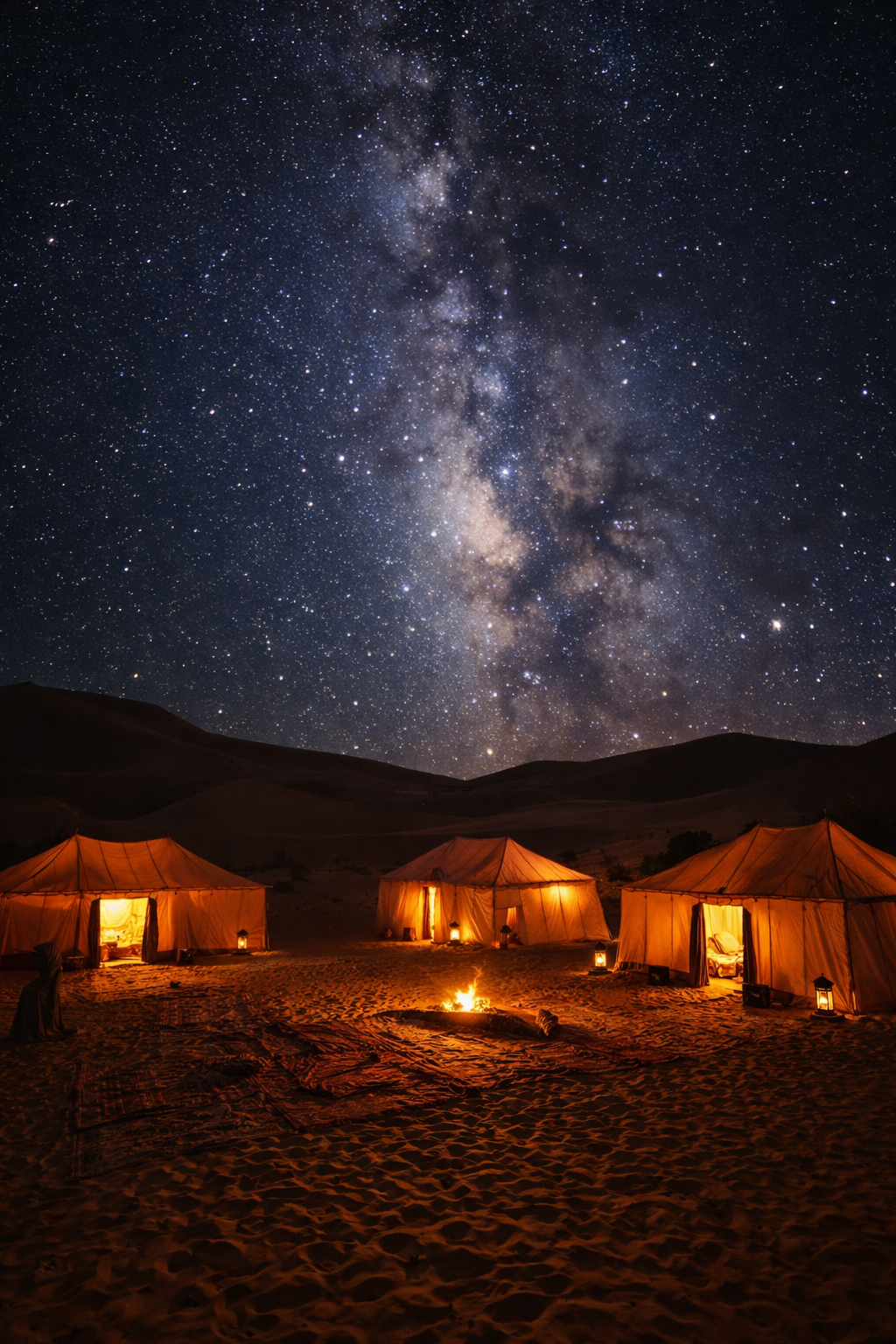
• Good stargazing — the light pollution from M'Hamid is minimal, making the sky almost as spectacular as at Erg Chigaga.
• More suitable for families with young children — the walk is shorter and the terrain less demanding.
• Can be combined with an overnight camp — simple Berber-style camps operate at the M'Hamid dunes and are bookable through La Petite Kasbah.
Honest comparison: the M'Hamid dunes are to Erg Chigaga what a village pond is to a lake. The experience is related but not equivalent. For a first desert experience or for families with children, the M'Hamid dunes are excellent. For anyone seeking genuine Saharan wilderness, Erg Chigaga is the answer.
9. Where to Eat and Stay in M'Hamid
M'Hamid has a small number of local restaurants serving standard Moroccan tagine, couscous, and bread. The food is simple and genuine — this is not a tourist town with menus in five languages, and the cooking reflects that. The local harira soup and fresh-baked bread served at the basic café near the ksar entrance are consistently good.
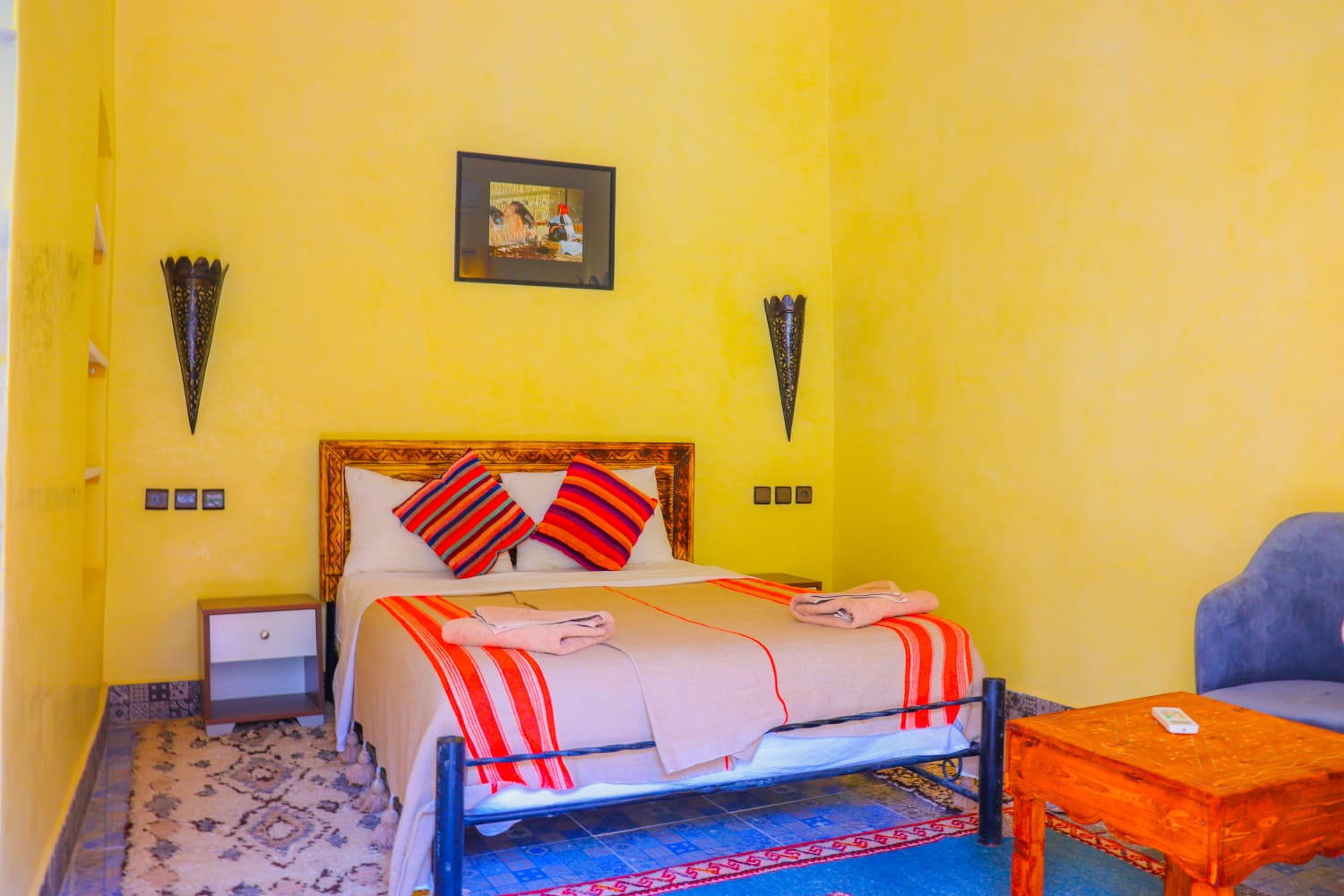
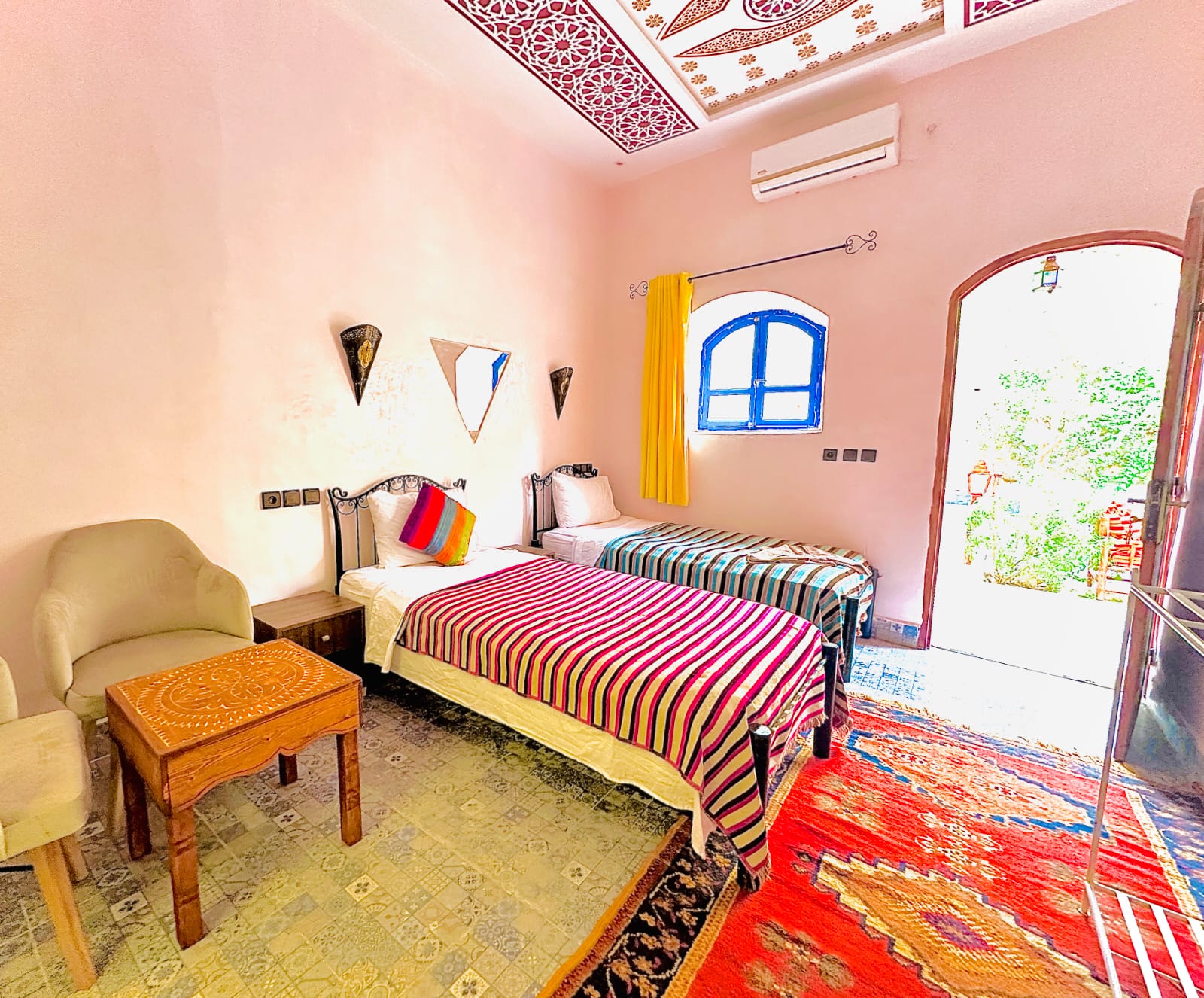
Accommodation in M'Hamid ranges from very basic guesthouses to a small number of desert camps in the dunes immediately south. La Petite Kasbah does not recommend overnight stays in M'Hamid town itself for most guests — the town is more compelling as a day trip destination, and the overnight desert experience is significantly better at Erg Chigaga (arranged through the riad) than in the M'Hamid dune camps.
For the day trip, lunch in M'Hamid is a pleasant experience. Eat wherever the locals are eating — the restaurants with Moroccan families at the tables are invariably the right choice. Avoid anywhere with a multilingual printed menu aimed at tour groups.
10. Combining M'Hamid with Other Zagora Activities
M'Hamid integrates naturally into several Zagora itineraries:
• M'Hamid + Tamegroute day trip: Drive south from Zagora, stop at Tamegroute (9:30–11am), continue to M'Hamid (arrive noon), explore the ksar and dunes, return via Tamegroute for a second look at the pottery workshop at a different time of day. Return to La Petite Kasbah by 5pm. One of the most complete single days available from Zagora.
• M'Hamid as start of Erg Chigaga expedition: Day 1 depart Zagora early, stop at Tamegroute, arrive M'Hamid at 10am, continue immediately to Erg Chigaga by 4x4. Night in the desert. Day 2 sunrise on the dunes, return to M'Hamid by 10am, Zagora by noon. Two of the most significant experiences in southern Morocco in a single 36-hour window.
• M'Hamid on the Draa Valley road trip: The logical southern terminus of the Draa Valley road trip. Drive south from Zagora to M'Hamid, see the end of the road, the Timbuktu sign, and the edge of the Sahara, then return north through the full valley.
Book through La Petite Kasbah: all M'Hamid day trips and Erg Chigaga expeditions are arranged directly through the riad. Brahim and Rhizlane use guides with deep personal connections to M'Hamid — men who were born there and know the history, the music, and the desert in ways that no hired driver from Zagora can replicate.
|
✔ |
M'Hamid is 120km south of Zagora — 90 minutes' drive on the paved N9 |
|
✔ |
The historical terminus of the Trans-Saharan caravan routes from Timbuktu — 52 days by camel |
|
✔ |
The old ksar retains extraordinary frontier atmosphere, largely untouched by tourism |
|
✔ |
M'Hamid is the gateway to Erg Chigaga — Morocco's wildest erg, 60km beyond on 4x4 piste |
|
✔ |
The Gnawa music tradition here is authentic — ceremonial rather than performed for tourists |
|
✔ |
Best combined with Tamegroute stop on the way south — adds cultural depth to the desert journey |
|
✔ |
All day trips and Erg Chigaga expeditions arranged through La Petite Kasbah — hotelzagora.com |
|
Arrange Your M'Hamid Day Trip or Erg Chigaga Expedition Rated 9.3/10. La Petite Kasbah arranges guided M'Hamid visits and full Erg Chigaga 4x4 expeditions with guides who were born in the desert. The most complete southern Morocco experience from Zagora. → www.hotelzagora.com ← |