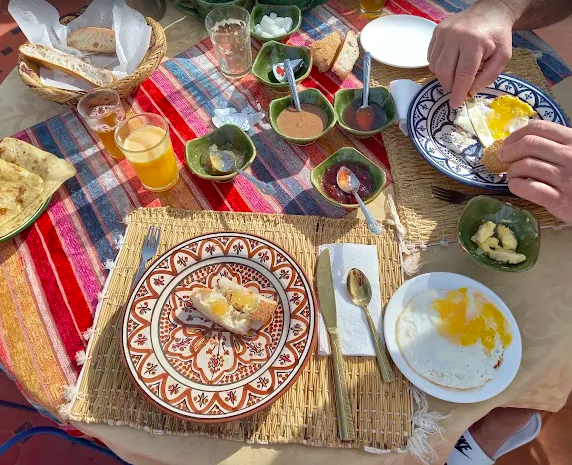
The first morning at a Moroccan riad sets the tone for everything that follows. Not because of the agenda for the day or the light at the desert edge — but because of what appears on the table at breakfast. A genuine Moroccan riad breakfast is not a continental breakfast with extra couscous. It is a specific, considered, generous thing: an assembly of handmade dishes that have been prepared since early morning, eaten slowly, in good company, with mint tea replenished without asking.
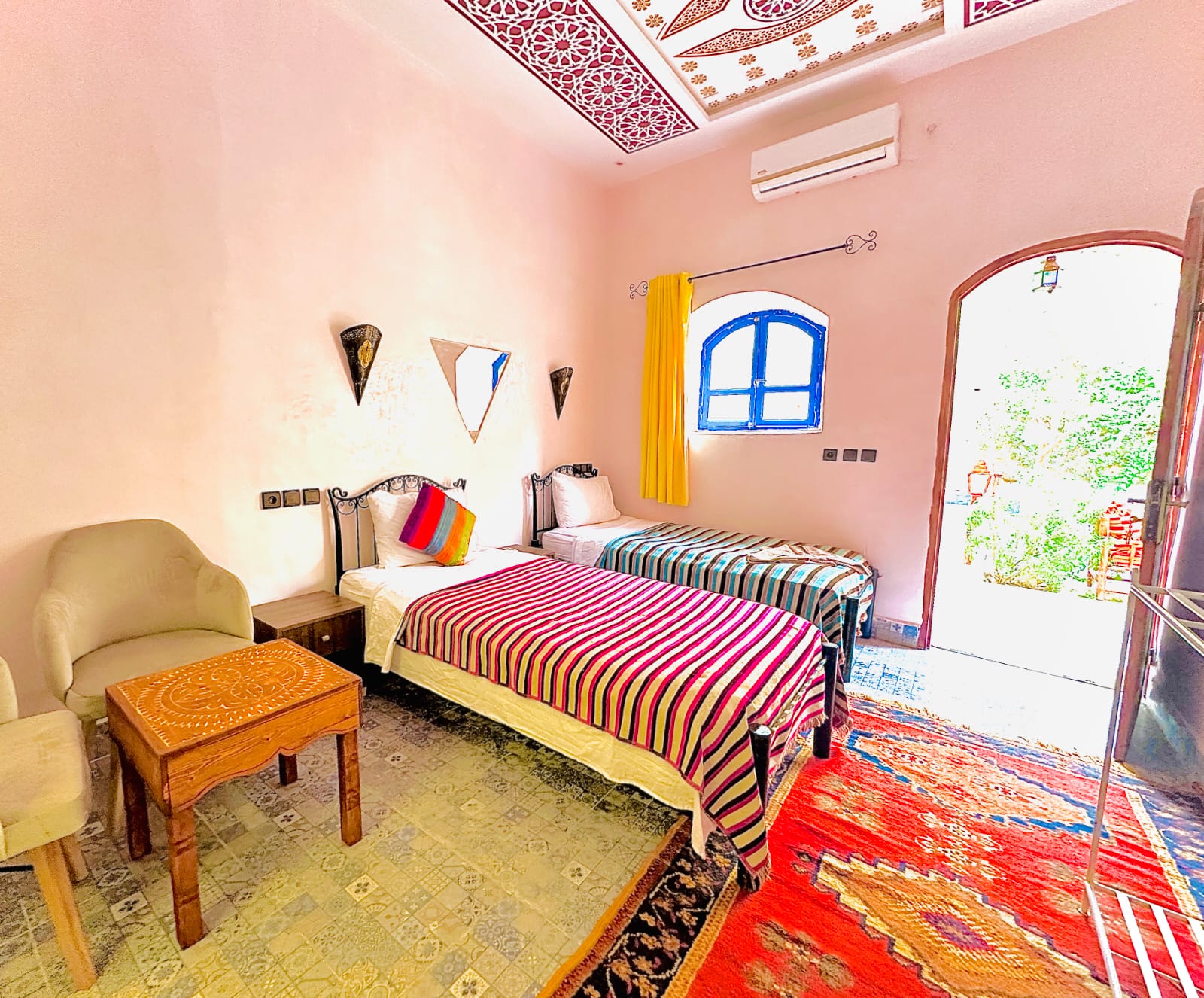
At La Petite Kasbah in the Amezrou palm grove in Zagora, breakfast is one of the things guests mention most consistently in their reviews — not just as good food but as an experience that slows them down in a way the rest of the trip does not. This guide explains what is on the table, what everything is, and why the morning meal at a good Moroccan riad is worth arriving for.
|
✦ KEY TAKEAWAYS |
|
› A traditional Moroccan riad breakfast typically includes msemen, harcha or beghrir, amlou, honey, argan oil, olives, fresh orange juice, and mint tea — all made from scratch that morning. |
|
› Amlou is the signature dish: a thick paste of ground almonds, argan oil, and honey — eaten by dipping msemen into it. Nothing like it exists in Western breakfast tradition. |
|
› Mint tea is served throughout breakfast and replenished without asking — it is not a drink but a ritual. |
|
› At La Petite Kasbah, breakfast is included with every room and served on the terrace or courtyard depending on season and weather. |
|
› The best way to experience a Moroccan breakfast is slowly — it is not designed for a 15-minute rush. |
|
TABLE OF CONTENTS |
|
1. What Is a Moroccan Riad Breakfast? |
|
2. The Full Spread: Every Dish Explained |
|
3. Msemen: The Star of the Table |
|
4. Amlou: Morocco's Most Distinctive Breakfast Food |
|
5. Mint Tea: Ritual, Not Just Refreshment |
|
6. Fresh Orange Juice in the Desert Morning |
|
7. Seasonal and Regional Variations |
|
8. Breakfast at La Petite Kasbah: What Makes It Special |
|
9. How to Eat a Moroccan Breakfast Properly |
|
10. Making Amlou at Home: The La Petite Kasbah Method |
1. What Is a Moroccan Riad Breakfast?
A Moroccan riad breakfast is a morning meal built around handmade bread — specifically a family of flatbreads and semolina pancakes that have no real equivalent in European or American breakfast culture. It is accompanied by sweet and savoury condiments, fresh juice, and an ongoing supply of mint tea. It is substantial without being heavy. It is unhurried. And it is, at its best, one of the finest morning meals available anywhere in the world.
The tradition varies by region — a breakfast in Marrakech will differ in small ways from one in Fès or one in the Draa Valley. But the core elements are consistent: handmade bread, amlou, honey, argan oil, olives, and tea. What changes is the quality of the ingredients and the care with which they are prepared. At La Petite Kasbah, Brahim and Rhizlane source locally — the honey from the Draa Valley, the argan oil from a cooperative, the eggs from the farm three lanes away.
The key difference from a hotel breakfast: a riad breakfast is made by people who live there, for people who are guests in their home. The food is not prepared in a commercial kitchen by a rotating staff. It is made by the family, that morning, using ingredients they have chosen. This distinction is immediately apparent when you sit down.
2. The Full Spread: Every Dish Explained
|
Dish |
What It Is |
How to Eat It |
|
Msemen |
Flaky, layered square flatbread made from wheat and semolina, folded and pan-fried |
Dip into amlou or honey, or eat with olive oil and salt |
|
Harcha |
Dense semolina griddle cake — slightly crisp outside, soft inside |
Break apart and dip in honey or soft cheese |
|
Beghrir |
Spongy yeasted pancake with thousands of tiny holes — the 'thousand-hole pancake' |
Pour honey over the top and eat warm; the holes absorb it perfectly |
|
Amlou |
Thick paste of roasted ground almonds, argan oil, and honey — unique to Morocco |
Spread on msemen or dip flatbread into the bowl |
|
Honey |
Local Draa Valley honey — floral, dark, occasionally thyme or sidr |
On any bread, with amlou, or stirred into tea |
|
Argan oil |
Cold-pressed oil from the argan nut — nutty, distinctive, produced only in Morocco |
Drizzle on bread or mix with honey |
|
Olives |
Oil-cured Moroccan olives — often with preserved lemon and herbs |
Eat alongside bread as a savoury counterpoint |
|
Fresh cheese |
Jben — a soft fresh cheese similar to ricotta, made locally |
With harcha or eaten plain |
|
Orange juice |
Hand-squeezed from small Moroccan oranges — more intense than packaged juice |
Drink alongside or between tea refills |
|
Mint tea |
Gunpowder green tea brewed strong, sweetened heavily, poured from height |
Drunk throughout breakfast — never refused a refill |
|
Seasonal fruit |
Figs, dates, pomegranate, or watermelon depending on season |
Between courses or at the end of the meal |
3. Msemen: The Star of the Table
Msemen is the centrepiece of the Moroccan riad breakfast — the bread around which everything else is organised. It is made from a combination of fine wheat flour and coarse semolina, worked into a dough, rested, then rolled thin, coated in oil, folded repeatedly to create layers, and pan-fried on a griddle until golden and flaky. The layering technique is similar to puff pastry in concept, but the result is chewier and more substantial — closer to a Yemeni malawah or a South Asian paratha than anything in the French or Spanish breakfast tradition.
Good msemen has a slightly crisp exterior and a tender, layered interior that tears into ribbons. Bad msemen — made from dough that was not rested enough, or fried at the wrong temperature — is dense and gummy. The difference is immediately apparent and takes years of daily practice to get right consistently. At La Petite Kasbah, the msemen is made fresh each morning for every breakfast.
How to eat it: tear a piece of msemen (never cut it — the tearing is part of the ritual), dip it into the amlou bowl, and eat it in a single motion. The combination of the slightly salty, chewy flatbread with the sweet, nutty, intensely aromatic amlou is one of the most distinctive flavour combinations in Moroccan food.
4. Amlou: Morocco's Most Distinctive Breakfast Food
If msemen is the structure of the Moroccan breakfast, amlou is its soul. Made from three ingredients — roasted ground almonds, cold-pressed argan oil, and honey — it has no exact equivalent in any other food culture. It is simultaneously a paste, a dip, a spread, and a condiment. Its flavour is complex: the almonds provide body and a slight bitterness, the argan oil contributes a distinctive nutty, smoky note unlike any other oil in the world, and the honey rounds everything with sweetness and floral depth.
Amlou is specific to Morocco and to the Souss and Draa Valley regions in particular — the areas where argan trees grow. The argan tree (Argania spinosa) exists nowhere else on Earth in significant numbers. The oil pressed from its nuts — a process traditionally done by hand by Berber women's cooperatives — is both a luxury food product exported globally and, in the Draa Valley, a quotidian part of the morning table.
A note on quality: the amlou you find at La Petite Kasbah is not the commercially produced jar available in airport shops. It is made in the riad kitchen from fresh ingredients sourced locally. The difference in flavour is significant — commercial amlou tends toward sweetness and uniform texture; fresh amlou has texture, body, and a complexity that makes it worth eating slowly.
5. Mint Tea: Ritual, Not Just Refreshment
Moroccan mint tea — atay in Darija — is the thread that runs through every riad breakfast. It is made from gunpowder green tea brewed strong with fresh spearmint and heavily sweetened with cane sugar. It is poured from height — sometimes 30 or 40 centimetres above the glass — to create the characteristic foam and to aerate the tea, softening the tannins and blending the flavours. It is served in small, ornate painted glass tumblers, never in mugs.
The three-glass tradition is observed at many Moroccan tables: the first glass is strong and slightly bitter, the second sweeter as the mint infuses further, the third sweetest of all. The saying associated with it — 'the first glass is as bitter as life, the second as strong as love, the third as gentle as death' — is quoted more often by tourists than by Moroccans, but the progression is real and worth attending to.
At La Petite Kasbah: tea is brought to the table at the start of breakfast and replenished without being asked. If your glass is empty for more than a minute, it will be refilled. This is not hospitality theatre — it is how the household genuinely operates. Accepting the refill is part of the experience.
6. Fresh Orange Juice in the Desert Morning
Morocco is one of the world's finest orange producers — the small, thin-skinned Moroccan orange is extraordinarily sweet and acidic, and the juice pressed from it is a different product from anything sold in a carton in Europe. In the Draa Valley specifically, orange trees grow in the riad gardens and along the edges of the palm grove, and the juice served at breakfast is squeezed that morning from fruit that was on the tree the previous day.
The flavour is intense, slightly bitter at the edges from the skin oil, and unmistakably fresh. It is usually served in a small glass rather than a large one — a considered quantity rather than a bottomless refill. Drink it slowly, between cups of tea, and notice the way the sweetness and acidity play against the richness of the amlou.
7. Seasonal and Regional Variations
The Draa Valley breakfast has specific seasonal characteristics that distinguish it from breakfasts elsewhere in Morocco:
• October–November (date season): Fresh Medjool and Boufeggous dates from the Amezrou palm grove appear on the breakfast table — soft, caramel-rich, and dramatically different from the dried dates sold in European supermarkets. This is when the breakfast table is at its most abundant.
• Winter (December–February): Pomegranate seeds may appear alongside oranges. The honey tends toward darker, more intensely flavoured varieties from the higher Atlas hives. The breakfast is served inside or in the sheltered courtyard.
• Spring (March–April): Fresh figs begin to appear by late March. The olive varieties change as the new harvest comes through. The terrace breakfast returns.
• Summer (May–September): Watermelon and melon appear. The breakfast is served earlier — by 7:30am — before the heat builds. Fresh herbs become more prominent.
8. Breakfast at La Petite Kasbah: What Makes It Special
The La Petite Kasbah breakfast is consistently mentioned in guest reviews — not as a highlight among other highlights, but as something that guests specifically return to describe. Several elements account for this:
• Everything is made that morning: The msemen is freshly folded and pan-fried. The amlou is prepared the previous evening and at room temperature for texture. The juice is pressed as you sit down. Nothing is reheated or pre-packaged.
• Draa Valley sourcing: The honey is from a local producer whose hives are in the Draa Valley. The argan oil is from a women's cooperative within 50km. The eggs are from a neighbour's chickens. The olives are cured in the riad kitchen.
• The setting: Breakfast is served on the terrace in good weather — with the palm grove visible and the desert light at its most gentle. In cooler months, the courtyard under the bougainvillea. The setting is not incidental to the food.
• No rush: Brahim and Rhizlane do not appear with a bill at 10am. Breakfast is not a service interval. Guests who sit for two hours are not hurried. This is unusual and, for most guests from Western hotel culture, immediately noticeable.
9. How to Eat a Moroccan Breakfast Properly
There are no strict rules, but there are conventions that make the experience better:
• Start with tea. The first glass of mint tea is the signal that breakfast has begun — not the food appearing on the table.
• Eat the msemen warm. It is served fresh from the griddle and deteriorates as it cools. Do not wait.
• Tear, don't cut. Use your hands for the bread. This is not informality — it is how the bread is designed to be eaten.
• Dip the msemen deeply into the amlou. A light surface dip gives you flavour but not texture. Push the bread to the bottom of the bowl and bring up a proper quantity.
• Let the tea cool slightly before drinking. Very hot tea obscures the flavour of the mint.
• Eat slowly. The Moroccan breakfast is not designed for a rush. Two hours is not unusual. One hour is the minimum to do it justice.
• Accept the tea refill every time. Refusing is polite in some contexts but at a riad breakfast, accepting is the more generous response.
10. Making Amlou at Home: The La Petite Kasbah Method
|
☕ AMLOU RECIPE — AS MADE AT LA PETITE KASBAH |
|
☕ Ingredients: 200g whole almonds (skin on), 3 tablespoons cold-pressed argan oil, 2–3 tablespoons dark honey |
|
☕ Step 1: Toast the almonds in a dry pan over medium heat, stirring constantly, until golden and fragrant — approximately 8 minutes. Watch carefully; they burn quickly. |
|
☕ Step 2: Allow to cool completely, then grind in a food processor or blender until a thick, slightly oily paste forms — similar in texture to peanut butter but coarser. |
|
☕ Step 3: Add the argan oil and pulse to combine. The oil should be absorbed into the almond paste, not pooling. |
|
☕ Step 4: Add the honey and stir by hand — do not blend further or the honey loses its character. |
|
☕ Step 5: Taste and adjust — more honey for sweetness, more argan oil for fluidity. The texture should be spreadable but thick. |
|
☕ Note: Argan oil (culinary grade) is available from Moroccan food importers and some specialty stores. Do not substitute with other oils — the flavour is irreplaceable. |
|
☕ Store in a sealed jar at room temperature for up to one week. The flavour deepens on the second and third day. |
|
✔ |
A Moroccan riad breakfast centres on handmade breads: msemen, harcha, beghrir — all made fresh that morning |
|
✔ |
Amlou — roasted almonds, argan oil, honey — is Morocco's most distinctive breakfast food and unique to the country |
|
✔ |
Mint tea is the thread of the meal: poured from height, replenished constantly, drunk in the classic three-glass progression |
|
✔ |
At La Petite Kasbah, everything is made from locally sourced Draa Valley ingredients — honey, argan oil, eggs, olives |
|
✔ |
The best way to eat a Moroccan breakfast: slowly, with your hands, accepting every refill of tea |
|
✔ |
October–November is the best season — fresh dates from the Amezrou palm grove appear on the table |
|
✔ |
Breakfast is included with every room at La Petite Kasbah — hotelzagora.com |
|
Experience the La Petite Kasbah Breakfast for Yourself Rated 9.3/10. Breakfast included daily — freshly made msemen, local amlou, Draa Valley honey, and mint tea on the terrace or courtyard. The morning meal that guests remember for years. → www.hotelzagora.com ← |